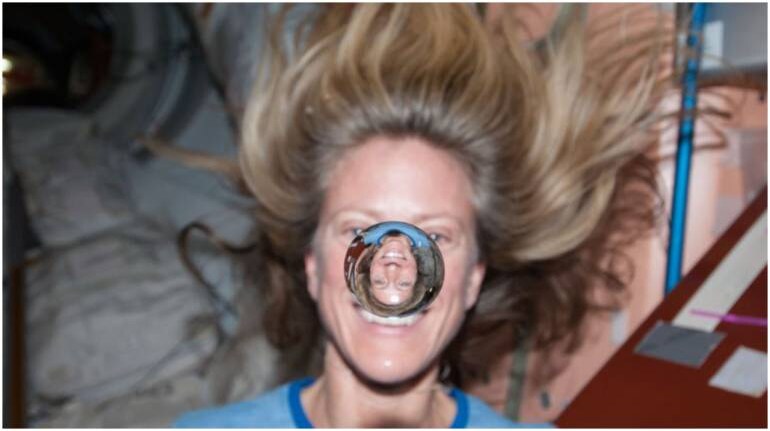
When it comes to telescopes, bigger is better since larger telescopes have bigger lenses which collect more light and allow astronomers to peer farther into space and see distant objects in greater detail.
But can a water bubble floating in space be used for a giant telescope? Researchers at Nasa have reason to believe so.
Explaining the process, the US space agency wrote in its website that all liquids have an elastic-like force that holds them together at their surface. "This force is called surface tension. It's what allows some insects to glide across water without sinking and gives water droplets their shape," it stated.
"On Earth, when droplets of water are small enough (2 mm or smaller), surface tension overcomes gravity and they remain perfectly spherical. If a droplet grows much larger, it gets squished under its own weight."
In space, however, droplets of water and other liquids assume a perfect spherical shape after wobbling about for a while.
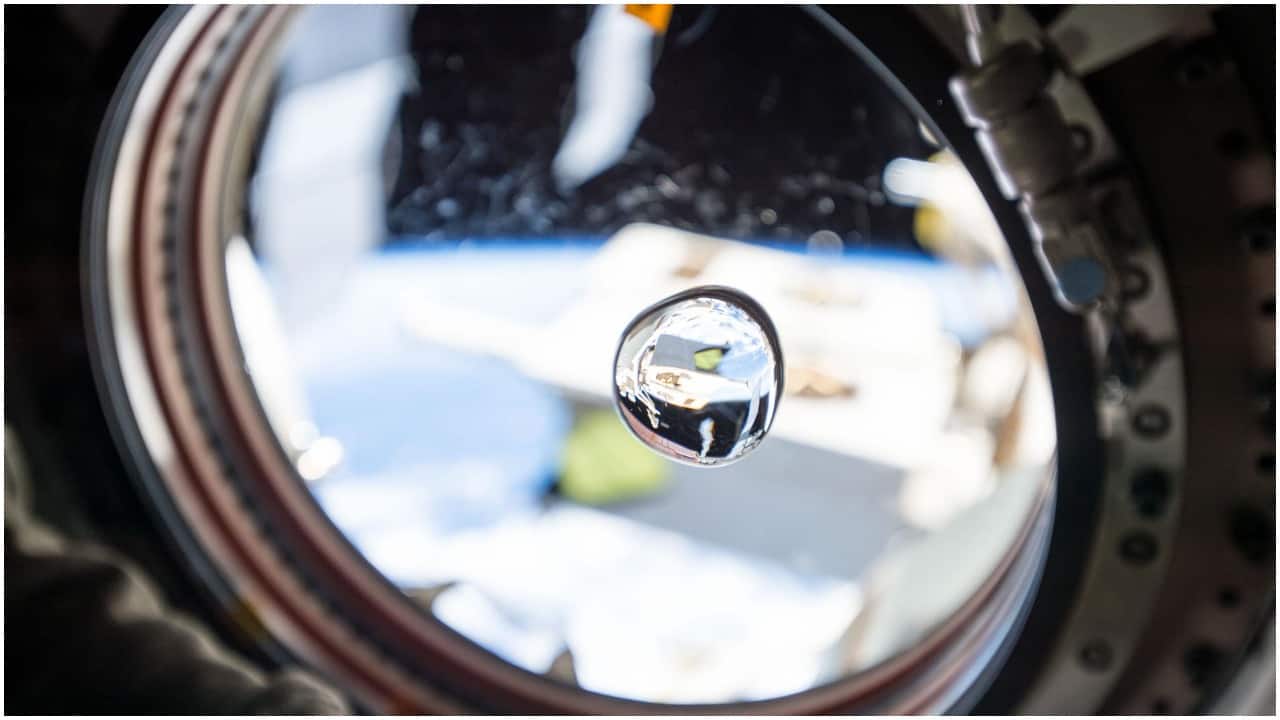 With the right liquid polymer, a class of materials used in everything from acrylic nails to superglue, a water bubble floating in space can become the lens for a giant telescope, NASA stated. (Image credit: @NASA/Twitter)
To study this phenomenon and explore whether it was possible to make high-precision lenses in space using liquids, Edward Balaban, principal investigator of the Fluidic Telescope Experiment (FLUTE) at NASA teamed up with researchers at Technion - Israel Institute of Technology.
"We thought, why not take advantage of the way liquids naturally behave in microgravity and apply it to the construction of large-scale telescopes," said Balaban. "In microgravity, liquids take on shapes that are useful for making lenses and mirrors, so if we make them in space, they could be used to build telescopes that are dramatically bigger than was previously thought possible."
But, before taking their ideas to the skies, the team wanted to test their ideas on the ground.
Moran Bercovici, an associate professor of Mechanical Engineering at Technion, said, "Liquids are useful not only for creating the lenses themselves, but also as a mechanism to eliminate the effect of gravity in an experiment on Earth."
"By injecting a liquid that can be solidified, into circular frames submerged in water, we were able to create lenses literally in a janitor’s bucket," said Dr Valeri Frumkin, who developed the method in Bercovici's group.
The resulting lenses have an outstanding surface quality comparable or even better than achievable with the best polishing methods, and they took only a tiny fraction of the time to construct, NASA stated.
In December 2021, the team tried out their ideas with synthetic oil and found that they were able to create a free-standing liquid lens.
"We expect this approach will create perfectly shaped and smooth surfaces: the best surfaces to turn into mirrors," said Vivek Dwivedi, a FLUTE scientist.
Discover the latest Business News, Sensex, and Nifty updates. Obtain Personal Finance insights, tax queries, and expert opinions on Moneycontrol or download the Moneycontrol App to stay updated!
Find the best of Al News in one place, specially curated for you every weekend.
Stay on top of the latest tech trends and biggest startup news.