Have you ever heard the expression, "Walk a mile in someone else's shoes?"
Recognizing our fallibilities and prejudices is essential to fostering mutual understanding among groups, yet seeing the world through someone else's eyes is difficult.
We can combat bigotry like racism and xenophobia and work toward a more empathetic worldview if we force ourselves to reevaluate our assumptions.
Researchers at the Massachusetts Institute of Technology have taken a small virtual step to enable this through a role-playing game: "On the Plane".
Caglar Yildirim and D. Fox Harrell of MIT explained their idea in a paper published in the 2022 IEEE International Conference on Artificial Intelligence and Virtual Reality (AIVR).
How does it work?
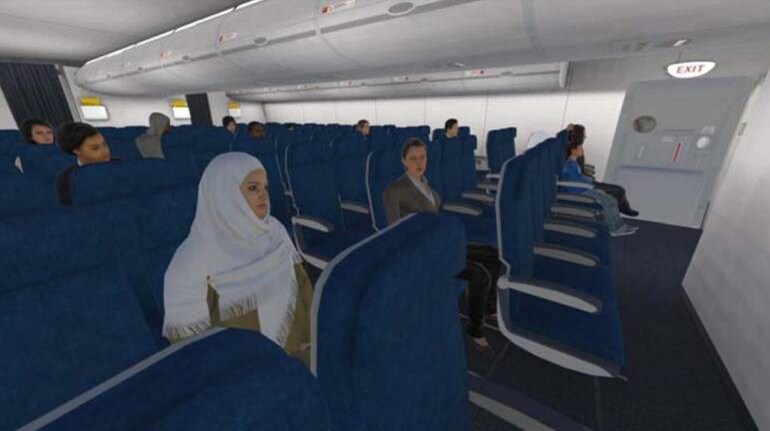
In the current version of the game, players get to assume one of three identities - Sarah, an American-born Muslim woman; Marianne, a woman from the American Midwest; or a flight attendant.
The scene, as the name of the game suggests, is on an aeroplane. The game simulates the plane travel experience, from airport security screening to in-flight events.
As the characters in the game interact with each other and respond to a set of prompts, it plays out scenarios that expose the player's in-group/out-group prejudices and allows players to engage in perspective-taking.
In-group prejudices refers to favourable treatment of people like us; out-group prejudice is bias against a different social/ethnic/racial/class group than us; and perspective taking is pausing to reflect on one's decisions and consider alternatives.
Interactive narrative engine
As players assume the roles of diverse people, and interact with their fellow passengers by responding to a series of prompts and making in-game decisions, their actions determine the course of a heated discussion between two characters as they try to understand one another's cultures.
To combat in-group/out-group bias, "On the Plane" incorporates new viewpoints into players' awareness of diverse cultures by having them assume roles that may be outside their own first-person experiences. For example, you can interact with Sarah, a Muslim American of Malaysian descent, Marianne, a white woman from the Midwest with limited experience with people of other cultures, or the flight attendant. Sarah stands for the outsiders, Marianne for the insiders, and the flight attendant for the bystanders who overhear their conversation.
 (Image: Screen shot)
The game depicts racism directed at a Muslim American woman, but the method may easily be applied to other situations.
Another component of this simulation is an interactive narrative engine, which, using a model of social classifications, generates a variety of potential reactions to player activities inside the game world. Players can influence their relationship with the other two characters and their place in the simulation by selecting different responses to each prompt. For example, if you're playing as the flight attendant, you can change your allegiances in response to Marianne's xenophobic comments and actions toward Sarah. When your social standing shifts, the engine responds by giving you a new set of story events.
AI knowledge representation techniques
"On the Plane" uses artificial intelligence knowledge representation techniques managed by probabilistic finite state machines, a tool often used in machine learning systems for pattern recognition, to animate each avatar. We can customize characters' body language and gestures with these machines. For example, suppose you play as Marianne. In that case, the game will alter her mannerisms toward Sarah based on user inputs, influencing how comfortable she appears in front of a member of a perceived out-group. Similarly, gamers can take on the role of Sarah or the flight attendant.
Harrell and co-author Sercan engün had called for virtual system designers to be more inclusive of Middle Eastern identities and cultures in a 2018 study based on work done in partnership between MIT CSAIL and the Qatar Computing Research Institute. They argued that allowing users to personalize virtual avatars that indicate their background will enable players to engage in a more supportive experience. "On the Plane", four years later, achieves a similar goal, bringing a Muslim's perspective into an immersive experience.
The purpose
"On the Plane" was created with the Unity game engine and the XR Interaction Toolkit, as well as Harrell's Chimeria platform for constructing interactive narratives with social categorization.
Later this year, the team plans to use the game for research investigations on desktop PCs and the standalone, wireless Meta Quest headsets. In December, they presented a paper on the research at the IEEE International Conference on Artificial Intelligence and Virtual Reality 2022.
Conclusion
Many confrontations arise from an inability to comprehend the perspectives of others. Role-playing games with computational support can encourage good perspective-taking. In addition, the intricacies of bodily communication in role-playing can be more robustly portrayed when implemented with the affordances of virtual reality.
Here, the researchers outline the concept and development of "On the Plane," a role-playing game targeted at mimicking ingroup-outgroup biases to boost optimistic viewpoint taking in virtual reality.
"On the Plane" allows you to experience the simulation through the eyes of different characters, enabling both ingroup and outgroup perspectives. Furthermore, the researchers explain how the game is designed to imitate and test ingroup-outgroup prejudices in the context of xenophobia, as well as our future ideas for using "On the Plane" to promote positive perspective transformation (e.g., confronting one's own ill-founded beliefs).
Discover the latest Business News, Sensex, and Nifty updates. Obtain Personal Finance insights, tax queries, and expert opinions on Moneycontrol or download the Moneycontrol App to stay updated!

Find the best of Al News in one place, specially curated for you every weekend.
Stay on top of the latest tech trends and biggest startup news.