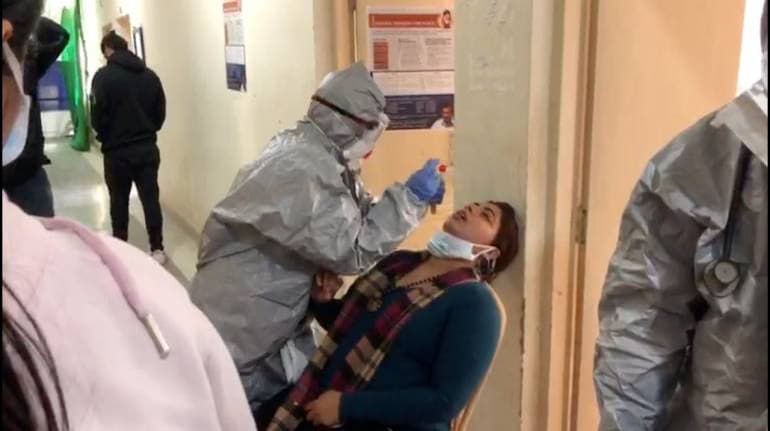
Union Health Minister Dr Harsh Vardhan on October 11 said that the indigenously developed Feluda paper strip test for COVID-19 diagnosis could be rolled out in the next few weeks.
During an interaction with his social media followers on the 5th episode 'Sunday Samvaad', Vardhan said that Feluda test has shown 96 percent sensitivity and 98 percent specificity in tests conducted on over 2,000 patients during the trials at the Institute of Genomics and Integrative Biology (IGIB) and testing in private labs.
He said that the results compare favourably to ICMR's current acceptation criteria of RT-PCR Kit of least 95 percent sensitivity and at least 99 percent specificity.
Sensitivity is the ability of a test to correctly identify individuals with the disease, while specificity is the ability to accurately identify those without the disease.
Track this LIVE blog for all the latest updates on coronavirus pandemic
The Feluda paper strip test for SARS-CoV-2 diagnosis has been developed by CSIR-IGIB and was earlier approved by the Drug Controller General of India (DCGI) for a commercial launch.
The test uses an indigenously-developed CRISPR (Clustered Regularly Interspaced Short Palindromic Repeats) technology for detection of SARS-CoV-2’s genomic sequence. It also takes less time compared to the RT-PCR test.
"The kit has already been validated by the Department of Atomic Energy's National Centre for Biological Sciences, Bangalore. While I cannot put an exact date on the availability, we should expect this test within the next few weeks," he said.
Read: Am I immune to the coronavirus if I've already had it?
On emergency authorisation of COVID-19 vaccines in India, Vardhan said, "Adequate safety and efficacy data are required for emergency use authorisation, approval to ensure patients' safety. Further course of action will depend on the data generated," he said.
Speaking about several confirmed cases of COVID-19 reinfection, Vardhan said that although there are reports of reinfection surfacing in various states, analysis by ICMR revealed that many such cases were "misclassified as reinfections."
"Actual reinfection would mean a fully recovered person getting infected by a freshly introduced virus in his/her body. ICMR is commissioning a study to understand the true burden of re-infected cases," he said, adding results of the study will be shared in a couple of weeks.
India's COVID-19 tally crossed 70 lakh on October 11 with 74,383 infections being reported in a day. The death toll climbed to 1,08,334 with 918 people succumbing to the disease in 24 hours. According to the ICMR, a cumulative total of 8,68,77,242 samples have been tested up to October 10.
Click here for Moneycontrol's full coverage of the COVID-19 outbreak
Discover the latest Business News, Sensex, and Nifty updates. Obtain Personal Finance insights, tax queries, and expert opinions on Moneycontrol or download the Moneycontrol App to stay updated!
Find the best of Al News in one place, specially curated for you every weekend.
Stay on top of the latest tech trends and biggest startup news.