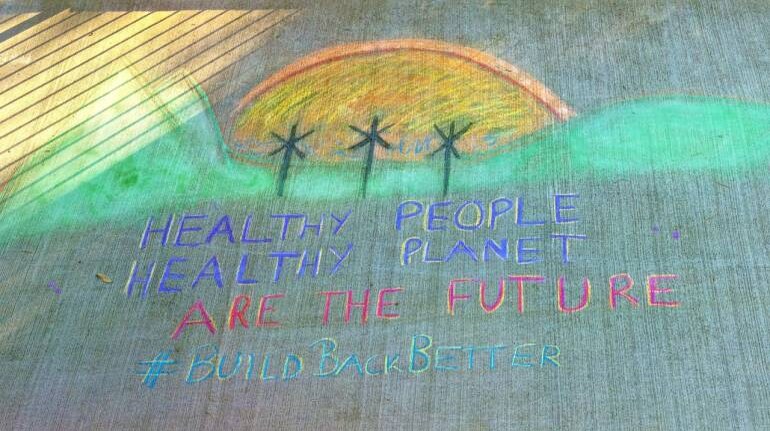
Almost every report from the proceedings of the recent G7 summit in Cornwall contained three words: “Build Back Better”. This summed up US President Joe Biden and other G7 leaders’ global infrastructure initiative, Build Back Better World, an expansion of Biden’s earlier Presidential campaign slogan.
Over the decades, such slogans have become a vital way to communicate to voters what parties and politicians stand for. They’re also handy for inflamed supporters to chant at rallies and use as social media hashtags. Here, as with so much else, advertising and marketing tactics are increasingly used to make people choose one electoral brand over another.
These slogans can range from the inspirational to the banal to the quirky. In India, to mention just three of several, there was the much-recalled “Garibi Hatao”, the much-derided “Achche Din Aane Wale Hain”, and the much-mocked “Jab Tak Samosa Mein Rahega Aalu, Bihar Mein Rahega Lalu”.
For linguistic anthropologist Adam Hodges, the most effective slogans are those that resonate with the political campaign’s larger theme, as well as being memorable and repeatable. He singles out Obama’s “Yes, We Can” for praise because of its “intertextual resonance with historical usages and the campaign’s own central message”.
Many times, the candidate’s personality is itself seen as a decisive factor, leading to slogans such as the one about Lalu Prasad Yadav. There are several others. “I Like Ike” and “Madly for Adlai”, for Eisenhower and Stevenson, respectively, in 1952; “All the Way with LBJ” for Lyndon Johnson in 1964; “Not Flash, Just Gordon” for Gordon Brown in 2007; and, lest we forget, “Abki Baar Modi Sarkar”.
At other times, slogans are recycled, on purpose or unwittingly. Donald Trump’s 2016 “Make America Great Again” was a reprise of words used by earlier American Presidential candidates, notably Ronald Reagan in 1980. Obama’s “Yes, We Can” was an echo of "Sí, Se Puede", the Spanish motto of the United Farm Workers of America from 1972. And “Let Us Go Forward Together,” one of Winston Churchill’s frequent utterances, was used by two other British Prime Ministers, Margaret Thatcher in 1980 and Theresa May in 2017.
Former Australian Prime Minister Malcolm Turnbull wasn’t so lucky with his 2016 campaign slogan, “Continuity and Change”. Opponents were quick to point out that “Continuity with Change” happened to be the line used by Selina Meyer, the fictional politician played by Julia Louis-Dreyfus in the American TV series Veep.
Simon Blackwell, the show’s writer and executive producer, said that the intention was to come up with a slogan that said “absolutely nothing but seemed to have depth and meaning”. As Philip Sargeant wryly comments in his The Art of Political Storytelling, it’s probably best not to rip off a phrase that was intended as satire in the first place.
Slogans that work, Sargeant continues, act as narratives for the campaign as a whole. An example is Vote Leave’s slogan for the Brexit referendum: “Take Back Control”. As Ash Sarkar noted in The Guardian, it “was able to tell a complex story in just three words – that voters had the opportunity to reverse national decline by participating in an insurgent political moment”.
Such slogans are effective, writes Sargeant, because they place the desire for change at their heart, and highlight the need for action to accomplish that change. There’s also the populist dream of an imagined golden age. He quotes Dominic Cummings as saying, “Note the word ‘back’ triggering loss aversion: something had been lost, and we can regain what we’ve lost”. It’s the same with “Make America Great Again”.
In terms of craft, some use the rule of three, a number with structural and folkloric resonance. (Past, present, future; beginning, middle, end; three blind mice.) This is the format of many powerful slogans and sayings, from “Citius, Altius, Fortius” to “Veni Vidi Vici” to “A government of the people, by the people, for the people”.
For Vladimir Lenin in 1917, it was “land, peace and bread”, and for Tony Blair in 1997, it was “education, education, education”. An example closer home is the All India Trinamool Congress’ “Maa, Maati, Manush”.
Though most slogans nowadays are developed after extensive voter outreach and research, many fall flat because of the desire to appeal to everyone. This results in tired, flat phrases containing words such as “change”, “forever”, and “values”. Hardly persuasive.
On the other hand, there are slogans that lend themselves to mockery. Republican Barry Goldwater ran for US President against Lyndon Johnson in 1964 with the rallying cry: “In Your Heart, You Know He’s Right”. The Johnson campaign’s response: “In Your Guts, You Know He’s Nuts”.
The award for the most honest political slogan, however, has to go to Filipino candidate Jun-jun Sotto. In a local election a few years ago, he plastered walls with posters bearing his face, along with the words: “I’ll do my best, but I can’t promise anything”. I’d vote for him.
Read more: G7 needs to learn from China, if it's going to succeed in pushing back China’s BRI
Discover the latest Business News, Sensex, and Nifty updates. Obtain Personal Finance insights, tax queries, and expert opinions on Moneycontrol or download the Moneycontrol App to stay updated!

Find the best of Al News in one place, specially curated for you every weekend.
Stay on top of the latest tech trends and biggest startup news.