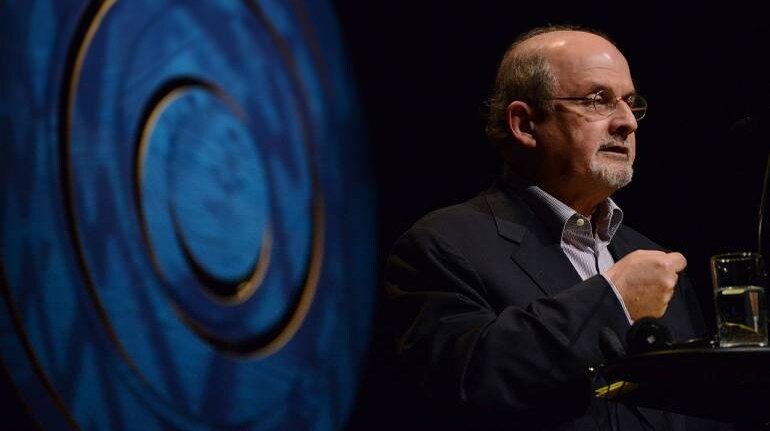
Salman Rushdie, who was born in Mumbai only weeks before India gained independence, influenced a whole generation of Indians still reeling from the toxic effects of the Emergency by his fearless defence of the country's democracy and freedom in his literary masterpiece, Midnight's Children.
Rushdie, who was attacked in New York state by a lone assailant on Friday at an event on writers in exile where he was the main speaker, published his Booker Prize-winning novel in 1981, four years after the Emergency ended. Taking the Congress and its leader Indira Gandhi to task for the party and its government's excesses during the Emergency in 1975-77, Midnight's Children became an instant literary success in India, providing the much-needed emotional and intellectual succour to a wounded nation.

Though he left India early to live in England, Rushdie kept his home country close to his heart, always ready to extend his searing indictment of authoritarianism and religious hatred. He was hurt more by the Rajiv Gandhi government's decision to ban The Satanic Verses in 1988 than by the hate of the Islamist fundamentalists in India who wanted his head.
"I was shocked when my country became the first to ban The Satanic Verses, even before it had arrived here," Rushdie said when he landed in India in April 2000 to end a decade-long self-exile after the ban. When his novel, The Ground Beneath Her Feet, lost the Commonwealth Writers Prize to South African J.M. Coetzee's Disgrace, Rushdie, present at the Oberoi Hotel in Delhi - the venue of the literary awards ceremony in April 2000 - had this to say: "My real prize is India."
Banner headlines screaming Rushdie's arrival in India greeted his fans the next morning. Reporters trailed him during his entire time in India. For Rushdie, it was also an occasion to reintroduce India to his son, Zafar, 20 years old then, both travelling together to Kashmir, Mumbai, Jaipur, Agra, Shimla and Old Delhi. In a front page article, one newspaper compared Rushdie and Zafar's journey to the literary landscape traversed in Midnight's Children. Leading a posse of journalists to Rushdie's room in a security-tightened five-star hotel in Delhi, an Indian editor demanded Rushdie sign his copy of the still banned The Satanic Verses first before talking to his colleagues.
Also read: Salman Rushdie stabbing sends ripples of ‘shock and horror’ through the literary world
Rushdie's return was marked by celebrations by his fans who drowned out the straggling protesters holding placards saying Salman Rushdie Go Back. "I am here to renew a broken friendship," Rushdie responded after the then Vajpayee government gave him a five-year visa braving protests from Islamic hardliners. He took his son to their ancestral home in Solan, Himachal Pradesh, gifted to Rushdie by his father on his 21st birthday.
Rushdie had won his Solan house after a long legal battle with the state government. He had, however, lost another court case, this time to Indira Gandhi, who took him to court in London over defamatory references in Midnight's Children and forced him to delete passages. Half-a-decade later, when he came to speak at the Jaipur Literature Festival (JLF) in 2007, the protests against him had grown. Islamic hardliners gathered outside the JLF venue whenever there was a mention of his name as a speaker.
"Rushdie came to JLF in 2007, but sadly he had to withdraw from the 2012 edition because of protests," says Sanjoy Roy, producer of JLF. "He is one of the most seminal writers of Indian origin. In many ways Midnight's Children sums up the trials and tribulations, traumas and achievements of India. He set the stage for every other Indian writer who followed him on the international stage. And that is what one needs to celebrate at this point of time even as he is struggling to survive," adds Roy.
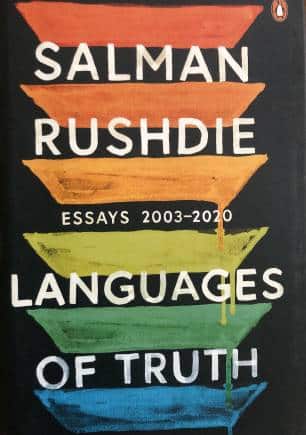 The fantasy-filled story of Saleem Sinai and his twin-brother Shiva in Midnight's Children - both brothers born at the stroke of midnight on August 15, 1947 - earned Rushdie legions of followers in India. The book, an allegory about independent India, became part of conversations in homes, hostels and coffee houses across the country in the years that followed its publication. Doctoral theses were written on the book by students, and some even attempted dissertations on sex in Rushdie's works.
"Rushdie has a huge fan following in India. He has many friends in his home country," says poet K. Satchidanandan, a former secretary of the Kendriya Sahitya Akademi. "People were protesting against him without reading his books like The Satanic Verses. I consider Midnight's Children to be his best work. It is a classic," he adds. "Anyone has the right to criticise a writer's works as strongly and as long as they want, but in a democratic way. The attack on Rushdie saddens writers and his fans like me."
Rushdie hasn't returned to India since his JLF appearance in 2007, but he has since spoken widely about his affection for his native country in essays and speeches at college convocations abroad. While some of his fan following in India may have cooled after he seemed to have lost his literary edge on crossing the Atlantic two decades ago to make New York his new home, his 2019 novel, Quichotte, about an Indian-American salesman crisscrossing the US certainly had his followers racing back to him with praise.
He continued his gaze on India at all times, especially during elections. In his opening night address to the PEN World Voices Festival in 2014, held as India went to vote, Rushdie spoke of democracy as more than "mere majoritarianism". "If freedom of expression is under attack, if religious freedom is threatened, and if substantial parts of society live in physical fear for their safety, then such a society cannot be said to be a true democracy," he said. Those were the words of a man who has fought all his life, even as he was attacked on Friday, in defence of freedom and democracy.
Also read: 'Utterly horrified and shocked': Shashi Tharoor on Rushdie attack
Discover the latest Business News, Sensex, and Nifty updates. Obtain Personal Finance insights, tax queries, and expert opinions on Moneycontrol or download the Moneycontrol App to stay updated!
Find the best of Al News in one place, specially curated for you every weekend.
Stay on top of the latest tech trends and biggest startup news.