Darren Aronofsky’s The Whale has bagged two of the three Oscars it was nominated for this year — Best Actor, Brendan Fraser, for the lead role of Charlie, and Best Make-Up and Hairstyling, Adrien Morot, for Fraser’s prosthetic transformation into a remorseful and obese writing instructor in a morbid stasis inside his cluttered home somewhere in Idaho. The third nomination was for Best Supporting Actress, Hong Chau.
It’s an Aronofsky world. Claustrophobia is expected.
 Oscar-winner Brendan Fraser in a still from 'The Whale'.
The Whale, like many of Aronofsky’s films, is about perilous implosion of trauma-laden humans fighting impossible odds to face their own demons. For those who can get past Aronofsky’s masterful ways with actors and manipulation of moods to create characters seething with such demons, and do follow his oeuvre, would have imprints of Mickey Rourke in The Wrestler (2008), or Natalie Portman in Black Swan (2010) or Russell Crowe in Noah (2014) or Jennifer Lawrence in Mother! (2017). Fraser has had an almost decade-long hibernation from the movies, much like an Aronofsky character himself. He is an unlikely actor to be cast for a film like The Whale, based on a play by Samuel D Hunter, who has also written the film’s screenplay.
There is a ton of psychologising and intellectualising in The Whale — and no moral lens. The overwhelming idea is the wretchedness of being human — the human inability to truly care for each other. “Nobody can save anyone,” says one character towards the end of the overwrought screenplay, which Aronofsky, Hunter and cinematographer (and Aronofsky’s long-time collaborator) Matthew Libatique remain dedicated to keep stagey and indoors like a play.
It is a dark, stuffy universe. Charlie (Fraser) teaches writing in an online class. His tips are not the most utilitarian for an amateur class, but from the first scene onwards, Charlie is capable of off-kilter spiels about honesty and authenticity over following objective form — and in extension, institutionalised social structures like religion and marriage over creativity and love. The students don’t see Charlie because, he says, his device camera is broke. Far from the truth, of course. He is obese to a degree that even simple movements cause him pain. He is ashamed to show himself to his students. Laughs threaten to strangle his heart and cause emphysemic spells, hard to watch. But there’s a transcendent quality about Charlie, too. His nurse and sister of a former lover, Liz (Hong Chau, brilliant as a sorrow-stifling, cynical woman with a traumatic history of loss of her own) visits him often to take care of him. Charlie mostly has memories, remorse and cluttered paper as companion. He has three more visitors besides Liz: Ellie (Sadie Sink), an estranged adolescent daughter seething with anger; Thomas (Ty Simpkins), a young Christian evangelist on the run in search of a mission; his embittered former wife Mary (Samantha Morton); and a bird outside his window.
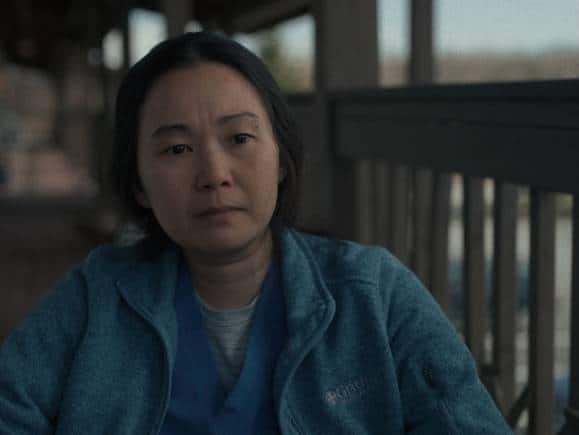 Hong Chau as Charlie's nurse Liz in a still from 'The Whale'
Most conversations in the film are verbose and only meant to unpeel layers of angst and pain. Charlie holds on to a fine piece of non-literary interpretation of Moby Dick — also the best piece of writing in the film. It’s related to his past, something he holds on to with kindness and hope. Will the writer of this piece save him?
Family dysfunctionality, abandonment, regret, trauma, anger — The Whale is a cauldron. Its emotions are fibrous and raw, a tear-jerker for those who can relate. Cinematic technique is sparse, accented only by a haunting and raspy background score by Rob Simonsen. Aronofsky biggest achievement is his ability to make cinema out of little movement — although “cinematic play” wouldn’t describe it at all.
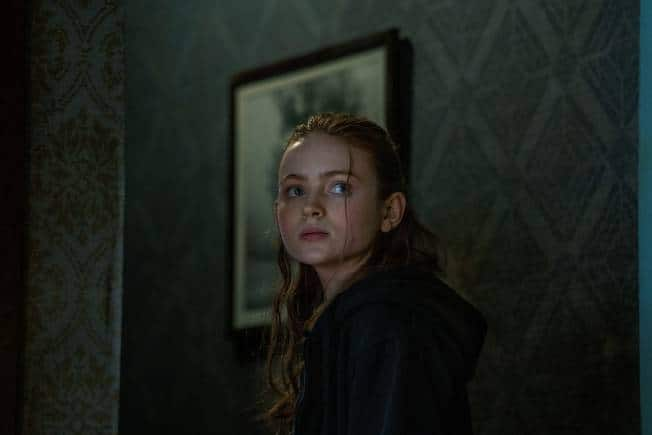 A still from the Oscar-nominated 'The Whale' (2022).
The acting has intensity and immersiveness. In an Aronofsky world, no actor can get by without being put to hard task. Fraser, in the lead role, has the most demanding role, of course, to inhabit the body weighed down by overeating (eating a pizza isn’t going to the same for a long time) and neglect. Food is revulsion for the audience, the way Charlie abuses it. Junk food teems every corner of the house like mounters wrapped in packets. Fraser’s character requires him to combine an unbearable heaviness with tenderness and intuitive wisdom — it’s the actor’s role of a lifetime and having gone through the film (and wept through some scenes), his earlier persona of an actor suited to blockbusters and comedies has completely obliterated from my mind. Charlie and Aronofsky has kintsugi-ed Fraser to heavy-duty acting league. His claim to the Best Actor Oscar is not only justified, but deserving.
Discover the latest Business News, Sensex, and Nifty updates. Obtain Personal Finance insights, tax queries, and expert opinions on Moneycontrol or download the Moneycontrol App to stay updated!
Find the best of Al News in one place, specially curated for you every weekend.
Stay on top of the latest tech trends and biggest startup news.