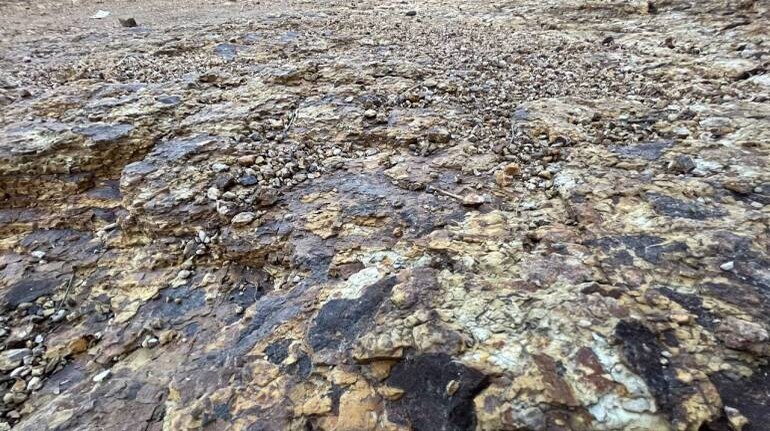
India announced on February 9 that it had found lithium inferred resources (G3) in Jammu and Kashmir (J&K) for the first time. While this came as a significant discovery for a country that is chasing a target of 30 percent electric vehicle (EV) penetration by 2030 and net zero by 2070, what actually grabbed eyeballs was the quantum of the inferred resource.
The Geological Survey of India (GSI) said about 5.9 million tonnes (MT) of G3 have been established in the Reasi district of J&K.
To put things in perspective, lithium is the main element required to make lithium-ion batteries, a critical input for EVs. So far, all of India’s lithium-ion battery requirement is being met through imports. That makes the latest discovery of the metal a big thing.
How many battery cells can be made with 5.9 MT of lithium?
Pankaj Sharma, Director and Co-founder, Log9 Materials, a battery cell maker, put this number in some context. If 100 percent of the 5.9 MT is extracted and all of it is put into making lithium-ion cells, India would produce six terawatt hour (TWh) of battery cells, which is six times the current global production, he said.
“So, does it mean we just became the richest country on the planet? No, not at all. Firstly, the number 5.9 MT is just a preliminary quantum, and in all likelihood, the actual feasible extractable lithium reserve may be much lower. Secondly, India will also have to get the extraction and refining technology for the same, which is currently not there. So, it is not that easy,” said Sharma.
Technology a major challenge
According to Rishabh Jain, Senior Programme Lead, Council on Energy, Environment and Water (CEEW), to scale up domestic lithium-ion manufacturing, India should step up research and development (R&D) investments, focus on battery cell component manufacturing, reduce material costs, and support recycling to reduce the need for new materials.
Ritudhwaj Singh, Country Manager, Targray, a leading supplier of sustainable commodities, said the biggest challenge that India would face in this regard would be scaling up from the R&D stage to mass production. “We do have technology available other than in China. India can borrow technology from Europe or even the US. We have the demand, but we need to find a way to get the technology and start production,” Singh said.
Sharma said, “You don't put lithium into a cell, like metal into a battery. It has to go through an intermediary process where you have to first purify it and then convert it into something called the cathode active material. China is an expert in this technology. If you open up a cell, it's a small nanoparticle of lithium that's sitting inside a powder of carbon. So, to make battery cells, the lithium has to be purified and converted into such small nanoparticles, an industry which is not there in India as of now.”
A report published by CEEW on February 21 stated that to fulfil the overall demand for battery, India will need 969-1,452 kilotonnes of anode, cathode, and electrolyte material (the components of a battery) between 2022 and 2030.
Akshay Kashyap, MD, Greenfuel Energy Solutions Pvt Ltd, said the extraction of lithium from mines requires the use of a significant volume of fresh groundwater, making the process of obtaining lithium inefficient.
“India must, therefore, utilise sustainable technologies, such as Direct Lithium Extraction (DLE), a tried-and-tested method. The process enables lithium extraction from brine without evaporation, preventing any harm to the local ecosystem or aquifer depletion. It is important to ensure that R&D into lithium extraction, refining, and applications keeps pace and is conducted responsibly. This includes improving the safety and environmental impact of lithium extraction and refining, and developing new technologies that can increase efficiencies and reduce costs,” he said.
Battery cells are not only about lithium
There is more to a battery energy storage cell than just lithium, said Sharma. “In a lithium-ion cell, lithium is only 2 percent. So, are we just chasing the tail? What about the 98 percent of the raw materials? There’s an aluminium foil, copper foil, carbon, graphite, polymer, paper, some liquid material, and some nanoparticles that go into making a battery cell. We need to source these other raw materials as well,” he said.
The Economic Survey this year highlighted the need for a strategic mineral reserve. “While the demand for critical minerals is set to increase because of the global preference and emphasis towards renewable energy, the global supply chain of the critical minerals is highly concentrated and unevenly distributed. The skewed distribution of the resource poses a supply risk in the face of its enhanced demand,” the 2023 India Economic Survey noted. A carefully crafted multi-dimensional mineral policy would reduce India's dependence and address the problems for the future, it said.
The Survey added the country has resources of strategic minerals, such as nickel, cobalt, molybdenum, and heavy rare earth elements, which need further exploration to evaluate quantities of reserves.
Let’s talk money
Kashyap said 5.9 MT of lithium would be worth around Rs 34 trillion ($41 billion).
As per industry estimates, it takes about $100 million to make 1 GWh of battery cell. The raw material that goes into making the 1 GWh battery cell is about $50 million, which is not a constraint in the Indian context in terms of producing raw materials, experts said.
But before all this, experts estimate that it might take 10 years or even more to merely reach the stage where lithium is actually extracted from the reserves found in Jammu and Kashmir.
So, before the cash register starts ringing, the technology, manufacturing infrastructure, and marketing set-up need to be put in place. That will do some doing.


Discover the latest Business News, Sensex, and Nifty updates. Obtain Personal Finance insights, tax queries, and expert opinions on Moneycontrol or download the Moneycontrol App to stay updated!
Find the best of Al News in one place, specially curated for you every weekend.
Stay on top of the latest tech trends and biggest startup news.