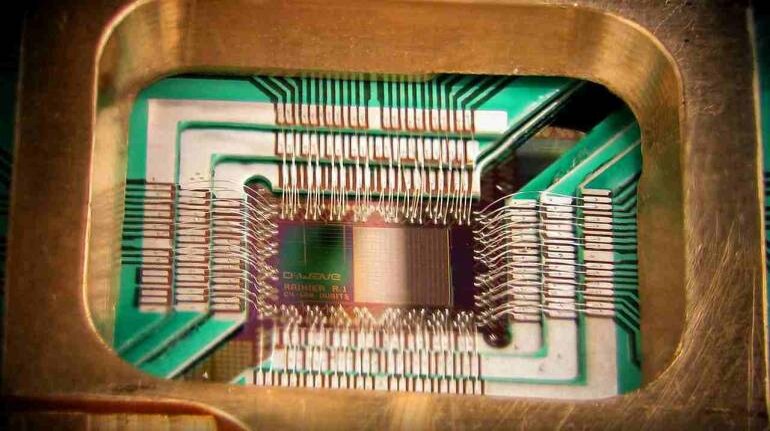
In simple words, Quantum computing is based on the principles of quantum mechanics to create an efficient computation system that far exceeds what supercomputers are capable of today. Quantum mechanics are a branch in the study of physics which deals with physical properties at the scale of atoms and subatomic particles.
The history of Quantum computing dates back to 1981 where the basics of the theory was formed over a three day discussion at the MIT Conference Center in Boston. The meeting was sponsored by IBM and MIT.
Okay but how is this different from what computers can do today?
Currently, the computers that we use are part of a branch of study called classical computation. This forms the backbone of all the computers that we use today which includes desktops, laptops, mobile devices etc.
Classical computation techniques involve something known as deterministic bits which are observable states of 0 and 1. Almost all of this is based on Isaac Newton’s formulae for macro particles but the problem is these fall apart when dealing with a world of smaller particles at molecule level. The reason for this is when we venture into smaller particles, they are no longer deterministic and hence the 0 and 1’s are no longer efficient. This is where Qubits come in.
Since smaller particles are often wave-like in structure, their classification as Qubits means they do not have to exist in one state or the other for instance – 0 or 1. A qubit can instead exist in both states simultaneously. A deterministic state is often characterised by a binary digit (0 or 1) which is called a bit. Its state can either be 0 or 1 whereas Qubit has the flexibility of processing both, which means it can theoretically be superimposed in both states. This means a qubit can carry more information and is not subject to the inherent limitation of having access to only state at a time.
The power of a qubit grows with each unit. For instance – 1 qubit can generate 2 bits, 2 qubits can generate 4 bits and 3 qubits can generate 6 bits and so on. This means a quantum computer is more efficient at processing data compared to classical computers and has particularly important implications in the future of computing.
This allows developers to use quantum mechanics to solve larger computational problems way faster than classical computers ever can. You know what is even crazier? Not only qubits hold more information and exist in more than one state, but two qubits can also be entangled i.e., set to the same state regardless of their location.
Uh-huh, so how is this useful again?
To be fair, Quantum computing still has its share of sceptics because it is still a field of research and is a long away from being put to practical use. If it were, however, it would dramatically speed up optimisation and research in various industries. The most sought-after use would be for would be in the fields of cryptography. Quantum computers have been known to break open encryption algorithms faster than a classical computer would and, in some cases, where classical computers cannot.
On the flip side of the coin, a quantum level encryption can be impossible to break for all but the wealthiest of companies and even then, they need to have a quantum solution of their own. A potential disadvantage can be quantum hackers, i.e., state funded hacking groups hacking into private networks of other government institutions.
AI (Artificial Intelligence) and ML (Machine Learning) can also benefit greatly by the superior computation capabilities of Quantum computers. It is already estimated that AI will run into a plateau due to the inefficient computational capabilities of the current classical computer systems, this is where Quantum computing can help with the data crunching. A mathematical problem that takes a classical computer about a week to solve can be solved in one second using a Quantum computer. How is that for efficiency?
Another problem that Quantum computing solves is the literal size of classical supercomputers. These are complex machines that require tons of CPU and GPU cores all bundled together in a large area for efficient computation and even then, there are problems they just cannot solve. Quantum computers in comparison are about as big as a domestic fridge and have accompanying wardrobe-sized control electronics. So, they are efficient in the amount of space they take up as well.
Can we see practical Quantum computers in our lifetime?
What if I told you, they already exist? Take Google for example, they already have a functioning Quantum system that they claim has solved various problems. Most megacorporation’s such as IBM, Fujitsu and Google have invested heavily into this technology. It has also grown since 1998, where the first 2 qubit-based Quantum computer was shown off. The last recorded Quantum computer already had 128 qubits in 2018.
As to when we can see a consumer application for the technology, it is hard to tell but start-ups such as D-Wave System have already raised $200 million to create systems that tackle a variety of problems ranging from logistics, AI, material science, drug discoveries, cyber security systems, fault detection and even financial modelling systems. It is currently estimated that an average customer may use a quantum computer by 2030 using cloud based technologies but don’t quote me on that.


Discover the latest Business News, Sensex, and Nifty updates. Obtain Personal Finance insights, tax queries, and expert opinions on Moneycontrol or download the Moneycontrol App to stay updated!
Find the best of Al News in one place, specially curated for you every weekend.
Stay on top of the latest tech trends and biggest startup news.