American cardiologist Eric Topol said, “The promise of AI in medicine is to provide composite, panoramic views of individuals’ medical data; to improve decision-making; to avoid errors such as misdiagnosis and unnecessary procedures; to help in the ordering and interpretation of appropriate tests; and to recommend treatment.”
In 2020, lung cancer was the primary cause of cancer deaths, with 1.8 million deaths (18 per cent of all cancer deaths), including 1.18 million deaths among men and 0.6 million deaths among women. In 2040, it is anticipated that there will be more than 28 million cases of cancer worldwide, representing a 47 per cent increase from 2020. In Europe, the five-year survival rate for lung cancer is only about 13 per cent, which is a very dismal prognosis. Furthermore, approximately 20 per cent of lung cancer cases are diagnosed at stage-I. This dramatic circumstance remained unchanged for decades.
The seriousness of lung cancer
Even though there have been significant improvements in how lung cancer is diagnosed and treated, the disease still has terrible clinical outcomes. Survival depends a lot on the stage of the disease at the time of diagnosis. For example, the five-year survival rate for patients with early-stage disease is 56 per cent, but less than 5 per cent for those with advanced disease. Since only 16 per cent of lung cancers are found early, and most patients show up with severe disease, making screening tests that can find the condition has been a goal in lung cancer care for a long time.
How do the technicians screen it?
Several screening methods have been tried, including sputum cytology, chest radiographs (CXR), low-dose computed tomography (LDCT), and, more recently, the analysis of various biomarkers. However, data from clinical trials show that only the use of low-dose computer tomography scans (LDCT) in heavy smokers has been linked to a significant reduction in lung cancer-related mortality. In addition, even though targeted therapies and immunotherapeutic agents, especially immune checkpoint inhibitors (used alone or in combination with standard chemotherapeutic regimens), have made overall survival last longer than with standard chemotherapy, these new treatments don't work for all patients. Therefore, early detection remains the most critical intervention window for improving patient survival.
How does AI make an impact on lung cancer?
The rise of AI as a new way to look at medical data opens up new ways to improve the identification and treatment of many diseases. For example, when diagnosing lung cancer, combining AI systems with clinical and biomedical data could improve lung cancer screening. For example, AI has the potential to enhance the analysis and interpretation of lung images from MRI or CT scans. It could also help determine the clinical significance of data from tissue or fluid biomarkers, electronic medical records (EMR), and metagenomic data, leading to better lung disease diagnosis.
Existing solutions around the globe
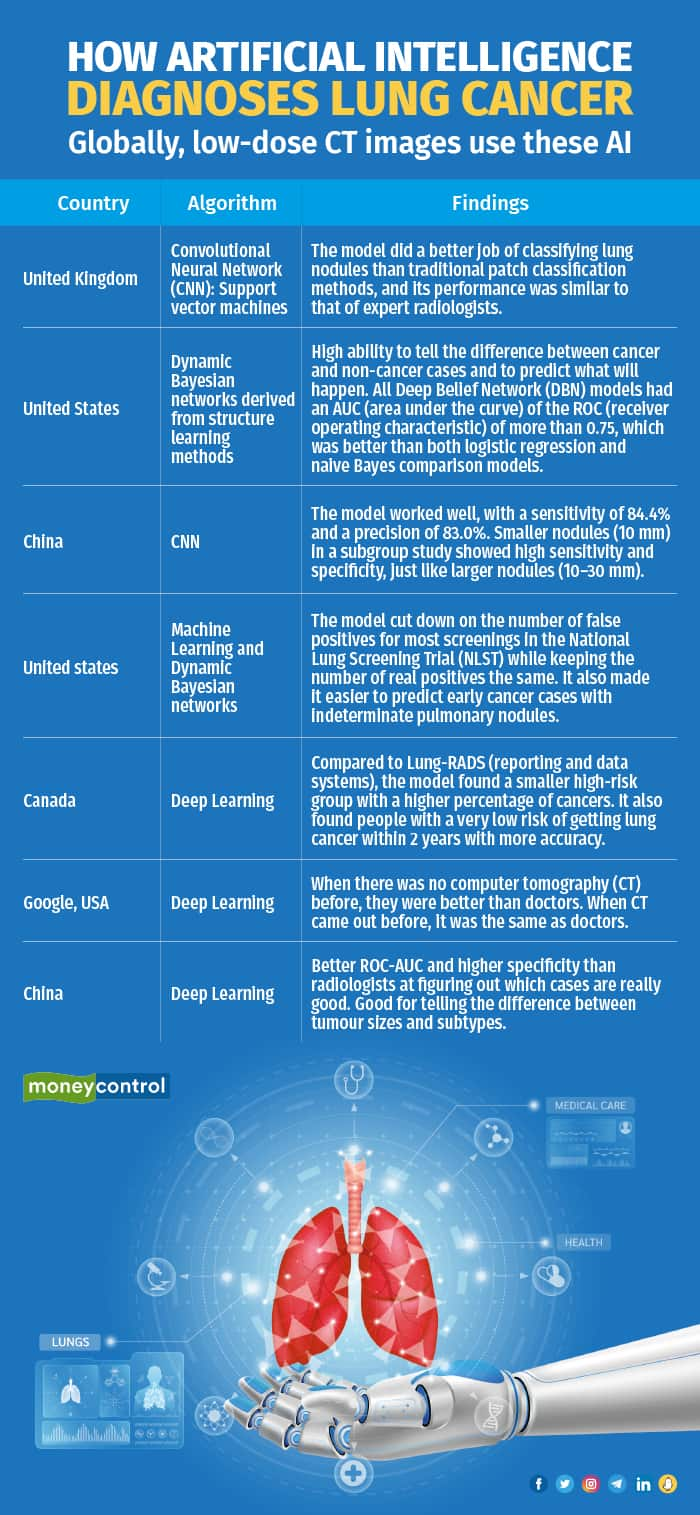
The following is the overview of approaches that examined low-dose computer tomography (LDCT) images using AI to diagnose lung cancer.
What is unique about the latest technique?
Researchers at MIT and the Massachusetts General Cancer Centre made the AI oracle. They taught it to figure out how likely a person will get lung cancer in the next six years, according to a study that came out this month in the Journal of Clinical Oncology. The software was made to get around two big problems with the standard guidelines for screening for lung cancer. For one thing, the researchers made sure to use the tool on patients who had never smoked before. It is because most of the rules focus on current or former smokers, even though the number of diagnoses of people who have never smoked has doubled in the last few decades.
Conclusion
The AI also wants to make screening easier for people who smoke or are used to smoking. According to the researchers, the guidelines say that people over 50 should get a low-dose computed tomography (LDCT) chest scan every year, but less than 10 per cent of people in that age group do that. So, predicting cancer risk for up to six years from a single scan could help increase the number of people diagnosed with cancer.
Furthermore, the AI could identify cancer within a year with an average AUC of 0.91 across all three data sets. The mixed data set from Taiwan had the highest score, with an AUC of 0.94. Its expectations for the next six years dropped to an average AUC of 0.79, which is still good. The algorithm did better with scans from the training set than with scans from the testing set.


Discover the latest Business News, Sensex, and Nifty updates. Obtain Personal Finance insights, tax queries, and expert opinions on Moneycontrol or download the Moneycontrol App to stay updated!
Find the best of Al News in one place, specially curated for you every weekend.
Stay on top of the latest tech trends and biggest startup news.