-
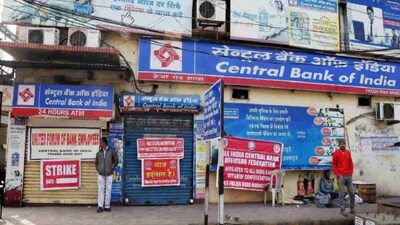
Raising growth capital to be Central Bank of India’s top priority post-PCA exit
The bank’s management expects credit growth to pick up after its exit from the Reserve Bank of India’s Prompt Corrective Action (PCA) list.
-

Central Bank of India likely to exit RBI PCA framework soon, shares rise
The bank has already made a representation to the Reserve Bank of India (RBI) based on the improvement in financial parameters on a sustained basis for the past five quarters, sources said.
-
After UCO Bank, IOB requests RBI to remove prompt corrective action tag
IOB MD & CEO Partha Pratim Sengupta said that the bank is yet to hear from the Government on the question of privatisation.
-
UCO Bank knocks on RBI’s door seeking removal of PCA tag
The Kolkata-based lender wrote to the regulator after its annual results for FY21 seeking removal of PCA tag.
-
Central Bank of India counts on recoveries as spike in bad loans may delay exit from PCA
The bank saw slippages of Rs 3998 crore, which includes divergences of Rs 1800 crore as assessed by RBI. As a result, the bank’s slippage ratio shot up to 3.2 percent, from 0.91 percent in the previous quarter.
-
RBI wants to punish weaker banks that are perennially sick. But how far can it go?
While ‘auctioning’ a distressed bank is a bit of a stretch, RBI could very well consider playing the role of a matchmaker to merge weak banks with stronger ones.
-
RBI tightens supervisory action framework for Urban Cooperative Banks
The SAF, if implemented in a timely manner, may help cooperative banks improve their financial conditions and avert restrictions on basic services like deposit withdrawals that are imposed by the regulator as a last resort.
-
Yes Bank: Timely capital infusion allays PCA fears
Apart from capital, the bank also needs to keep its asset quality from deteriorating further and control further slippages, an analyst said
-
Banking wrap: How PMC Bank crisis unfolded; Lakshmi Vilas Bank comes under RBI scanner
Weekly banking wrap: Finance Minister-private banks' meet outcome; RBI releases report on liquidity management framework and more
-
No "witch hunt" in future for genuine decisions: Government to banks
MoS Finance Anurag Thakur said that banks should treat the Insolvency and Bankruptcy Code as the last resort for resolution of stressed assets and approach the NCLT only when other options have been explored.
-
PSBs may raise funds to cut down govt's shareholding in line with SEBI's 25% public float norm
The banks are exploring different ways to reduce the government’s stake, including instruments such as qualified institutional placement, FPO, rights issue, among others
-
3 Point Analysis | Risks of moving weak banks out of PCA
Moneycontrol's Vaibhavi Khanwalkar does a 3 Point Analysis on the risks of moving the banks out of PCA.
-
Jaitley hopeful of more banks coming out of PCA
Reasoning that the banks were adequately capitalized to absorb any loss and had shown improvement in their financial performance, the board of the RBI decided to take out all the six banks from the PCA restrictions
-
Opinion | Is the lifting of PCA curbs on three banks premature?
There are risks looming in the form of delayed loan recovery and power sector defaults
-
Quick Take | With so many frauds in PCA banks, why take the risk of allowing them to lend?
The share of frauds in banks under the prompt corrective action framework far outweighs their share of total bank capital dedicated to operational risk
-
Editor's Take | RBI Board Meeting: Great Expectations
The meeting will review the progress with respect of some of the decisions taken in the last meet on November 19.
-
Why the stock market is being myopic in celebrating Urjit Patel's resignation
There is no free lunch. The market is forgetting there will be a price to pay for loosening the government’s and RBI’s purse strings.
-
Banks under PCA shun corporate loans to take on private banks in retail lending: Report
Restricted lending reduced the overall loans of these banks over the past six years, but they are fighting tooth and nail for market share in retail lending
-
Finmin hopes 3-4 banks to be out of PCA this fiscal
Last week, the RBI in its central board meeting decided the issue of banks under Prompt Corrective Action (PCA) will be examined by Board for Financial Supervision (BFS) of the central bank
-
Indian norms on PCA, capital are conservative, rule-based: SBI report
"Whether a rule-based or a discretion-based approach works better remains a matter of empirical debate till date," it said, while commenting on the PCA and provisioning norms.
-
RBI versus govt: FinMin was in agreement over changes in PCA in 2017
The Finance Ministry had also indicated at the time that it was 'broadly in agreement' with the framework that RBI proposed
-
PCA norms could be aligned to international practices: Banking secy Rajiv Kumar
Banks have strongly pitched for easing the regulatory requirements in order to expand their loan books
-
Govt may ask RBI to relax PCA norms at its board meet today
Finance Minister Arun Jaitley had said last month that demands of public sector banks (PSBs) to relax the norms of the PCA framework will be taken up with RBI
-
RBI's corrective action on 12 banks limited losses, saved taxpayer money: Viral Acharya
Currently, there are 12 banks - 11 in the public sector and one in the private sector – whose capital, asset quality and/or profitability do not meet pre-specified thresholds
-
Opinion | How our laws are increasingly undermining war against corruption
Sadly, legislators forget that when laws get corroded either by inaction or through amendments, or through moves that make the collection of evidence difficult, the very fabric of governance gets frayed.