Omicron, the new COVID-19 variant, has rattled markets, and clouded the global economic outlook with uncertainty. Based on early on-ground observations from South Africa, and research from the University of Hong Kong, Omicron is more transmissible but less severe than previous variants. If this corroborates, Omicron’s long-term outcome might be surprisingly positive, and even accelerate the pandemic’s end.
The possibility of an upside scenario is aided by the fact that many global economic activity indicators are exhibiting a robust revival. Following a contraction of 3.1 percent in 2020, the International Monetary Fund (IMF) has projected the global economy to grow at 5.9 percent in 2021. In a similar vein, the Global Composite PMI edged up to a four-month high of 54.8 in November, signalling an accelerated rate of global expansion.
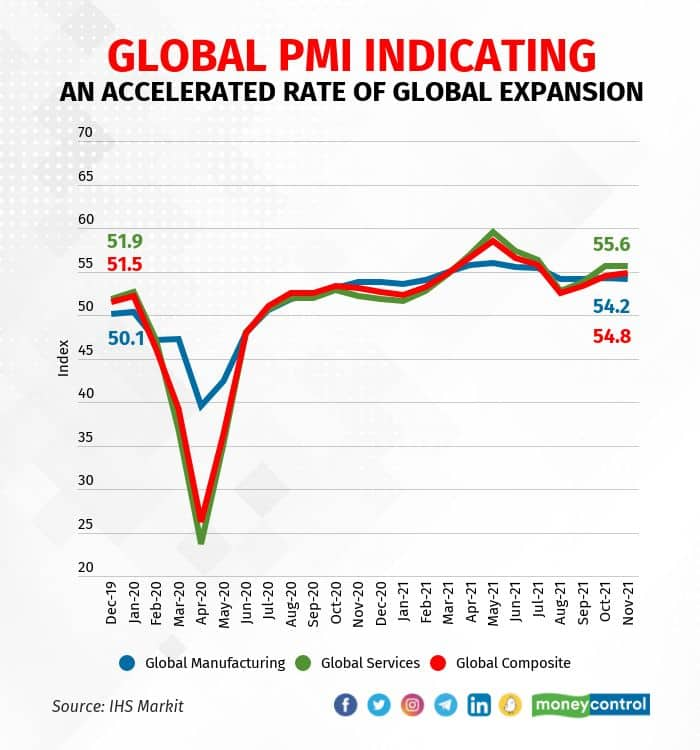
The quick improvement in global economic activity can be attributed to the growing ability of economies to adapt better to COVID-19-related restrictions. Every subsequent wave has witnessed lesser economic damage compared to the previous one. Indeed, India saw a muted economic impact of the second wave, with a growth of 13.7 percent in between April to September FY22 as opposed to a contraction of 15.9 percent in the first wave (during the same period in FY21).
Apart from the improved adaptability, and better understanding of economic risks, the ramp-up in vaccinations worldwide has allowed people and economies to safeguard their economic growth. Further, creative workarounds to deal with supply-chain disruptions have been figured out by economies. For instance, passenger flights are transporting cargo to avoid packed shipping ports, while investors are simultaneously gravitating towards start-ups building cargo drones. Similarly, alternative raw material sources are being worked out by smaller manufacturers.
On the other hand, the downside scenario linked to the Omicron variant threatens to drive a still-fragile recovery off-track. It poses new risks and uncertainties for global trade growth. As per the Global Trade Outlook released by the United Nations Conference on Trade and Development (UNCTAD), global trade is expected to be worth about $28 trillion in 2021, 23 percent higher than 2020. However, with various countries announcing border closures and travel restrictions in response to Omicron, this could be an adverse game changer for global trade prospects.
It could also worsen the existing supply bottlenecks which in turn would intensify global inflationary pressures. US inflation hit a 39-year high in November (6.8 percent) while the United Kingdom recorded the highest inflation (4.2 percent) since November 2011 in October 2021. Omicron-fuelled supply shortages threaten to drive up already-high inflation in such economies, worsening their macroeconomic woes, and dampening consumer and corporate confidence.
Prior to Omicron’s emergence, several economists had predicted a robust revival in contact-intensive service sectors such as leisure, travel and tourism. A spike in consumer spending in the holiday season had also been anticipated, but prospects of a broad-based demand revival do not look too certain given the current circumstances.
Policymakers and central banks have exhausted the available policy options, and there is little room to inject stimulus or loosen monetary policy in the face of another economic downturn in an overheated economy. According to the IMF, global government debt is forecasted at a whopping 97.8 percent of GDP in 2021. With debt ballooning to unprecedented levels, countries must act with caution to avoid or escape long-term debt traps.

An Omicron-triggered wave could also amplify geopolitical pressures. With the South African President issuing a statement to lift the travel bans imposed by countries on South Africa and the WHO head condemning the supposed "vaccine apartheid", issues pertaining to vaccine equity and vaccine nationalism have become all the more critical.
While the global community anxiously waits for information, the importance of exercising caution at this juncture cannot be overemphasised. Pfizer recently announced that three vaccine doses could offer protection against Omicron. As evidence pertaining to the efficacy of other existing vaccines pours in, rapid vaccination could definitely prevent the virus from mutating to newer and more virulent variants.
According to an analysis by the IMF, the benefits of vaccinating the world far outweigh the cost which was estimated to be around $50 billion. Ramping-up vaccination across the world is undoubtedly the need of the hour.
[Views are personal and do not represent the stand of this publication.]Discover the latest Business News, Sensex, and Nifty updates. Obtain Personal Finance insights, tax queries, and expert opinions on Moneycontrol or download the Moneycontrol App to stay updated!
Find the best of Al News in one place, specially curated for you every weekend.
Stay on top of the latest tech trends and biggest startup news.