






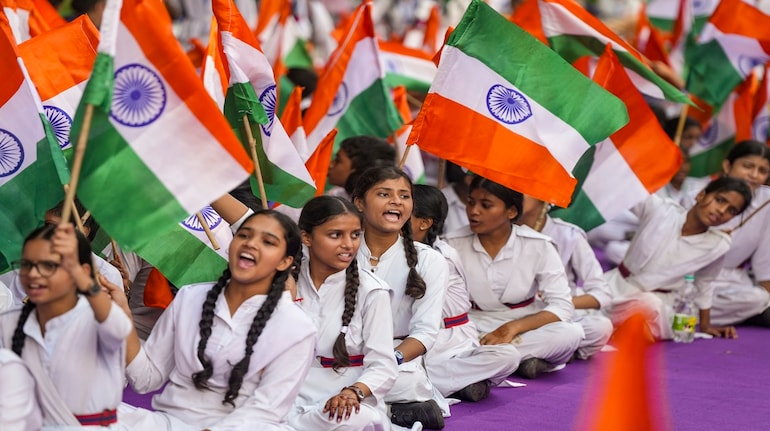
To commemorate 150 years of the national song of India, Vande Mataram, Parliament on December 8 organised a special discussion in both the Lok Sabha and the Rajya Sabha. Written by Bankim Chandra Chattopadhyay in 1875, Vande Mataram holds a luminous place in India’s freedom struggle, inspiring generations of revolutionaries and becoming a rallying cry for national awakening.
The legal inconsistency between national song and national anthem
When India attained Independence, and the Constituent Assembly deliberated on adopting the national symbols of the new Republic, there were strong voices—both inside and outside the Assembly—arguing that Vande Mataram should be accorded the status of the National Anthem. Ultimately, however, ‘Jana Gana Mana’, the iconic composition of Nobel laureate Rabindranath Tagore, was elevated to the position of the National Anthem, while Vande Mataram was formally adopted as the National Song.
On December 8, as the Parliamentary debate commenced, a series of long-standing concerns resurfaced—from the perceived “injustice” of not declaring Vande Mataram the National Anthem to objections about endorsing only the first two stanzas as the official version. Amid these discussions, two significant points emerged from Defence Minister Rajnath Singh's address.
First, he questioned why, despite claims of equal status between the National Anthem and the National Song, Vande Mataram finds no mention in the Prevention of Insults to National Honour Act, 1971. Second, he invited parliamentarians to collectively examine whether respect for the National Song could be explicitly incorporated into the Fundamental Duties under Article 51A.
Legislative protection for national symbols
Coming to the first point—the Prevention of Insults to National Honour Act, 1971—it is important to highlight two key aspects. First, this legislation was enacted in 1971, nearly two decades after India had already adopted the Constitution, the National Anthem, the National Flag and declared Vande Mataram as the national song. Second, the Act was subsequently amended in 2003 and 2005.
Statement of Objects and Reasons for the Prevention of Insults to National Honour Act, 1971 stated: "Cases involving deliberate disrespect to the National Flag, the National Anthem and the Constitution have come to the notice in the recent past. Some of these incidents were discussed in both Houses of Parliament, and members expressed great anxiety about the disrespect shown to the national symbols. The government were urged to prevent the recurrence of such incidents. Disrespect to the National Flag and the Constitution or the National Anthem is not punishable under the existing law. Public acts of insults to these symbols of sovereignty and the integrity of the nation must be prevented. Hence, the Bill. The scope of the law is restricted to overt acts of insult to and attack on the national symbols by burning, trampling, defiling or mutilating in public. It is not intended to prohibit honest and bona fide criticism of the symbols, and express provisions to this effect have been made in the Bill.”
Through the 2003 amendment, Section 2 of the act was amended to insert “disrespect’ and also the scope of the expression “insult” in the original act was widened. Then in 2005, again section 2 was amended as the original act provided that disrespect would include using the National Flag as a portion of a costume or uniform of any description or embroidering or printing it on cushions, handkerchiefs, napkins or any dress material.
The Statement of Objects and Reasons for the 2005 amendment stated that there were demands from the common citizens in general, and the sportspersons in particular, to express their love and affection for the National Flag by displaying it on their dresses, headgear, T- T-shirts, vests, etc., in a respectable manner.
Jurisprudence allowed citizens to respectfully use national symbols
The question of national symbols and the citizens’ right to use them has been the subject of several landmark judicial pronouncements. One of the most significant among these is the Union of India vs. Naveen Jindal case. In this case, the petitioner challenged a government order that restricted the flying of the National Flag on private premises, arguing that such restrictions under the Flag Code and related executive orders were unconstitutional. He contended that the right to fly the National Flag with dignity and respect is a part of the fundamental rights of Indian citizens, and that no law could arbitrarily curtail this expression of patriotism.
Avoiding compulsion
The Supreme Court has also examined issues related to the National Anthem on multiple occasions. A notable instance dates back to 1985–86, when three schoolchildren belonging to the Jehovah’s Witnesses faith in Kerala were expelled for refusing to sing “Jana Gana Mana” during the morning assembly. Although they stood respectfully while the Anthem was being sung, they objected to singing it themselves on grounds of religious belief.
The Court held that standing up respectfully while the National Anthem is sung, even without singing it, does not amount to preventing others from singing, nor does it disturb the assembly. Therefore, it does not constitute an offence under Section 3 of the Prevention of Insults to National Honour Act, 1971.
National anthem as a civilisational heritage
In 2005, the Supreme Court also dismissed a petition seeking the removal of the word “Sindh” from the National Anthem. The Court clarified that the reference to “Sindh” in Jana Gana Mana is not a territorial claim but an acknowledgement of the cultural and historical contribution of the Sindhi community. The term, the Court observed, celebrates a shared civilisational heritage rather than geographical boundaries.
This interpretation reinforces the Anthem’s larger purpose: to honour the diverse cultural fabric that forms the essence of India’s national identity.
The long road to bringing Fundamental Duties into the Constitution
As far as Fundamental Duties are concerned, it is important to note that they were not part of the original Constitution. They were incorporated through the 42nd Constitutional Amendment Act, 1976, based on the recommendations of the Swaran Singh Committee, which had been appointed to review the Constitution during that period.
However, the idea of introducing Fundamental Duties into the Constitution predates this by more than a decade. The K. Santhanam Committee (1961) had first proposed the inclusion of certain duties to instil a sense of discipline, national unity, and social responsibility among citizens. While these recommendations were not acted upon at the time, they laid the conceptual foundation for the eventual insertion of Part IVA into the Constitution.
Judiciary has used Fundamental Duties as a guidepost
It is important to note that, unlike the legislations mentioned above, the enforceability of Fundamental Duties has remained a persistent constitutional dilemma. The Constitution does not prescribe any legal sanction for the breach or non-performance of a Fundamental Duty. As a result, while these duties carry significant moral and civic weight, their implementation has largely depended on citizen awareness and voluntary compliance rather than enforceable legal obligations.
However, the Indian judiciary, especially the Supreme Court, often invokes Fundamental Duties to decide matters of public importance. In several environmental cases, the Supreme Court has stressed its relevance. In Rural Litigation and Entitlement Kendra vs. State of Uttar Pradesh, Justice Ranganath Mishra observed that preservation of the environment is a responsibility not just of governments but of every citizen. It is a social obligation and a Fundamental Duty under Article 51A(g).
This reflects how the judiciary uses Fundamental Duties as guiding principles despite their non-enforceability.
Conclusion
Whether enforceable or not, Fundamental Duties place at least a moral obligation on every citizen to uphold the values codified in the Constitution. Including Vande Mataram in this list would undoubtedly enhance the honour of a song already cherished by millions. Likewise, its inclusion in the Prevention of Insults to National Honour Act, 1971 would provide clear legal backing to prevent—and punish—any insult to the National Song.
Discover the latest Business News, Sensex, and Nifty updates. Obtain Personal Finance insights, tax queries, and expert opinions on Moneycontrol or download the Moneycontrol App to stay updated!
Find the best of Al News in one place, specially curated for you every weekend.
Stay on top of the latest tech trends and biggest startup news.




