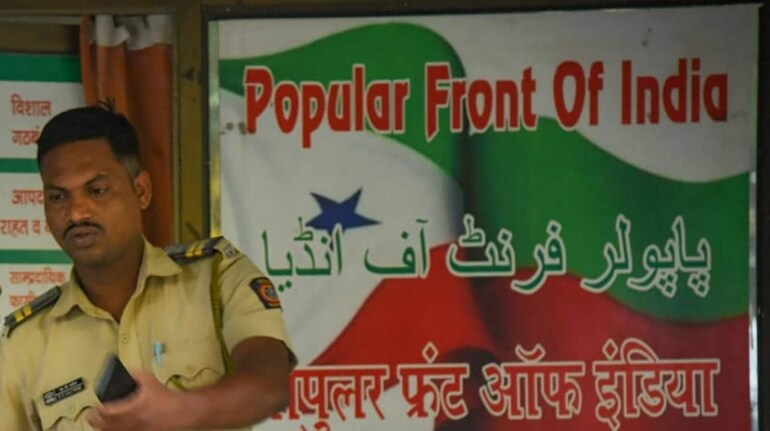
While it had offices in many Indian states, the now-banned Popular Front of India (PFI) was predominantly a Kerala-based organisation. The NIA–ED crackdown was more rigorous in Kerala, and most of the frontline leaders arrested were also from the state. What started off as a social organisation transpired very quickly into a radical Islamist movement, for which the PFI exploited the demographics, and the anti-Right-wing political ground in Kerala.
In a sense, the PFI’s growth in Kerala can be ascribed to the state’s mainstream politicians who lacked the will to resist communalism.
Unbiased Early Views
Within four years of the PFI’s formation, then Chief Minister VS Achuthanandan, in July 2010 said about the PFI’s devious design to convert Kerala into a Muslim-dominated state in two decades. Despite being at loggerheads with the then Communist Party of India (Marxist) State Secretary Pinarayi Vijayan, Achuthanandan gained his support amid political chaos. In 2012, the Congress government led by Oommen Chandy filed a data-driven affidavit in the high court, terming the PFI communal. But what happened in the later years is baffling.
No Appeasement, No Gain
In the last decade, Kerala witnessed the stellar rise of the PFI, thanks to the Social Democratic Party of India (SDPI), its political wing. The unprecedented growth made both the CPI(M) and the Congress vulnerable. The SDPI became a significant entity in local body polls, and started offering discreet support to both parties based on regional equations.
It could upset the ruling entity, support another party to rise to power, help pass no-confidence motions, and even abstain from voting to enforce changes. In return, it was rewarded with power, positions, and a softer approach, allegations to which neither the CPI(M) nor the Congress has confessed till date.
In 2021, shortly after the assembly polls, an SDPI leader claimed that in two constituencies the party voted in favour of the CPI(M) and the Congress to avoid votes getting split and the Bharatiya Janata Party (BJP) candidate, thereby, winning. The CPI(M) never said no to the votes from an organisation Vijayan himself had considered ‘communal’ a decade ago.
SDPI Snarl-Up Ahead
Although the SDPI is a registered political party which cannot be banned by the Centre, it is the biggest and most-influential unit connected to the PFI. Even if it is not banned, the local body understanding they have with other parties will come under the scanner now more than ever before. This will put the leaders of other parties in a precarious spot, and has the potential to alter the political situation in several places. But since the CPI(M) and the Congress have both been beneficiaries, it is to be seen whether any of them will even broach the topic; but a ban on the SDPI will make things more complex.
Cloned Avatars
Since the PFI ideologues, fundraisers, and organisers are all behind the bars, and the organisation is fast losing its assets, the economic backbone of the system may have already suffered a huge hit, from which a recovery may not be impossible, but definitely improbable. It will also need funds to run cases and pay for the huge damages incurred from the violence-ridden hartal called in Kerala on September 23. Anybody funding internally would become easy targets for the law enforcement agencies. Other states are shutting down PFI offices to prevent its return in other forms, but it is worth noticing that Kerala, the PFI’s major stronghold, is focussing on nabbing hartal vandals.
Sangh Parivar Strawman
Like CPI(M), and Congress, the PFI had also made it a point to describe the Sangh parivar as a political evil. When Union minister Kiren Rijiju said in 2018 about an active proposal from Kerala to ban the PFI, Vijayan was quick to dismiss it as baseless, and reiterate it was not his government’s policy to outlaw organisations. He even took at dig at Riiju that if any organisation was to be banned, it should be the Rashtriya Swayamsevak Sangh (RSS).
Early this year, Kerala witnessed the alarming sight of a young boy on the shoulder of an activist shouting hate slogans against Hindus and Christians in a PFI rally in Alappuzha. Those slogans exposed the PFI’s communal agenda. Even then, neither the CPI(M) nor the Congress pushed for a ban on the PFI.
Now that the PFI is banned, hopefully Kerala will not hear slogans of communal hate for the foreseeable future, but it will be dangerous if the state’s mainstream political parties feel the urgency to become the guardians of a disbanded communal group that searches actively for political shelter.
Sreejith Panickar is a Kerala-based political commentator. Twitter: @PanickarS.
Views are personal and do not represent the stand of this publication.
Discover the latest Business News, Sensex, and Nifty updates. Obtain Personal Finance insights, tax queries, and expert opinions on Moneycontrol or download the Moneycontrol App to stay updated!
Find the best of Al News in one place, specially curated for you every weekend.
Stay on top of the latest tech trends and biggest startup news.