





The science behind that equilibrium which only an Onam sadhya — the Onam lunch which is had on a banana leaf — can achieve is far from what is visible to the human eye. A sadhya for Onam signifies the dawn of the new harvest from nature’s bountiful treasures.
The preparations for a sadhya begin months in advance with the first seeds sown aimed to be harvested in the Malayalam month of Chingam (which roughly falls between August and September). A gluten-free, almost vegan meal is what the sadhya traditionally appeared to be.
Dairy products were sparingly used, and was limited to the curds used in kootu curries (accompaniment dishes served with rice) such as Kaalan or Pachadi, and the buttermilk served towards the end of the meal. Raw mangoes were preferred instead of yogurt in some places to sour the all-inclusive Avial.
It all begins with the banana leaf that is rich in antioxidants, and allows food served on it to absorb polyphenols that help with its antibacterial properties to aid with the ingestion of germ-free food.
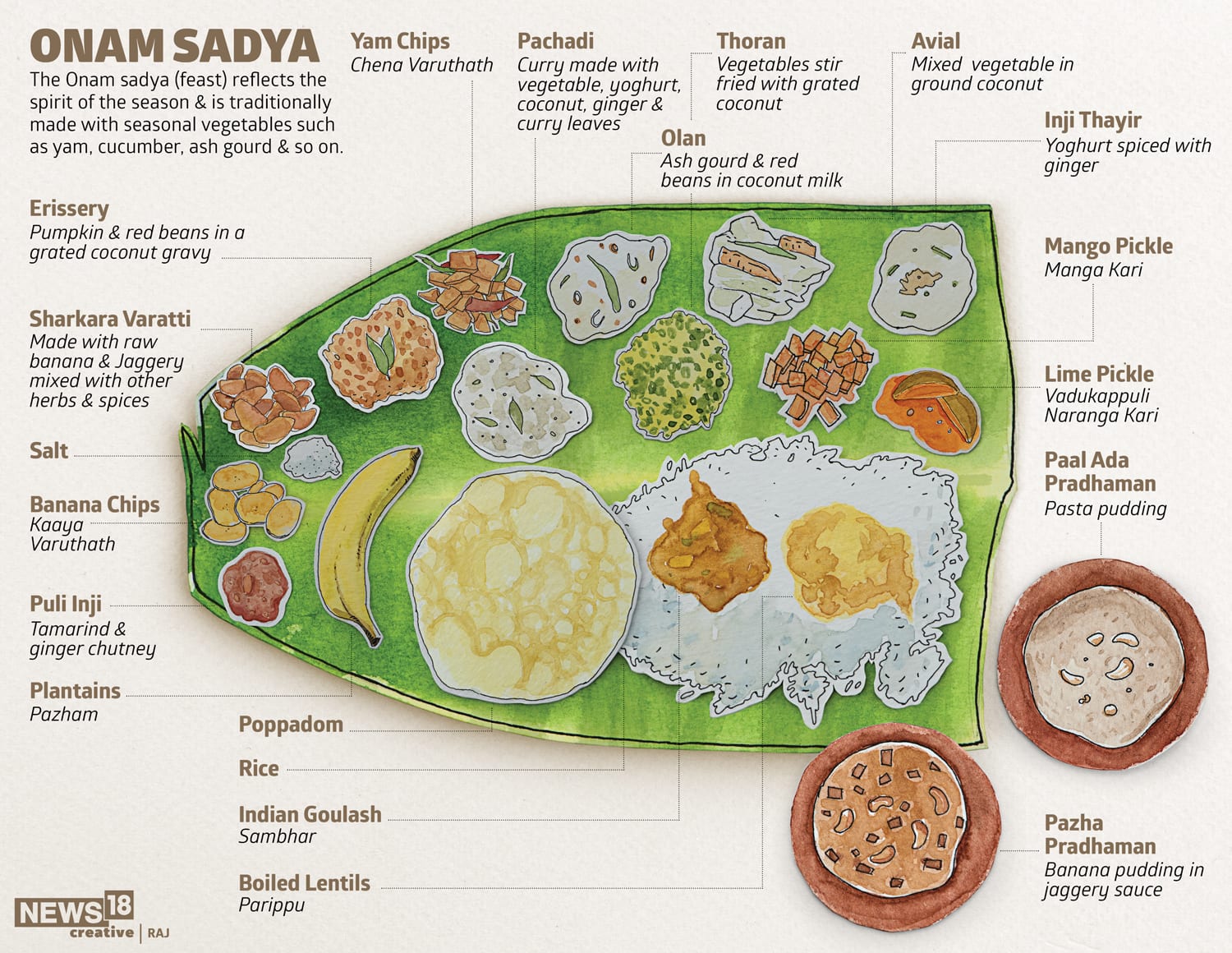
The usage of leaves stops with the banana leaf — there is no other leafy vegetable used in any of the dishes in a sadhya. The seasonal availability and the fact that the monsoon showers in the month of Karkidagam (preceding Chingam) make leafy vegetables unsafe to be consumed are primarily the reasons behind this — with the exception of cabbage which is used in preparing thoran at times.
Ayurvedic references from the Ashtavaidya Nambis propound the principle ‘Kaale hithamit bhoji Kruth, Chamkraman kramen vamasaya’ meaning ‘He who eats a balanced food is healthy, He who eats on time is healthy’. The sadhya, therefore, is mostly prepared by 10AM to be served in time for lunch.
The people of Kerala, regardless of religion, take pride in preparing a sadhya that it is more a way of life to Keralites. The adage is: ‘Kaanam Vittu Onam Unnanam’ which means ‘one must have the Onam lunch even if they have to sell everything’.
Sadhya is eaten differently in different parts of Kerala, the Travancore sadhya features Boli and Palpayasam towards the end, whereas the Palakkad Sambar has dry roasted coconuts in it. Pappadams are meant to be crushed over the dark Payasam (dessert) along with a small banana to balance the meal. Sambhar and Rasam, like Pappadam, are invasive to Kerala cuisine, but harmoniously co-exist with other traditional elements.
Even the most basic of sadhyas would have 11 items to begin with and could go up to 64, and even beyond like the Aranmula Vallasadhya which could feature more than a 100 items in one sitting. The balance of acid, proteins, carbohydrates and fat is essential for every sadhya and that makes it unique.
The principles of Ayurveda and Yoga are diligently applied in choosing the ingredients, the cooking utensils, the eating patterns, and governs all elements involved in the sadhya.
Eating the sadhya facing East is based on cosmic energy points, and that is why a sadhya can only be eaten with the right hand as the South is considered inauspicious. The banana leaf is laid out with its tip pointed to the left and the items are served starting from the top left corner of the leaf signifying North East which is most auspicious according to Vastu Shastra.
The tips of our fingers are considered to invoke the five cosmic energy elements (Pancha bhootas: Earth, Water, Fire, Air and Ether) and that helps in warding off any negativity to befall from the food, hence no cutlery is used to eat a sadhya.
Sitting cross legged on the floor to eat a sadhya is a derivative from Yoga, Ardha Padmasana or Sukhasana is the posture ideally suited to help channel the blood flow to the stomach and ease digestion primarily working the hand eye co-ordination like a dream.
Onion and garlic were traditionally never used in the sadhya as they were considered Rajasic foods (increases aggression). The sadhya would involve only Sattvic food using fresh and local ingredients which conceptually aligns with farm to table as we understand today. Nevertheless, the void created by non-inclusion of onion and garlic was made up for by substituting with asafoetida/hing, known for its digestive qualities.
Puliinji or Injicurry is a mix of jaggery and ginger. The jaggery is rich in iron and boosts immunity. The ginger counters food poisoning. Sambhaaram or Moru (buttermilk) is served at the end of the meal to regulate body temperature.
Water served is often infused with dry ginger (Chukku Vellam) or Cumin (Jeeraka vellam) for blood purification and controlling acid reflux.
As opposed to the West where the primary tastes are sweet, sour, salty, bitter, and umami (which is undefined), Ayurveda identifies two additional tastes of pungent and astringent in place of umami.
The first taste that should prepare your taste buds for a meal is often sweet, hence jaggery plays an important part in preparing the accompaniments (Kootu curries).
We begin the sadhya with the Sharkara Upperi (jaggery coated chips) and end the meal with a pickle (usually the sour lemon pickle) after a Payasam to prevent sluggishness.
Satiety from the grandeur of a sadhya is expressed after folding the empty banana leaf respectfully towards our side with salutations to the chef in Malayalam “Balebesh”!
Discover the latest Business News, Sensex, and Nifty updates. Obtain Personal Finance insights, tax queries, and expert opinions on Moneycontrol or download the Moneycontrol App to stay updated!
Find the best of Al News in one place, specially curated for you every weekend.
Stay on top of the latest tech trends and biggest startup news.




