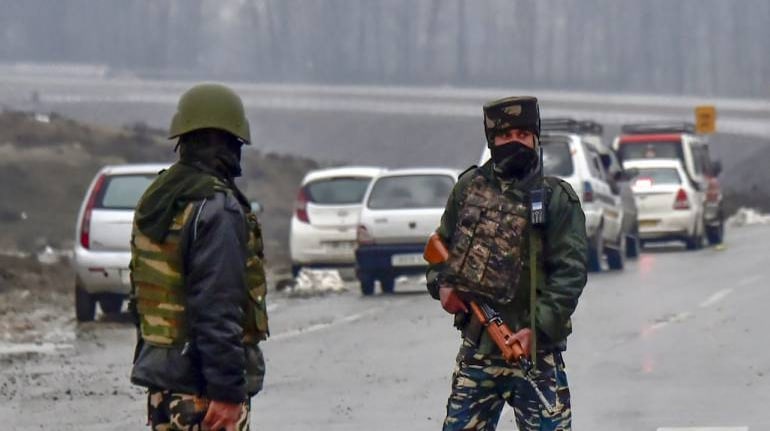
More than 40 Central Reserve Police Force (CRPF) jawans were killed last week in the Pulwama district of Jammu & Kashmir (J&K) in one of the worst terrorist attacks in recent times. While strategic analysts are debating all possible options in terms of dealing with such incidents, it is important to note that the cost of such acts goes beyond the immediate loss of lives.
The economic impact of terrorism can have wider implications. Subhayu Bandyopadhyay of Federal Reserve Bank of St. Louis and Javed Younas of American University of Sharjah, for example, in an article in 2017 noted: “The associated rise in security costs and loss in productivity of the workforce — through damages to labour and capital — are likely to reduce national income.”
While terrorism affects a developing economy in a number of ways, the immediate economic impact of Pulwama will depend on how the government of India intends to deal with it. It will not be easy for the ruling Bharatiya Janata Party (BJP) to seek re-election under the shadow of Pulwama attack. In terms of pure economic measures, the government of India has withdrawn the Most Favoured Nation (MFN) status and imposed a tariff of 200 percent on imports from Pakistan. However, it is unlikely to have a significant impact as trade between the two countries is just about $2 billion.
But the more important part to watch at this stage is whether the tension leads to a conflict between the armed forces of the two nuclear power states. The standoff in the aftermath of the Parliament attack in 2001 had cost India in excess of Rs 8,000 crore. An armed conflict today will entail a much higher cost. The problem for India is that terrorists are supported by Pakistan and retaliation in terms of an attack on terrorist bases can result in an escalation. The possibility of a strike, as conducted after the Uri attack, has diminished as terrorists are reported to have been relocated to safer places.
However, it is not clear if a limited or full-scale war will solve the problem. The risk is that it could end up giving an impression that India will engage militarily with Pakistan in case of provocation in the future as well. Continued tension in the region can affect the Indian economy in multiple ways. For example, since capital is mobile, it can impact both foreign and domestic investments. Further, the diversion of fiscal resources to security can affect investment and growth.
The fiscal impact of terrorism tends to be higher in the case of developing economies compared to developed economies. In this context, a 2015 International Monetary Fund (IMF) working paper concluded: “…the econometric analysis supports the view that public finances in developing and low-income countries are more vulnerable to terrorism than those in countries that are richer and diversified.”
Although retaliation would impose a disproportionate cost on Pakistan, which is battling an impending balance of payments problem, it doesn’t seem to be interested in economic progress. Its continuous support to terror has reduced India’s options. But the Indian government would do well to carefully evaluate all possibilities before taking action.
For complete and exhaustive coverage of the Pulwama terror attack, click here..

Discover the latest Business News, Sensex, and Nifty updates. Obtain Personal Finance insights, tax queries, and expert opinions on Moneycontrol or download the Moneycontrol App to stay updated!
Find the best of Al News in one place, specially curated for you every weekend.
Stay on top of the latest tech trends and biggest startup news.