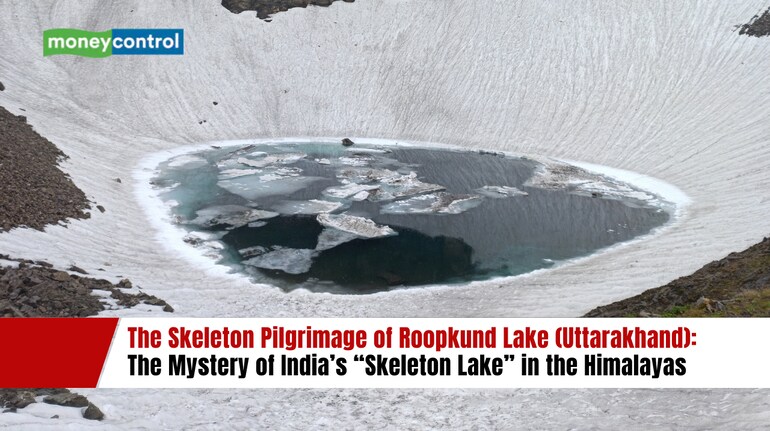

High in the Himalayas lies one of India’s most mysterious and fascinating places. Roopkund Lake, often called Skeleton Lake, is famous for the hundreds of human skeletons found around its icy waters. Located in the Himalayan region of Uttarakhand, the lake has puzzled historians, scientists and trekkers for decades.
At an altitude of about 5,020 metres, this glacial lake is surrounded by towering peaks and snow-covered landscapes. The combination of breathtaking beauty and unexplained human remains has turned Roopkund into one of the most intriguing destinations in the Indian Himalayas.
Roopkund Lake
Roopkund Lake sits between two majestic Himalayan peaks, Trishul Peak and Nanda Ghunti. The small glacial lake usually measures less than 40 metres in diameter and remains frozen for most of the year.
When the ice melts during certain weeks of summer, something astonishing becomes visible. Hundreds of human skeletons appear beneath the clear water and around the lake’s edges, giving the site its chilling nickname, Skeleton Lake. Because of its remote location and strange history, Roopkund has become a popular destination for Himalayan trekking, mystery tourism and historical research.
Discovery of the Skeletons
The skeletons were first widely reported in 1942 by forest ranger Hari Kishan Madhwal, who was patrolling the region near the protected forests of Nanda Devi National Park. At that time, British authorities initially feared the bones might belong to Japanese soldiers from World War II. However, further examination quickly ruled this out because the skeletons were far older.
Over time, researchers discovered not only bones but also wooden artifacts, leather slippers, iron spearheads and rings scattered around the lake. Some skeletons even had traces of preserved flesh, due to the extremely cold climate.
The local legend behind the skeleton lake
Local folklore tells a dramatic story about the mysterious deaths. According to traditional belief, a king named Raja Jasdhaval once travelled to the sacred shrine of Nanda Devi along with his pregnant queen Rani Balampa, royal servants and a group of dancers.
During the pilgrimage through the mountains, the group reportedly faced a sudden storm with massive hailstones. The stones were said to be so large and powerful that the entire party perished near Roopkund Lake. For generations, villagers have sung songs and passed down stories describing this tragic pilgrimage.
Scientific Research: What studies revealed
Modern research has provided new insights into the mystery. Studies conducted by the Anthropological Survey of India in the 1950s found that many skeletons had severe head injuries. These injuries appeared to be caused by round objects striking from above, which supported the theory of a deadly hailstorm.
Later scientific studies used radiocarbon dating and DNA analysis to learn more about the victims. The findings revealed something surprising.
Key discoveries from scientific studies
Researchers identified three ancestry groups:
This discovery challenged the earlier belief that all the skeletons belonged to a single disaster.
Why Roopkund is called “Skeleton Lake”
The nickname Skeleton Lake comes from the striking sight that appears when the ice melts. During certain weeks each year, human bones and skulls become visible in the shallow waters of the lake. The clear glacial water allows visitors to see the skeletal remains resting at the bottom.
Because of this unusual phenomenon, Roopkund has become one of the most mysterious archaeological sites in the Himalayas.
Religious traditions and the Nanda Devi raj jat
Despite the mystery, the region holds deep spiritual significance. A major pilgrimage known as the Nanda Devi Raj Jat takes place once every 12 years. During this sacred journey, devotees worship Goddess Nanda and travel through high Himalayan routes near Roopkund.
Another annual religious gathering happens at Bedni Bugyal, where local communities celebrate traditional rituals and prayers.
Trekking to Roopkund Lake
Roopkund is also one of the most famous trekking destinations in the Indian Himalayas. The trek usually begins from the mountain village of Lohajung, passing through scenic alpine meadows and forests.
Popular trekking route
Lohajung – Wan – Bedni Bugyal – Roopkund
Trekkers travel through:
The journey typically takes five days, with camping stops along the way. The best time to attempt the trek is mid-September to October, when the weather is clearer and the snow begins to melt.
Concerns About Conservation
In recent years, authorities have raised concerns about the preservation of the skeletons. Some visitors have reportedly taken bones as souvenirs, causing a gradual loss of historical remains. Officials in Chamoli district have called for stronger protection measures to preserve the site. Efforts are now being made to develop the area as an eco-tourism destination, ensuring that both the natural environment and archaeological remains are protected.
Today, Roopkund Lake continues to fascinate explorers, scientists and pilgrims alike. The silent skeletons resting in the icy Himalayan lake tell a story that blends history, science, local tradition and natural wonder.
Whether viewed as a historical mystery, a sacred landscape or a trekking adventure, Roopkund remains one of the most intriguing places in the Himalayas. Its secrets, preserved in ice and legend, continue to spark curiosity across the world.

Discover the latest Business News, Sensex, and Nifty updates. Obtain Personal Finance insights, tax queries, and expert opinions on Moneycontrol or download the Moneycontrol App to stay updated!
Find the best of Al News in one place, specially curated for you every weekend.
Stay on top of the latest tech trends and biggest startup news.