






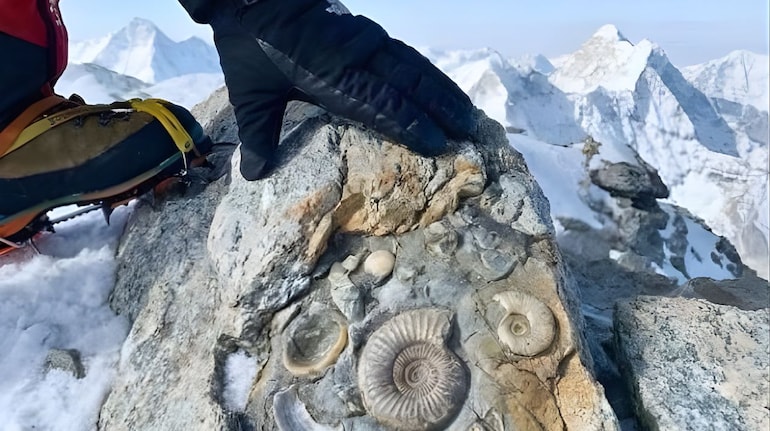

Photos of marine fossils on Mount Everest recently attracted millions of online views. The images show ancient sea creatures preserved inside limestone rocks. These fossils appear near the summit of Earth’s tallest mountain. Scientists say the fossils reveal Everest’s surprising geological past.
They confirm the mountain once formed beneath an ancient ocean. Researchers say these fossils date back roughly 450 million years. The discovery highlights dramatic changes shaping Earth’s surface through time.
Evidence of an Ancient Seabed
Mt Everest’s summit rocks consist mainly of marine limestone deposits. These rocks formed when sediments accumulated across the ancient seabed. At that time, the region belonged to the vast Tethys Ocean.
This prehistoric ocean separated Asia from the drifting Indian continent. Marine organisms lived and died within those shallow ocean waters. Their shells and skeletons slowly settled into accumulating seabed sediments.
🚨: Mount Everest contains marine rocks, proving that the highest point on Earth was once at the bottom of the ocean pic.twitter.com/jqK5ucDyYj— Curiosity (@MAstronomers) March 8, 2026
Marine fossils were discovered near the summit of Mount Everest
Scientists and climbers have found fossils of ancient marine animals more than 8,000 metres above sea level. These fossils include remains of trilobites, crinoids and brachiopods.
The organisms that once lived in ancient oceans hundreds of millions of years ago. Their presence high in the Himalayas initially seems strange because Everest is the highest mountain on Earth.
This discovery is extremely Rare
Finding marine fossils at extreme altitudes is exceptionally unusual worldwide. Mountains rarely preserve clear evidence of ancient marine life. Yet Everest’s summit rocks contain remarkably well-preserved fossil remains.
Such discoveries are rare because erosion often destroys fossil evidence. They lived hundreds of millions of years ago beneath ocean waters.
What is the mystery behind Everest’s rocks?
Scientists explain the mystery through Earth’s ancient geological history. Everest’s rocks originally formed beneath the prehistoric Tethys Ocean. Millions of years ago marine sediments accumulated across the ocean floor.
Tiny shells and skeletons settled slowly into these sediments. Over time they fossilised inside layers of limestone rock. The real mystery involves how seabed rocks reached extreme altitude. The answer lies in powerful continental movements shaping Earth’s crust.
About 60 million years ago tectonic forces began lifting. This slow uplift eventually created the Himalayan mountain range. Everest became the highest point of this rising landscape.
The Himalayas are still changing today
The geological process that formed Everest has not completely stopped. The Indian plate continues moving northwards, keeping pressure on the Himalayas and slowly raising the mountains over time. At the same time, erosion from wind, ice and glaciers gradually wears the mountains down.
Researchers continue studying Everest to understand mountain formation better. The Himalayas are still rising several millimetres every year. This ongoing uplift shows Earth remains geologically active today.
Discover the latest Business News, Sensex, and Nifty updates. Obtain Personal Finance insights, tax queries, and expert opinions on Moneycontrol or download the Moneycontrol App to stay updated!
Find the best of Al News in one place, specially curated for you every weekend.
Stay on top of the latest tech trends and biggest startup news.





