






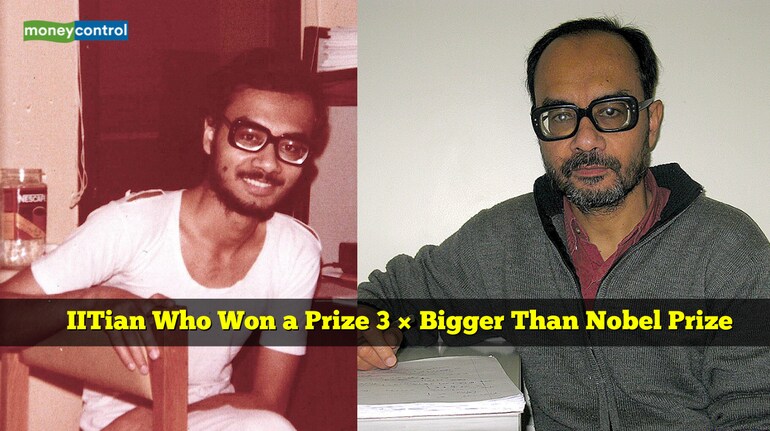

If you ever visit the Harish-Chandra Research Institute in Prayagraj, you might see an unassuming man pedaling a bicycle through the campus. He wears simple clothes and keeps to himself. You would never guess that you just passed one of the greatest physicists in the world—or that the man on the bicycle is a millionaire.
This is Professor Ashoke Sen, an Indian scientist who won a prize three times bigger than the Nobel, yet chose to live a life of remarkable simplicity.
Ashoke Sen was born in Kolkata in 1956. His father was a physics teacher at Scottish Church College, and his mother was a homemaker. Growing up, science was always respected in their household, but young Ashoke wasn't a child genius. He was simply curious.
Read Also - IITian Selling Tea After Layoff in US: Story of a Bihari Chaiwala in LA
He studied in a Bengali medium school until Class 11 and gave his board exams in Bengali. When he moved to college, he had to practice writing his physics answers in English because the tests were in that language. It wasn't always easy, but he worked at it.
After graduating from the famous Presidency College in Kolkata, he heard about a new institute called IIT Kanpur. Going there meant leaving home and moving to an unfamiliar city, but it also meant better opportunities. Along with one friend, he took the chance and went to IIT Kanpur. That decision changed his life.
From IIT, he went abroad for higher studies—first for a PhD in the United States, and then for research positions at top labs like Fermilab and Stanford. The world was his oyster. He could have taken a high-paying job in the US and lived a comfortable life.
But Ashoke Sen missed India. Despite receiving lucrative offers to stay abroad, he chose to return home. He joined the Tata Institute of Fundamental Research (TIFR) in Mumbai in the late 1980s. Later, in 1995, he moved to the Harish-Chandra Research Institute in Prayagraj (then called Allahabad). There, away from the noise of big cities, he buried himself in his work.
At that time, scientists were struggling with something called "string theory"—a complex set of ideas trying to explain the basic laws of the universe. Professor Sen's work in the 1990s was groundbreaking. He came up with new concepts, including the famous "Sen Conjecture," which helped connect different versions of string theory. His insights were so important that they sparked what experts call the "second superstring revolution."
In simple words, he helped rewrite the rules of theoretical physics.
In 2012, Professor Sen got a phone call that would shock anyone. He had been awarded the inaugural Breakthrough Prize in Fundamental Physics. The prize money? Three million dollars. To put that in perspective, it was nearly three times the cash award given with a Nobel Prize.
Suddenly, the quiet professor cycling to work was a millionaire.
Everyone expected his life to change. Would he buy a fancy car? A big house? Maybe retire in luxury?
They didn't know Ashoke Sen.
He donated a large chunk of the money to help students and support scientific research in India. And the very next day, he got on his bicycle and pedaled back to his small, modest office. There, he picked up a piece of chalk and went back to writing equations on his blackboard.
For him, the joy was always in the work—in the quiet satisfaction of solving a puzzle that explains how the universe works. The millions were just a way to help other young scientists follow their dreams.
Professor Ashoke Sen’s story teaches us something valuable. In a world obsessed with wealth and showing off, true greatness often comes in quiet packages. It comes in the form of a man who could own a fleet of cars but chooses two wheels, who could sit on any boardroom in the world but prefers a dusty blackboard.

Discover the latest Business News, Sensex, and Nifty updates. Obtain Personal Finance insights, tax queries, and expert opinions on Moneycontrol or download the Moneycontrol App to stay updated!
Find the best of Al News in one place, specially curated for you every weekend.
Stay on top of the latest tech trends and biggest startup news.





