






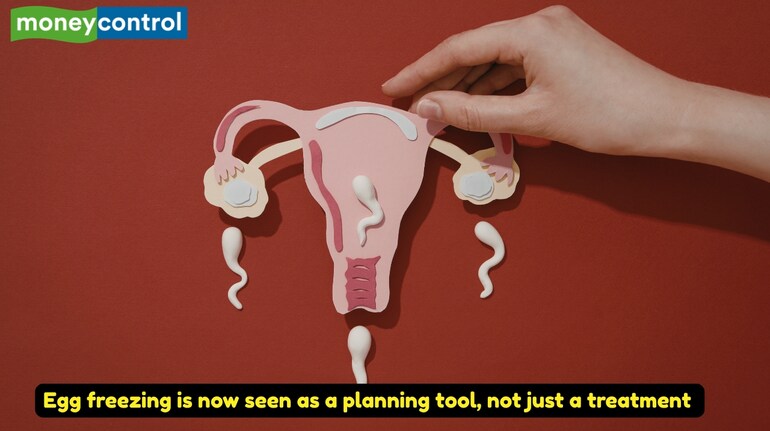

Something has quietly shifted in how women are now planning their lives. Over the past decade, many have arrived at their early thirties with a stable career, financial independence and a clearer sense of who they are, before the question of parenthood becomes pressing.
Dr Spandana Nuthakki, Fertility Specialist at Birla Fertility & IVF, Hyderabad, said, “From a social standpoint, this reflects meaningful progress. From a biological one, however, the reproductive clock has not kept pace. It is this tension that is bringing egg freezing into conversations far earlier than before.”
Female fertility is deeply tied to age. “Women are born with a finite number of eggs, and by puberty the ovarian reserve has already declined significantly, continuing to fall each year after that. What often surprises patients is that egg quality begins to change even before fertility visibly dips,” Dr Nuthakki noted. Research published in Human Reproduction shows that the likelihood of chromosomal abnormalities in eggs increases gradually after the early thirties, which helps explain why conception rates fall and miscarriage rates rise with age.
She added, “This is where egg freezing offers something different: it functions as a planning tool, not just a treatment. Modern vitrification techniques allow eggs to be preserved at a younger biological stage and used later if needed.”
Studies of large vitrification programmes have shown survival rates of over 90% when eggs are thawed in experienced laboratories, a significant improvement from even a decade ago, and one that has reshaped confidence in the procedure.
That said, egg freezing is not a guarantee, and it should never be presented as one. “Outcomes depend on several variables, including the age at which eggs are frozen and the number retrieved,” Dr Nuthakki said. For these reasons, many specialists consider the early thirties to be the most favourable biological window.
Ultimately, what matters most is awareness and timing. Many women first hear about fertility preservation when they are already facing time pressure, which turns what could be a considered decision into a reactive one. When conversations about reproductive timelines begin earlier, that changes. Egg freezing is not about delaying motherhood. It is about preserving the freedom to choose, in a life where personal timelines are no longer one-size-fits-all.
Also read: Doctor says these 3 medicines can save a heart attack patient
1. What is egg freezing?
Egg freezing, medically known as Oocyte Cryopreservation, is a process in which a woman’s eggs are collected, frozen, and stored for future use. The eggs can later be thawed, fertilised, and implanted during fertility treatments.
2. Why do women choose egg freezing?
Women may opt for egg freezing to preserve fertility if they plan to delay pregnancy due to career goals, personal reasons, medical treatments, or because they have not yet found a suitable partner.
3. At what age should someone consider egg freezing?
Fertility specialists generally suggest that egg freezing works best when done in the late 20s to early 30s, when egg quality and quantity are typically higher.
4. How does the egg freezing process work?
The process involves hormone injections to stimulate the ovaries, monitoring through scans and blood tests, retrieval of mature eggs from the ovaries, and freezing them for future use.
5. Is egg freezing painful?
The hormone injections may cause mild discomfort or bloating, and the egg retrieval procedure is usually performed under sedation, so pain is generally minimal.
Disclaimer: This article, including health and fitness advice, only provides generic information. Don’t treat it as a substitute for qualified medical opinion. Always consult a specialist for specific health diagnosis.
Discover the latest Business News, Sensex, and Nifty updates. Obtain Personal Finance insights, tax queries, and expert opinions on Moneycontrol or download the Moneycontrol App to stay updated!
Find the best of Al News in one place, specially curated for you every weekend.
Stay on top of the latest tech trends and biggest startup news.





