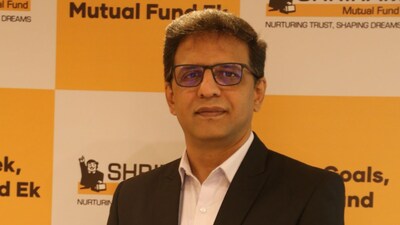
Daily Voice: RBI might delay future rate cuts given weak rupee, uncertainty over Trump tariffs, says Shriram AMC's Deepak Ramaraju
The possibility of FIIs returning strongly in FY26 looks good driven by India's robust GDP growth, rising corporate profitability, and government policies supporting investment, said Deepak Ramaraju.

Chartist Talks: SBI Securities' Sudeep Shah sees no possibility of FMCG index bottoming out soon, bets on these 2 stocks
The momentum indicators and oscillators suggest strong bearish momentum in the Nifty FMCG index, Sudeep Shah said.
Daily Voice: Ashika Global's Amit Jain cautious about Nifty crossing 27,000 in 2025, even though India's fundamentals remain strong
Amit Jain of Ashika Global Family Office Services foresees several risks that could disrupt the equity markets in the short to medium term. Potentially, a US market correction is the key risk for the Global Stock Markets including India.
The IPO gold rush in Edtech is worrisome, many are mistaking it for easy capital, says Ronnie Screwvala
Operating at a revenue run rate of Rs 2,400 crore, upGrad is targeting a steady 35 percent CAGR over the next decade, with a balanced expansion across domestic and global markets, Co-founder and Chairperson Ronnie Screwvala told Moneycontrol.
Daily Voice: Sharp decline in food prices likely to bring CPI inflation down to around 4.5% in Jan, says this fund manager
The budget has the potential to lay a strong foundation for the equity market, said Alok Ranjan of ITI Mutual Fund.
US’ change in climate change policy won’t affect India’s energy transition journey: ReNew’s Sumant Sinha
Sinha said the Union Budget for FY26 aims to achieve high-impact growth while keeping the fiscal deficit within the 4.4 percent target, ensuring macroeconomic stability
Daily Voice: Supportive fiscal measures in Budget and potentially dovish RBI policy may drive economic recovery, says Navneet Munot
Continued focus on ease of doing business will certainly instil confidence in investors – domestic and foreign alike, said Navneet Munot.
MC Interview: Growth impulse from Budget positive for FY26, focus now on corporate earnings, says Kotak AMC's Shibani Kurian
The Budget FY26 delivers on the 3Cs supporting middle class consumption, increase in capex through centre, state and PSU allocations even while continuing to walk on the path of fiscal consolidation, said Shibani Kurian.
Daily Voice: 100% FDI in insurance unlikely to significantly change competitive landscape, says Manish Gunwani of Bandhan AMC
The budget does provide a fairly strong boost to urban consumption via tax cuts, said Manish Gunwani.
Daily Voice: This CIO rates budget an '8 out of 10', believes FY26 fiscal deficit target appears achievable
Post-budget, portfolio adjustments are anticipated, leading to a more balanced distribution across investment-related sectors, consumer goods, financials, and export-oriented industries, said Shailendra Kumar.
Chartist Talks: Ashish Kyal advises buying these 2 stocks post Budget
Over short term we can expect market to consolidate between 23,630 to 23300 levels before resuming he positive trend, said Ashish Kyal.
Daily Voice: Apart from consumption-oriented themes, these 6 sectors appear to benefit from Union Budget, says Anil Rego of Right Horizons
With a focus on boosting domestic electronics manufacturing, expanding nuclear energy, and supporting MSMEs, the government is creating significant investment opportunities across these sectors., said Anil Rego of Right Horizons.
Daily Voice: Equirus' Ashutosh Tiwari bets on private capex revival post-budget, rules out RBI rate cut
Government has tried to address one of the biggest concerns emerging in the economy over the last few quarters – consumption, especially urban consumption, said Ashutosh Tiwari.
Daily Voice: Private capital expenditure expected to be key focus area in Budget 2025, says this investment advisor
The government is most likely to focus on both consumption boost as well as economic expansion in the union budget, says Narinder Wadhwa.
Daily Voice: Aggressive divestment plan unlikely in Budget, time to pick chemical stocks, says Green Portfolio's Divam Sharma
On the RBI policy next week, Divam Sharma believes rate cut seems highly likely, considering the current liquidity situation and falling inflation globally.
Daily Voice: Public capex to drive FY26 growth; February rate cut likely, says fund manager
In the short term, markets are expected to remain volatile, driven by news flow, liquidity, economic outlook, and geopolitical events, said Karan Doshi.
Daily Voice: Market unlikely to flinch if FY26 fiscal deficit rises for growth, says this investment head
The RBI's recent bond purchases have raised expectations of a possible rate cut in February, signaling its focus on supporting growth amid economic uncertainties, said Vivek Sharma.
Daily Voice: Need short-term measures in Union Budget 2025 to stimulate demand and support consumption recovery, says Bajaj Finserv AMC's Nimesh Chandan
Nimesh Chandan of Bajaj Finserv AMC believes this year to be a challenging year for RBI.
Daily Voice: Vikas Khemani believes finance minister has a tough job balancing socialist and capitalist priorities in Budget 2025
Vikas Khemani does not believe that FM choosing for a higher fiscal deficit target for FY26 will be seen as a major negative by markets, if the measures taken point towards economic growth revival.
Chartist Talks: Sudeep Shah of SBI Securities sees Nifty testing 22,800 support next week, bullish on these 3 stocks
The Nifty 50 continues to underperform its global counterparts, which adds to the overall negative sentiment. This clearly indicates bearish momentum in the index, said Sudeep Shah.
Daily Voice: Incentivizing green energy, attracting foreign investment likely seen in Budget 2025, says this fund manager
According to Rishabh Nahar, the equity markets could continue to experience extreme volatility following the budget.
Daily Voice: HDFC AMC's Rakesh Sethia believes govt to achieve FY25 fiscal deficit target and likely to maintain 4.5% target for FY26
Overall, the commitment to the fiscal consolidation path supports more favourable borrowing conditions for corporates, said HDFC AMC's Rakesh Sethia.
Daily Voice: Budget must balance tax reforms, fiscal discipline, strategic investments to sustain growth, says Equentis Wealth founder
To sustain growth and investor confidence, the government should maintain fiscal discipline by achieving the FY26 fiscal deficit target of 4.5% of GDP, prioritize a 10-15% capex increases for economic and infrastructure growth, and set a clear long-term debt-to-GDP target, said Manish Goel.
Daily Voice: This portfolio manager sees strong economic growth in Q3FY25, further correction in mid-smallcaps
According to Ashwini Shami, the midcap and smallcap segments are trading at significantly higher levels than their respective 5-year averages.
Daily Voice: Dramatic fiscal stimulus measures unlikely in budget, bullish on these 7 megatrends, says Enam AMC's Jiten Doshi
The Indian equity market presents a mix of opportunities and challenges in CY25, said Jiten Doshi of Enam AMC.