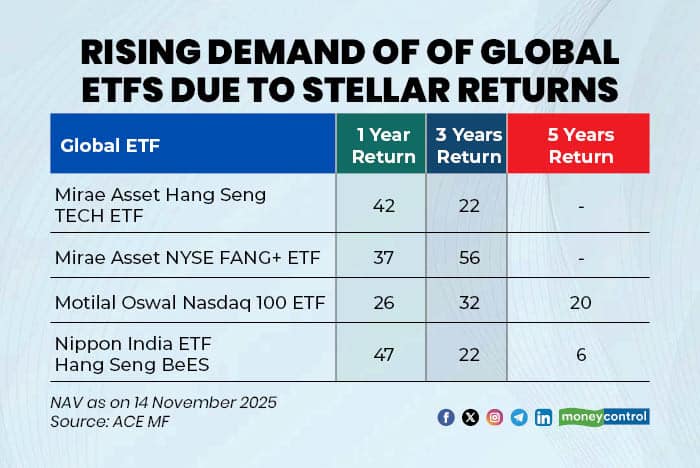
Indian investors continue to crave exposure to the world’s biggest stocks, especially after the strong performance of the international markets and recent tech rallies. But as mutual funds still cannot make new overseas investments, most usual paths to global markets have disappeared.
With limited choices left, investors are flocking to the global exchange-traded funds (ETFs) on Indian exchanges that track global indices.
There’s just one problem. These ETFs are now trading at premiums. And those premiums could ultimately eat into returns, even if the underlying global stocks continue to perform well.
“If an ETF’s market price is much higher than its net asset value (NAV), investors in India are paying a premium, meaning you get less exposure for your rupee, and if the premium falls, your returns could turn negative even if global stocks rise,” said Col Sanjeev Govila (retd), Certified Financial Planner, CEO, Hum Fauji Initiatives, a financial advisory firm.
Last month Silver ETFs were also trading at a premium because of shortage of the supply. It was a case of FOMO buying, as investors were piling into silver ETFs because they didn’t want to miss out, even though the underlying spot market was showing signs of short-term overheating.
This time global funds have caught the fancy of investors. “These premiums are worsened by RBI overseas investment limits, resulting in a shortage of new ETF units and crowd-driven buying, plus time zone and arbitrage inefficiencies that keep prices out of sync, explains Govila.
Why are global ETF's trading at a premium
With mutual funds already hitting their overseas investment limits, most global schemes remain shut for new inflows.
Yet, since they continue to trade on the exchanges, investors are free to buy whatever units are already in circulation. This has increased demand into a handful of popular global ETFs.
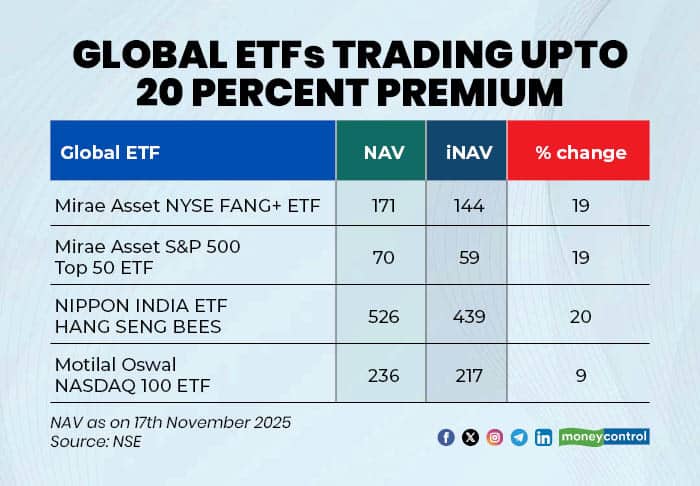
Under normal circumstances, ETF prices should hover close to their NAV. But as demand is soaring, prices have decoupled sharply from their real worth. This divergence is evident when comparing the ETF’s market price with its iNAV, the real-time value of its underlying stocks.
The premiums are striking. On November 17, Mirae Asset FANG+ ETF traded at more than a 20 percent premium to its NAV. Mirae Asset S&P 500 Top 50 ETF quoted at a similar markup, while Nippon India ETF Hang Seng BeES traded nearly 20 percent higher.
For investors, this means paying significantly more than the fund’s true value. And while a stable premium causes no harm, it rarely stays that way. Eventually, ETF prices gravitate back to their NAV. When that happens, any decline in the premium directly hits investor returns.
Why buying at a premium is risky?
When you buy a global ETF at a high premium, you are basically paying extra for the same product.
"When international ETFs are trading at a significantly higher price compared to their iNAV, investors are actually paying a premium over the actual worth of the underlying assets. This occurs mainly due to SEBI’s limits, which have not only limited new unit creation but have also increased demand," says Rajesh Minocha, CFP, Founder - Financial Radiance.
Even if the ETF’s actual value (iNAV) goes up later, you may not benefit because the premium you paid can shrink or disappear by the time you sell.
So your returns can drop sharply or even turn into a loss despite the ETF performing well. In simple terms, if you overpay at the start, the ETF has to rise a lot more just for you to break even.
The distortions don’t end with ETFs. Investors in the fund-of-funds (FoF) versions of these same schemes are also getting misleading signals.
What investors should do
With the Reserve Bank of India (RBI) holding firm on overseas limits, investors are looking to diversify need to look at other avenues.
"Investors, particularly those with shorter time horizons, should avoid getting involved in the race for overpriced stocks and instead wait for the premiums to cool down or consider alternatives, such as Gift City or direct global investing, for the purpose of diversification," says Minocha.
Moreover, investors should always compare an ETF's iNAV with live market price before transacting and use limit orders and avoid buying large chunks at steep premiums, said Col Sanjeev Govila (retd).
Until regulations ease, investors chasing global themes must navigate these premium traps carefully. The underlying markets may perform well but if you have overpaid on entry, the payoff may not reach you.
Discover the latest Business News, Sensex, and Nifty updates. Obtain Personal Finance insights, tax queries, and expert opinions on Moneycontrol or download the Moneycontrol App to stay updated!
Find the best of Al News in one place, specially curated for you every weekend.
Stay on top of the latest tech trends and biggest startup news.