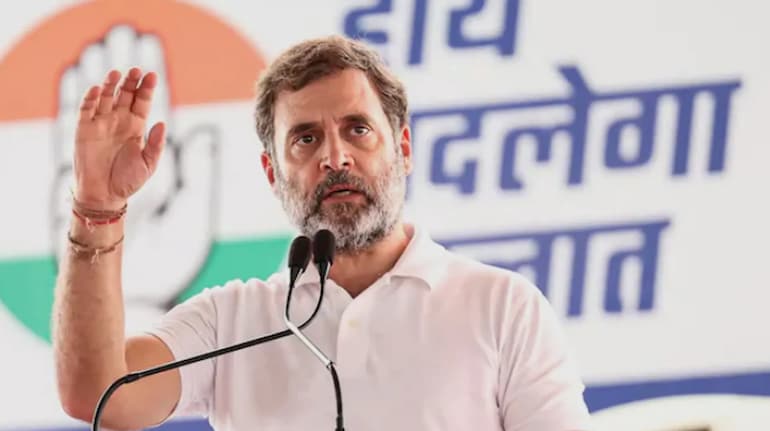
Hours after the Union government stumped Opposition leaders, especially the Congress, with the surprise announcement of inclusion of caste enumeration in the upcoming decennial census, Congress leader Rahul Gandhi welcoming the move, directed the Centre to release a timeline for its execution and urged the Centre to form a committee that could visit Telangana to study their caste survey model.
The Leader of Opposition in Lok Sabha went on to highlight the success of the Telangana caste census and reasoned how the process was non-erroneous and free from political interference. The former Congress president elaborated that prior to the caste enumeration in the southern state, elaborate consultations were held with all sections of society, following which 57 questions were prepared for collecting data during caste census. The data of each family was collected through these questions.
While announcing the Cabinet's decision to enumerate caste in the next Census, Union Minister Ashwini Vaishnaw made it a point to argue that the 2011 socio-economic and caste census (SECC) and caste enumeration exercises conducted by state governments were just “surveys”.
“The Census is a Union subject, but some states have done it (caste enumeration). Some States had done it well, while some States have done this purely from a political angle in a non-transparent manner,” Vaishnaw said at the press briefing, in a reference to Bihar, Karnataka and Telangana governments which have tried to enumerate caste.
In light of Vaishnaw's comments on how states failed to accurately capture the existing caste realities, and Rahul Gandhi's singular emphasis on the success of Telangana model, it is worthwhile to take a look at each of these states to get a fairer reading of their caste studies.
Why is Rahul Gandhi rooting for Telangana model?
Reiterating his commitment to conducting a caste census in the country, Gandhi said that it would not be like the one conducted in Bihar but on the lines of that carried out in Telangana.
In his presser, Gandhi, hailing the mechanism behind Telangana caste study, said that as part of the exercise to collect data, the state was divided into 95,000 units. A total of 95,000 enumerators were appointed and each enumerator visited 150 houses to collect the data during this 60-day-long exercise. The state government had also appointed a supervisor for every 10 enumerators.
Rahul added that 96% of the population was covered by the caste census and in view of the demands to cover the remaining four per cent of people, the government provided a toll-free number to enable the families not covered earlier to give their details.
Main findings from Telangana caste census
Telangana's Socio, Economic, Education, Employment, Political and Caste Survey, dubbed as the caste census, has revealed that Backward Classes (except Muslim BCs), make 46.25% of Telangana's population, thereby making them the largest social group in the state. Following the BCs, the report reveals that Scheduled Castes (SCs) account for 17.43%, Scheduled Tribes (STs) make up 10.45%, and Muslim BCs constitute 10.08% of Telangana's population. Following the BCs, the report reveals that Scheduled Castes (SCs) account for 17.43%, Scheduled Tribes (STs) make up 10.45%, and Muslim BCs constitute 10.08% of Telangana's population. Currently, BC reservations in Telangana local bodies stand at 23%, and the Congress had promised to increase it to 42% within six months of assuming power.
The picture from Bihar
The 216-page report was built on the demographic details, with additional information on income, employment, vehicle ownership, housing details, educational qualifications, residential status and laptop ownership. The report found that 9.4 million families earned less than Rs 6,000 per month, accounting for 34.13% of 27.6 million families in the state and adding up to a total population of 130 million. Only 3.9% of the state earned more than Rs 50,000 a month.
The survey, also found that 42.93% of scheduled castes (SCs) earned less than ₹6,000 a month – considered by the government as poor. 42.7% of scheduled tribes (ST), 33.58% of extremely backward classes (EBCs), 33.16% of backward castes and 25.09% of general categories were found to be poor.
The report found that among general categories, Bhumihars, a landowning caste with significant political influence, had the highest proportion of poor households at 27.58%, and Kayasthas, at 13.83% the lowest. But they were better off than other backward classes (OBCs), where the largest caste, Yadavs, had 35.87% families classified as poor. 34.32% of Kushwaha families and 29.9% of Kurmi households were found poor. Major EBC groups such as Teli and Mallah had 29.87% and 34.56% poor, respectively.
Findings from Karnataka
In a recently approved report, it has been revealed that during the Socio-Economic and Education Survey conducted in Karnataka in 2015, approximately 2 lakh people stated that they did not know their caste name. This census took place during the first tenure of chief minister Siddaramaiah (2013-2018).
Furthermore, 1,34,000 people reported having no caste, while 1,94,000 individuals were unaware of their caste name. According to a PTI report, the caste census presented to the Karnataka cabinet has suggested increasing the reservation for Backward Communities from the current 32 per cent to 51 per cent. According to government sources, the Socio-Economic and Educational Survey, commonly referred to as the caste census, also indicated that the BC population constitutes 70 per cent. The report recommended that 51 per cent of reservations be allocated to BCs in state educational institutions.
The report was submitted to the chief minister on February 29, 2024. Dominant communities such as the Lingayats and Vokkaligas have expressed concerns over the survey’s methodology and findings, fearing that the data may not accurately reflect their population sizes. Siddaramaiah has indicated that the government intends to accept the report but has not specified when it will be made public.
Discover the latest Business News, Sensex, and Nifty updates. Obtain Personal Finance insights, tax queries, and expert opinions on Moneycontrol or download the Moneycontrol App to stay updated!
Find the best of Al News in one place, specially curated for you every weekend.
Stay on top of the latest tech trends and biggest startup news.