
These days, investors in equity markets are having a rollercoaster ride. S&P BSE Sensex and NSE Nifty have dropped by over 20 percent from highs after news on loan default by Infrastructure Leasing & Financial Services (IL&FS), coupled with rising crude oil prices and depreciating rupee against dollar. As per the current scenario of the bearish market, passive funds are snatching the limelight from active funds.
Active funds are those funds which are maintained to outperform the market, to give their investors returns better than the market, but these funds do not promise or guarantee the continued and regular out-performance. On other hand, passive funds are those funds which eventually invest in the index stocks in the same ratio as the stocks have weighed in the index, which means that these stocks are maintained to give the market return and no better or below than that.
Whenever the market turned bearish, the probability of the index performing well then the stock picking active funds is higher. Abhinav Angirish, Founder, Investonline.in, said: "In the current scenario, when the market is bleeding, the passive funds are good to invest in as the active stock picking funds are underperforming." Financial experts advises investors to effectively allocate their investments to active as well as passive funds, but when the disruption takes over, it is better to increase the investment allocation to passive funds from active funds.
In the current scenario, Angirish said investors should allocate 45-60% of their total portfolio to passive funds on higher volatility.
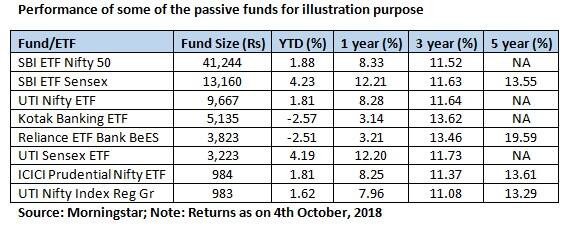
What is passive funds and who should invest? Passive funds could either be Index Funds or Exchange Traded Funds (ETFs). "This funds mirror a particular index, thus it becomes an easy choice for novice investors who do not have the understanding or wherewithal to pick actively managed funds," said Kaustubh Belapurkar, Director – Manager Research, Morningstar.
So, these funds are ideal for first-time investors who would like to take equity exposure.
"New investors should start investment in index funds like Sensex or Nifty and think passively. It would take time, but sooner, or later, it will reap great benefits for the investors," Rachit Chawla, Founder and CEO, Finway,
For instance, if the GDP is growing at 7% and inflation is at 6%, then the index should ideally grow at 13% in the long run which is a great return for investors.
"Passive funds should be included as a part of your portfolio construct, based on your risk appetite and other factors. The choice of opting for passive over actively managed funds is purely at a portfolio level and should not be based on market movements," said Santosh Joseph, Founder & Managing Partner, Germinate Wealth Solutions LLP.
Increasing inflows to passive funds In developed countries like the US, in India too most active managers in active funds fail to beat the benchmark and thus over the last few years passive funds have been witnessing increased flows as compared to actively managed funds. Belapurkar said, “Once the assets under management (AUM) of the Indian fund industry grow multifold, the alpha will start shrinking and thus we will see a migration towards funds. But that is still some time away.”
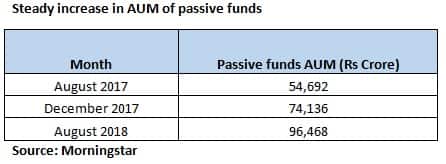
The Indian ETF markets have crossed the $12 billion mark and the space has witnessed a steady growth. Koel Ghosh, Business- Head, South Asia, S&P Dow Jones Indices & Asia Index said, “The boost provided by the Government via EPFO investing in ETFs and Bharat 22 ETF have supported the passive funds. Not only did the first tranche of the Bharat 22 ETF received a strong response but the second follow on offer was also well subscribed. The passive space is not only growing in terms of assets but variety as well.”
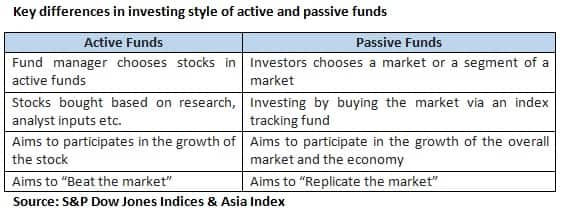
Expense ratio Active funds have higher expense ratios which means they charge a higher amount to maintain the portfolio. Whereas, passive funds have lower expense ratio in comparison to active funds. Studies show that active funds are no better than the passive funds in the long term and there is only one difference between both of them that active fund drained more money from the investor by giving no better than the average market returns.
Investing in passive funds can save the investor about 1.5%, which is the lower expense ratio in passive funds than active funds, and when these savings compounded it saves a lot more.
Discover the latest Business News, Sensex, and Nifty updates. Obtain Personal Finance insights, tax queries, and expert opinions on Moneycontrol or download the Moneycontrol App to stay updated!
Find the best of Al News in one place, specially curated for you every weekend.
Stay on top of the latest tech trends and biggest startup news.