




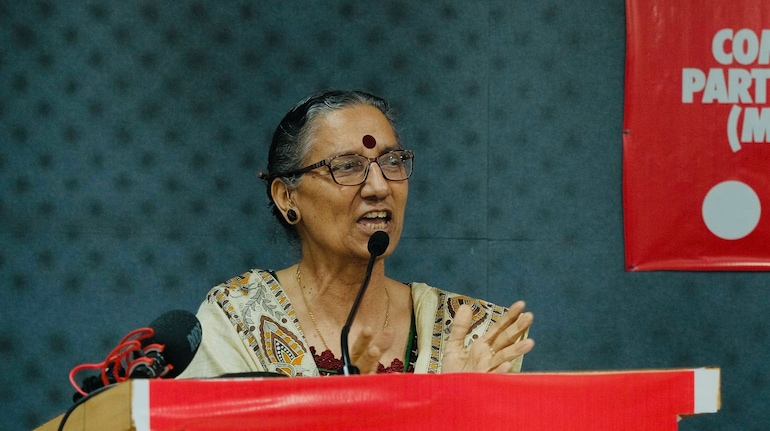
Layoffs in roughly 60–70 percent of industrial units across India will no longer require prior government approval under the new labour codes, All India Trade Union Congress (AITUC) General Secretary Amarjeet Kaur told Moneycontrol, questioning the basis for considering the changes “employee-friendly.”
"The Industrial Relations Code (IRC) has now made layoffs of workers much easier. The threshold for compliance with labour codes kicks in once the number of workers within a factory is over 300. But 60-70 percent units have fewer people in their workforce," Kaur said. "How can we say labour codes are employee-friendly then?"
Under the current IRC, only establishments with 300 or more workers need prior government permission, before laying off workers or shutting operations. Earlier, this threshold was 100.
Establishments with fewer than 300 workers now have greater flexibility to adjust their workforce without bureaucratic approval, provided they comply with the mandatory notice periods and compensation requirements.
Further, the tweaks to the Occupational Safety, Health and Working Conditions Code, 2020 (OSH Code) regarding the recognition of a "factory" have exempted smaller factory units from basic safety compliance measures, Kaur said.
According to the OSH Code, units with 20 or more workers which use power and units with 40 or more workers that don’t use power have to comply with the code. Earlier, the threshold was 10 for the former and 20 for the latter.
Once classified as a factory, the units must obtain a factory license, ensure compliance with specific health and welfare provisions (such as drinking water, sanitation, and first aid), and establish detailed rules on working hours and overtime, as well as on timely payment.
"The higher thresholds mean many units, impacting lakhs of workers, will not be compliant with labour laws," said Kaur.
She added that every worker needs different kinds of protection. "For instance, a worker in atomic energy sector would require different safety instruments from those who’re engaged in construction activity or electricity repair. But the Codes don’t have any mention of separate safety measures."
Kaur said that the OSH Code “has not subsumed all the provisions” of the Inter-State Migrant Workmen (Regulation of Employment and Conditions of Service) Act, 1979 (ISMW Act). "If the intention is to consolidate all laws, do it completely, or don’t."
Under the ISMW Act, the migrant worker was entitled to a ‘Displacement Allowance’ from the contractor, equivalent to 50% of the monthly wages (or a prescribed amount), paid at the time of recruitment. But under the OSH Code, this specific allowance has been omitted.
Also, the contractor, under ISMW Act, was legally required to issue a passbook to every migrant worker containing details of their employment, wages, allowances, and other conditions of service. The OSH Code, however, does not mandate a physical Passbook. While it requires the employer to maintain records and issue an appointment letter, the consolidated, portable Passbook specific to migrant workers is gone.
Regarding labour unions, she said the new recognition mechanism is "arbitrary, undemocratic, and anti-worker".
While the old law required a minimum of seven members to form a labour union, the IRC, 2020, introduces a stricter requirement--a trade union of workers must have a minimum membership of 10% of the workers in the establishment/industry, or 100 workers, whichever is less. "Why can’t 10 workers form a union. Why do they have no right to protest?" Kaur noted.
"Derecognition of unions has got easier now," she added.
Moreover, the IRC stipulates that the recognized-union must have the support of at least 51% of the workers for the purpose of negotiation with the establishment. Or else, a Negotiating Council must be constituted, comprising representatives from all registered trade unions that have the support of at least 20% of the workers.
On fixing minimum wages, Kaur said the government should fix it through a committee, which should include all members of labour unions. "But, if 60-70 percent units are shut without any approval…who will ensure timely payment of wages?"
Discover the latest Business News, Sensex, and Nifty updates. Obtain Personal Finance insights, tax queries, and expert opinions on Moneycontrol or download the Moneycontrol App to stay updated!
Find the best of Al News in one place, specially curated for you every weekend.
Stay on top of the latest tech trends and biggest startup news.




