






Dear Reader,
The Panorama newsletter is sent to Moneycontrol Pro subscribers on market days. It offers easy access to stories published on Moneycontrol Pro and gives a little extra by setting out a context or an event or trend that investors should keep track of.Donald Trump did not set out to make the world more cooperative. Yet, paradoxically, his tariff tantrums have done precisely that.
By turning trade into a weapon-slapping duties, tearing up arrangements, and threatening allies as casually as rivals, the US has pushed the rest of the world to look for insurance.
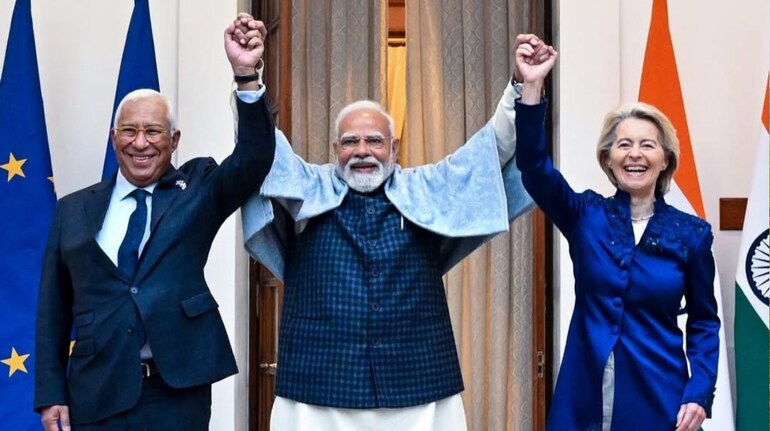
New trade corridors are being stitched together, deals fast-tracked, and old negotiations dusted off. The newly signed India-EU agreement must be read squarely in this context.
This is urvashee shapam upakaram—a curse that turns into a blessing.
Trump’s America-first economics has forced both India and Europe to hedge against US unpredictability. For Brussels, India offers scale, growth, and a democratic counterweight in a fragmented world.
For New Delhi, Europe provides market depth, technology, capital, and—crucially —diversification away from overdependence on any one bloc. The deal is less about romance and more about realism.
After nearly two decades of on-again, off-again talks, speed itself tells a story. What was earlier bogged down by disagreements over tariffs, data, labour standards and sustainability was suddenly propelled by geopolitical urgency.
Europe wants to reduce its exposure to US trade volatility and Chinese supply chains. India wants stable access to high-value markets at a time when global trade rules are becoming messier, not clearer.
On paper, the agreement looks impressive. Tariff reductions across a wide range of goods, better access for Indian services, investment facilitation, and deeper regulatory cooperation could all materially improve India’s export profile.
You can read more about this deal here and here.
Engineering goods, textiles, pharmaceuticals, chemicals and IT-enabled services stand to gain. For an economy that still struggles to break into global manufacturing value chains, Europe’s market—large, affluent and rules-based—offers a genuine opportunity.
But trade deals are won or lost not in summit photographs, but in execution. And this is where caution is warranted.
Some of the clauses that Europe considers non-negotiable—particularly around climate and sustainability—can easily turn into hidden trade barriers.
Carbon taxes, border adjustment mechanisms and stringent compliance norms may sound virtuous, but they risk penalising Indian exporters who operate in a very different cost and energy ecosystem. If carbon pricing becomes an indirect tariff, the promised market access could quickly narrow.
There is also the question of regulatory asymmetry. European firms are adept at navigating complex compliance regimes; Indian MSMEs are not.
Without serious domestic hand-holding — on standards, certification, logistics and finance — the benefits of the deal could accrue disproportionately to large firms, leaving smaller exporters squeezed out. Trade liberalisation without trade preparedness is a familiar Indian story, and not a happy one.
Then there is timing. Europe’s own economy is slowing, grappling with energy transitions, political fragmentation and demographic headwinds.
Demand growth may not be as robust as headline trade projections suggest. India, meanwhile, must ensure that it does not open sensitive sectors prematurely or concede policy space that it may need as its manufacturing ambitions evolve.
None of this negates the strategic value of the deal. In a world where the US is unreliable and China is assertive, India-EU cooperation makes geopolitical sense. It signals that India can still strike large, complex agreements without being boxed into binary choices. It also reinforces India’s claim to being a serious player in shaping post-US-centric trade architecture.
Yet optimism must be tempered with realism. Trump’s tariffs may have nudged the world towards each other, but they have not made trade easier — only more political.
The India-EU deal is an opportunity born out of disruption, not stability. Whether it becomes a growth engine or a missed chance will depend on how deftly India manages the fine print, supports its exporters, and negotiates future disputes.
For now, the curse has yielded a blessing. Whether that blessing endures will only be known with time.
The devil, of course, lies in the details.
Investing insights from our research teamEU-India FTA: Sectoral shake-up – Who gains, who loses?India–EU FTA: Not much impact on India’s mass passenger vehicle marketAsian Paints Q3 – Volume improves; pricing remains constrainedBruised but Not Broken: Stocks worth a bet amid the market weaknessMarico Q3 FY26: In-line performance, multiple growth triggersTata Consumer Q3 FY26: Growth businesses continue to deliverDCB Bank Q3 FY26: Earnings momentum builds, re-rating still has legsWhat else are we reading?Budget Snapshot | Why time is now the biggest creditor riskTrade as Strategy: Why the India–EU FTA belongs to today’s age of geoeconomicsWhy Japan’s yen intervention could rattle global marketsBig realty firms Q3 results show some cracks in luxury home salesCan BJP break Mamata's grip on Bengal in 2026?Physical or electronic bullion, where does the money lie?Investors bet on ‘hot’ US economy heading into mid-term elections (republished from the FT)Why the India–EU Trade deal finally happened and what it says about coercive trade practicesUnion Budget must spell out measures to strengthen corporate earnings growth, vital to bringing back FPIs and re-energizing the marketWhy this ‘Indian bear market’ should worry us a bitBudget 2026–27 calls for a stronger state-led capex pushIndia’s True Two-Front Battle: America and ChinaUnion Budget ideas to transform India’s citiesHow to win allies and get rich at the same timeBudget 2026 and the MSME Growth Agenda: Reducing compliance burden and enabling scale MarketsBudget 2026 Playbook: 5 triggers that could ignite a post-Budget market rallyTech and StartupsBudget 2026: Food delivery ecosystem pushes for tax relief as costs pressure mounts on restaurants
Technical Picks: RECLTD, NLCINDIA, NMDC, ONGC, BEL
Dinesh Unnikrishnan Moneycontrol Pro

Discover the latest Business News, Sensex, and Nifty updates. Obtain Personal Finance insights, tax queries, and expert opinions on Moneycontrol or download the Moneycontrol App to stay updated!
Find the best of Al News in one place, specially curated for you every weekend.
Stay on top of the latest tech trends and biggest startup news.




