






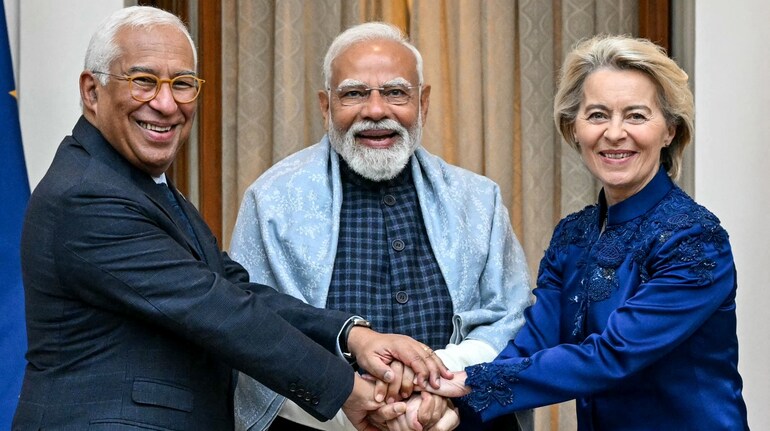
The India–EU free trade agreement announced on 27 January marks the end of nearly two decades of stop-start negotiations that began in 2007 under the banner of a Broad-based Trade and Investment Agreement.
Talks stalled in 2013 amid familiar disagreements over tariffs, intellectual property, agriculture and regulatory disciplines—most visibly India’s reluctance to slash duties on European cars and wine, and European concerns over market access and standards.
2025 marked an inflection point in negotiations
For much of the following decade, trade slipped down the bilateral agenda even as political ties strengthened. Although negotiations were formally relaunched in 2022, momentum only truly gathered last year.
The catalyst was escalating trade frictions, widening use of export controls, and the increasing use of punitive tariffs by the United States for strategic geopolitical ends. These developments forced both New Delhi and Brussels to rethink their economic partnership with each other.
De-risking benefit for both parties
For India, deepening engagement with its largest trading partner offered diversification at a time of rising uncertainty in global markets. For the European Union, closer integration with a fast-growing, geopolitically significant economy fitted squarely into its own “de-risking” strategy and search for reliable partners beyond China. This shared reassessment translated into unusually intense negotiating activity in 2025, culminating in political instructions to conclude the pact in time for the India–EU summit around Republic Day, at which leaders from both sides duly announced what they hailed as the “mother of all deals”.
A big deal is a message to others, particularly the US
trade agreements do not speak only to those who sign them. They also broadcast messages to others watching closely from outside the room.
One such audience is Washington. Over recent years the United States has relied heavily on punitive tariffs, sanctions, supply-chain conditionalities and export controls to advance strategic objectives—often sidestepping multilateral disciplines.
India has encountered this approach directly, including through tariff actions tied to energy and industrial policy choices. Efforts to explore a comprehensive US–India trade agreement didn’t make sufficient progress because New Delhi’s domestic red lines - on dairy, agriculture and data governance - were treated more as obstacles to be bulldozed rather than parameters to be negotiated.
EU chose a slower, institutionalised path
Not that Brussels didn’t have its own wish-list, borne out of the sensitivities of its Member-States, who were pressing for commitments on sustainability, labour standards, carbon emissions and regulatory cooperation. Yet, rather than pushing for rapid, unilateral concessions, the EU chose a slower, institutionalised path: phased tariff reductions, standing committees on standards, dispute-prevention mechanisms and dialogue on climate rules embedded in negotiated frameworks rather than imposed through broader measures.
That patience is written into the structure of the final agreement. The pact puts gradual liberalisation over shock therapy, cooperation over conditionality, and process over posturing. India and EU pursued their interests through patient negotiations rather than brinkmanship – the result of which was a deal that had eluded both sides for years.
There’s a lesson for the US
The implicit lesson for Washington is hard to miss. With a large, self-confident economy such as India, partnership and accommodation travel farther than rhetorical pressure or arm-twisting. India’s foreign policy has long been anchored in strategic autonomy, and the agreement with Europe reinforces that posture. It widens export options, enhances India’s appeal as a manufacturing hub, and demonstrates that ambitious trade deals can be concluded without surrendering regulatory sovereignty. For the United States, this should be read less as defiance than as demonstration: India will integrate, but on terms shaped through negotiation and political realism.
For American policymakers, the deal should invite reflection rather than irritation. Publicly framing a partner’s commercial ties as “financing a war”—even when aimed at third countries—risks turning economic engagement into a theatre of accusation rather than a platform for problem-solving. This jars with a US–India relationship that is otherwise deeper than ever, spanning defence production, critical minerals, semiconductors and Indo-Pacific security.
Yet the absence of a trade framework remains a conspicuous gap. Without one, bilateral commerce risks being shaped by episodic industrial-policy skirmishes and regulatory friction rather than predictable rules. Re-engagement would likely require recalibration: greater sensitivity to India’s domestic constraints, willingness to negotiate digital and regulatory disciplines, and acceptance that market access is inherently reciprocal. Persisting with pressure and selective decoupling may preserve strategic cooperation while nudging India’s economic integration further towards Europe and other partners.
The most important takeaway is that the method matters
The pact also sends a signal to a multilateral trading system that has struggled to adapt to today’s geopolitical rivalries. With WTO rule-making paralysed and dispute settlement crippled, power-based bargaining has increasingly displaced consensus-driven cooperation. By contrast, the India–EU agreement suggests that rule-oriented economic diplomacy still has life—at least among partners willing to invest time and political capital in it.
Ultimately, the most important message of the India–EU FTA lies in method rather than merchandise. It shows that even in an era of rivalry, countries still respond to reciprocal concessions and institutionalised cooperation. By choosing this route with Europe, India has clarified its preferences. And by succeeding where others stalled, Brussels has demonstrated that collaborative economic diplomacy can still command results in a world drifting steadily towards transactionalism.
(Shishir Priyadarshi, President, Chintan Research Foundation (CRF); former Director, WTO.)
Views are personal and do not represent the stand of this publication.
Discover the latest Business News, Sensex, and Nifty updates. Obtain Personal Finance insights, tax queries, and expert opinions on Moneycontrol or download the Moneycontrol App to stay updated!
Find the best of Al News in one place, specially curated for you every weekend.
Stay on top of the latest tech trends and biggest startup news.




