







India’s Budget for 2026–27 has to make an unambiguous policy choice given global growth uncertainty and private investment off the peak, with the state once again stepping forward as the principal growth catalyst. The strategy is not novel, as the government from time to time has pump-primed the economy towards its potential GDP to sustain economic momentum.
Scaling up public capital expenditure
At the heart of our proposal lies a substantial increase in government capital spending—about 2.6% of GDP 2024–25 (PE), or nearly ₹5 lakh crore over and above existing plans in the next five years—to target investment in productive assets, ranging from infrastructure and logistics to green energy, housing, manufacturing, digital systems, and human capital.
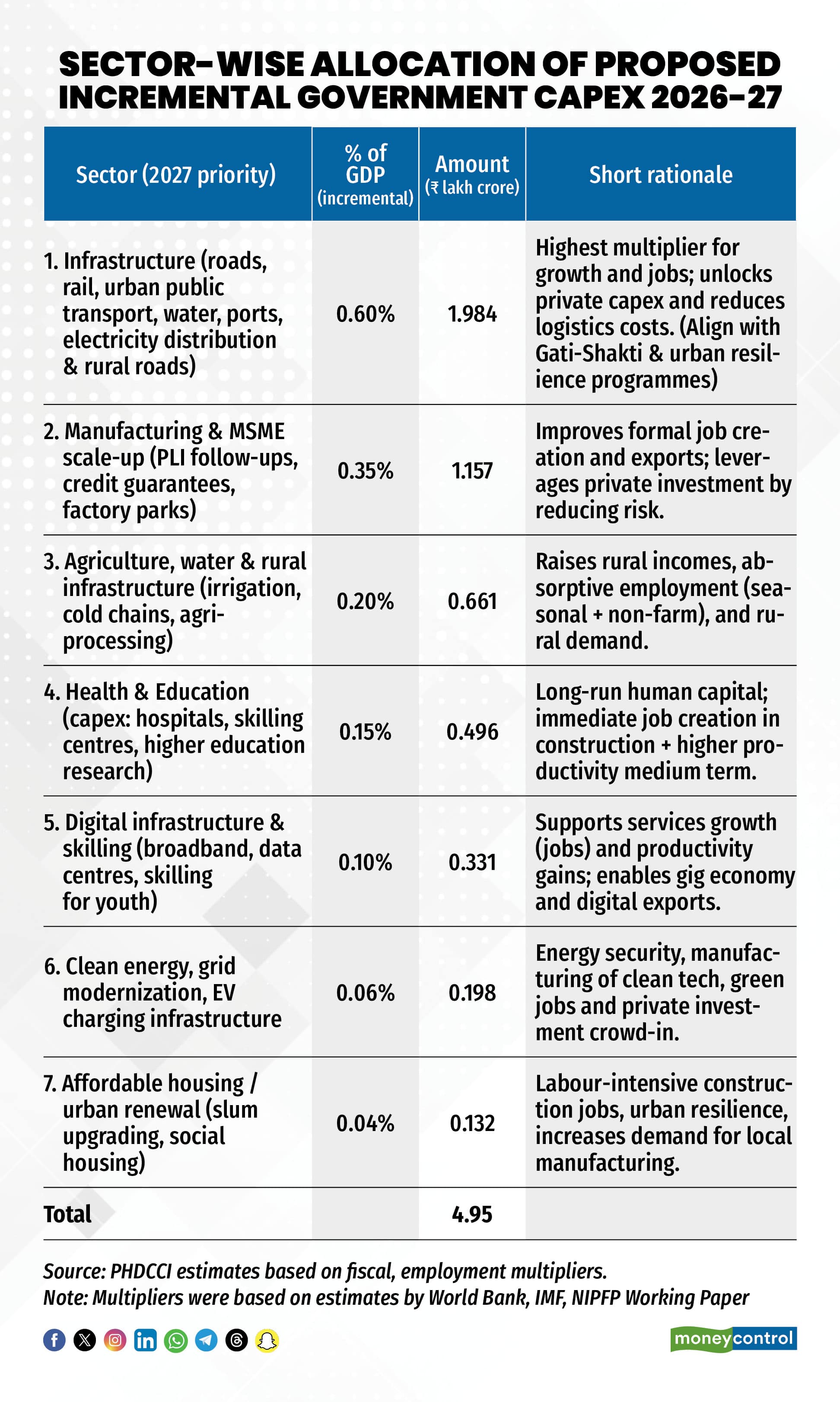
For the budget year 2026–27, an incremental capex of ₹2.98 lakh crore is proposed out of the estimated ₹5 lakh crore capex in the next five years. Empirical evidence shows capital expenditure multipliers peak in the first 2–3 years, especially when infrastructure gaps exist. The goal is to raise near-term demand while simultaneously expanding the economy’s productive capacity. Table 1 describes the allocation proposed by PHDCCI.
Growth multipliers and macroeconomic impact
Public investment has one of the highest fiscal multipliers in the Indian context. Construction activity, materials, transport, and services respond immediately, while better infrastructure lowers costs for businesses over time.
The macroeconomic logic is familiar. Public investment has one of the highest fiscal multipliers in the Indian context. Construction activity, materials, and transport services respond directly, and improved infrastructure will lower costs for businesses over time. According to our estimates, the incremental capital push could lift GDP by roughly 0.7–1.1 percentage points over the medium term, once lagged effects are accounted for through a decisive push.
Employment generation and private investment
Incremental employment generation was central to our budget proposal for pushing government capex. At a time when job quality and participation remain major policy concerns, our proposal is economically significant. Infrastructure and housing remain among the most labour-intensive sectors, absorbing large numbers of low- and semi-skilled workers. Our estimates suggest job creation, both direct and indirect, ranging from around 0.9 million to nearly 2.7 million over the coming years as a result of incremental government capex.
Though public investment is not a permanent substitute for private enterprise, improved logistics, reliable power, digital connectivity, and urban infrastructure reduce risk and enhance returns for businesses. The public capex push will untangle not only higher corporate investment but will also reinforce India’s attractiveness as an FDI destination and should not be viewed through the lens of displacing private spending.
Integrating growth with sustainability goals
One of the more distinct aspects of our 2026–27 proposal is its integration of growth policy with climate and sustainability objectives. Green, ESG, and Sustainable Development Bonds are positioned as financing instruments for renewable energy, green hydrogen, and energy transition projects aligned with India’s target of 500 GW of non-fossil capacity by 2030. Programmes such as the National Green Hydrogen Mission and solar rooftop expansion underline an attempt to combine fiscal expansion with global long-term decarbonisation goals.
The effectiveness of the strategy will depend on timely project rollout and coordination with states. But there are risks. Global financial conditions and commodity price volatility could complicate outcomes.
Conclusion: Capital formation over populism
In essence, our Budget 2026–27 proposal reflects a practical assessment of India’s growth constraints and opportunities. By prioritising capital formation over populism, the proposal reinforces the case for public investment as the link between today’s ambiguities and tomorrow’s growth.
(Dr Ranjeet Mehta, CEO & Secretary General, PHDCCI.)
Views are personal, and do not represent the stand of this publication.
Discover the latest Business News, Sensex, and Nifty updates. Obtain Personal Finance insights, tax queries, and expert opinions on Moneycontrol or download the Moneycontrol App to stay updated!
Find the best of Al News in one place, specially curated for you every weekend.
Stay on top of the latest tech trends and biggest startup news.




