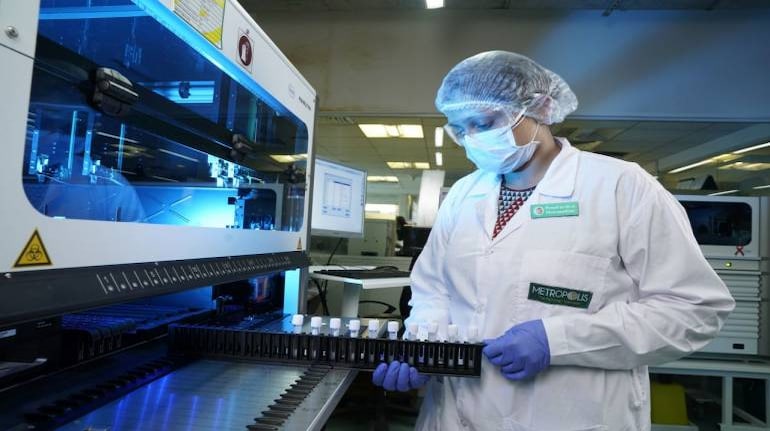
Metropolis Healthcare, one of India’s largest diagnostic chain, said it is sitting on huge idle COVID-19 testing capacity as states prioritise government laboratories over private ones.
"Private labs including Metropolis are operating at 30 percent capacity. We can actually carry out much more testing. For that, we obviously need a stronger partnership between the government and private players, which has not fully happened," said Ameera Shah, Managing Director of Metropolis Healthcare.
Metropolis is one among of the first private laboratories that received a licence from Indian Council of Medical Research (ICMR) to commence COVID-19 RT-PCR testing. The company has five fully equipped COVID-19 testing labs, of which two are in Mumbai Metropolitan Region (MMR) and one each in Pune, Chennai and Delhi. The company plans to add two more labs in Gujarat and Karnataka. These labs also test samples from other states as well.
"We can carry out 5,000 COVID-19 tests per day, we are not fully utilising our capacity. We can raise our capacity, but the government needs to indicate it will avail our services," Shah said.
Shah denied that cost has anything to do with the reluctance of government to utilise the testing capacity with private labs.
Metropolis, she said, is carrying out testing for state governments at a price lower than ICMR's price cap of Rs 4,500. She declined to offer specific details about what price Metropolis is charging state governments for COVID-19 testing, only saying the pricing differs from state to state.
Industry executives says that low testing in private labs could be because of state governments trying to wrest control over testing. "Some states are possibly keeping their testing numbers low as they don't have enough beds to treat patients," said an industry executive.
According to Worldometer, India is carrying out around 2,876 tests per 1 million population. Despite a ramp-up in recent weeks, India's testing is one of the lowest in the world. India's testing is slightly better than Mexico, Pakistan and Bangladesh, but much lower compared with Russia and Brazil which is carrying out 76,418 and 4,378 tests per 1 million popoulation, respectively.
Non-COVID testing remains low In contrast to the popular view that private diagnostic chains benefit from COVID-19 testing, Shah says the reality is different.
She said Metropolis' non COVID-19 testing business had suffered as there was little patient activity with hospitals postponing elective surgeries and reduced outpatient consultations. There are also issues of non-availability of transport and courier services during the initial phase of lockdown and employees had problems reaching labs.
Shah said towards second half of March and entire April large part of the lab network remained non-functional.
Metropolis' revenue in April was down to 40 percent of its normal trend. The company expects an improvement to around 75 percent of its normal trend by the end of June as the government eases lockdown restrictions.
Although not profit accretive, Metropolis said it expects COVID-19 testing will help cover its fixed cost and minimise the downfall in margin.
Cost-cutting initiatives, eyes acquisitions Shah said Metropolis has reduced fixed and semi-variable costs to Rs 21-22 crore a month from Rs 28-29 crore. The company is also rationalsing its collection centres and anticipates this exercise to culminate in June or July. It expects this exercise will result in a 10-15 percent reduction in its collection network, which is not contributing meaningfully to revenue.
Shah expects COVID-19 to lead to faster consolidation in the Indian diagnostic industry, thus helping established diagnostic chains. Metropolis with its strong Balance Sheet, zero-debt and high cash, will look at expanding network through M&As, she added.
Metropolis has network of 124 laboratories and 2,731 patient service centres. The company ended FY20 with Rs 856 crore in revenues, a 12.6 percent growth year-on-year. Net profit rose 14.1 percent to Rs 147 crore in the same period.

Discover the latest Business News, Sensex, and Nifty updates. Obtain Personal Finance insights, tax queries, and expert opinions on Moneycontrol or download the Moneycontrol App to stay updated!
Find the best of Al News in one place, specially curated for you every weekend.
Stay on top of the latest tech trends and biggest startup news.