
Most days, the kitchen feels like the most predictable room in the house — a place where water bubbles, onions brown, and someone inevitably shouts from the living room asking when the chai will be ready.
But tucked between flour jars and soap bottles is something far less ordinary: a miniature laboratory hiding in plain sight.
Open a cupboard, and you’re suddenly a few ingredients away from bending light, breaking invisible forces, coaxing colours into motion and launching a rocket. You don’t need lab coats or fancy instruments — just curiosity and a willingness to spill a little.
You can pull a vanishing act all by yourself in your kitchen. Don't believe me, try this:
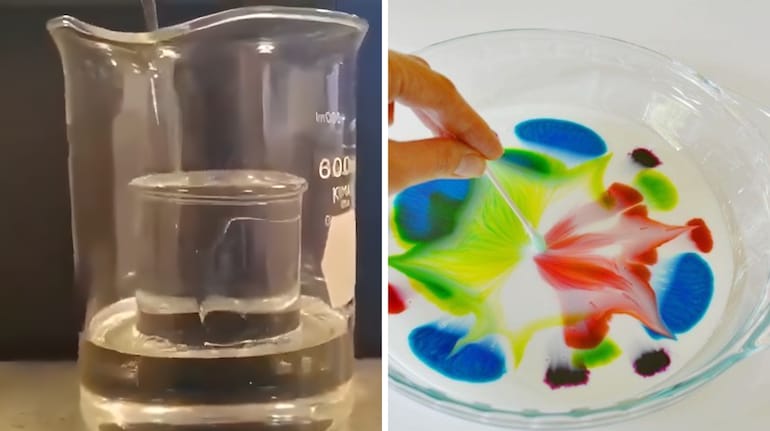
Pour vegetable oil into a clear bowl and gently lower a Pyrex cup or borosilicate rod into it. Watch how it seems to disappear into thin air.
Light travels at different speeds depending on what it’s passing through — air, water, oil, glass — and it bends as it changes speed. This bending is called refraction, and it is governed by a property called the refractive index — the ratio of the speed of light in a vacuum to the speed of light in a medium.
Also Read: Why do vadas have a hole in the centre? The quiet wisdom behind this South Indian staple
Vegetable oil and Pyrex glass have nearly identical refractive indices — roughly 1.47 — meaning light slows down the same amount in both. So light doesn’t bend at the boundary where they meet.
Without bending or scattering, your eyes can’t distinguish the glass from the oil — and the object simply disappears.
You are a wizard Harry!
It’s the same optical rule responsible for distorted pool floors and fiery sunsets.
Here's another trick to create your own magic mandala:
Pour milk into a plate, dot it with food colouring, and tap the surface with a cotton swab dipped in dish soap.
Suddenly, soft droplets burst into swirling galaxies of colour.
The culprit — or the hero — is surface tension.
Water molecules cling tightly to one another due to cohesion, creating an invisible elastic film across the surface. Milk, because it contains fat and proteins in addition to water, forms its own slightly weaker but still structured surface layer.
Soap is a substance that reduces surface tension. At the molecular level, soap molecules wedge themselves between water molecules, weakening their cohesive pull.
As soon as the soap touches the milk:
the surface tension drops in that spot,
milk molecules scramble away from the disturbance,
food colouring—just sitting on top—gets dragged with them.
What looks like art is actually molecules rearranging themselves as fast as possible.
The stillness was an illusion — until chemistry shook it awake.
Fancy yourself a Sherlock Holmes? With this trick, you can pass on secret messages.
Dip a cotton swab in lemon juice and write on plain paper.
Let the words dry and disappear.
Bring the paper close to a candle flame — and your message reappears, warm brown and glowing with mischief.
Lemon juice contains acids and natural sugars, colourless at room temperature.
When heated, these organic compounds oxidise — they react with oxygen in the air, breaking down and turning brown faster than the cellulose in the paper.
The paper is still burning slowly, but the lemon juice burns first and more visibly.
Invisible ink revealed by oxidation: science hiding behind childhood magic.
Also Read: Who is Mirumi? The Japanese 'palm-healing' bot everyone is talking about
Take three mugs: fill the two outer ones with coloured water, leave the middle empty.
Bridge them with folded paper towels, then walk away.
Over the next hour, water climbs the paper, crosses into empty space, and drips into the dry mug, seemingly defying gravity.
This is capillary action, a process powered by two forces,
Cohesion — water molecules sticking to each other
Adhesion — water sticking to the cellulose fibres in the paper towel
Because water molecules like each other and the surface they’re touching, they pull themselves upward through tiny channels in the paper — called capillaries — one tug at a time.
It’s the same trick plants use every second to haul water from soil to leaves sometimes several hundred feet high.
Your kitchen experiment is a tiny echo of the physics that keeps forests alive.
Thread a string through a straw, tape a balloon to it, blow it up and let go.
The balloon rockets forward along the string, usually accompanied by laughter.
This is Newton’s third law of motion distilled into its simplest form: for every action, there is an equal and opposite reaction.
Inside the inflated balloon is compressed air, when you release it,
Action: air rushes out the open end of the balloon
Reaction: the balloon is pushed forward in the opposite direction
Also Read: Simple physics trick to stop your dosa from sticking
The same principle powers jet engines, rockets and missiles; the only difference being it is with controlled combustion rather than exhaled breath and rubber.
Your kitchen experiment is a miniature version of what launches satellites, probes and astronauts into space.
With just five everyday setups, the kitchen becomes a classroom of forces, reactions and quiet laws shaping the world.
Science isn’t locked behind laboratory doors. It simmers in pots, hides in jars, swirls in glasses and waits patiently on countertops like an extraordinary lessons disguised in ordinary ingredients.
All it needs is a curious hand, a few minutes of wonder, and yes, a little bit of clean-up afterwards.

Discover the latest Business News, Sensex, and Nifty updates. Obtain Personal Finance insights, tax queries, and expert opinions on Moneycontrol or download the Moneycontrol App to stay updated!
Find the best of Al News in one place, specially curated for you every weekend.
Stay on top of the latest tech trends and biggest startup news.