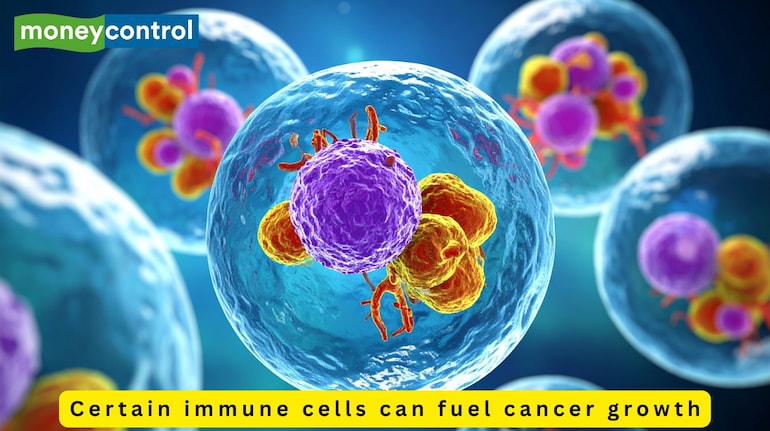

Immune cells are specialised cells in the body that help protect you from infections, diseases, and foreign invaders. They work together to identify and destroy harmful substances, like bacteria, viruses, and abnormal cells such as cancer cells. However, researchers at the University of Geneva reveal that neutrophils, the very cells you rely on to defend you, can help tumours grow instead of attacking them.
Led by Professor Mikaël Pittet, the team says tumours do not grow alone. They develop within a complex network of surrounding cells that constantly send chemical signals to each other, and within this environment, some cells change sides and begin supporting the cancer.
The change, researchers say, is driven by a small but powerful molecule called CCL3. Normally, neutrophils help fight infection. But inside a tumour, they start producing CCL3, which helps the cancer grow.
Professor Pittet describes CCL3 as another key factor in identifying how a tumour behaves. In 2023, his team linked two genes in macrophages to cancer progression. Now, neutrophils have also been identified as playing a role.
Neutrophils are among the most abundant immune cells in the human body. Their presence in tumours has often been associated with poorer outcomes. This new work suggests tumours actively recruit these cells and subtly reprogramme them. It is less invasion, more seduction.
Studying neutrophils is notoriously difficult to manipulate genetically. Evangelia Bolli, who led the experimental work, described the process as a delicate balancing act that controlls the CCL3 gene in neutrophils without disrupting other cells. By combining several experimental techniques, the team showed that when CCL3 was removed, the neutrophils still travelled through the bloodstream and gathered inside tumours, but they no longer egged the cancer on.
To strengthen their case, researchers searched through vast datasets from independent cancer studies. Spotting neutrophils within this genetic noise required fresh analytical tools. Their low gene activity often renders them practically invisible.
However, with refined methods, a pattern emerged, which suggested that across multiple cancer types, neutrophils frequently produced high levels of CCL3, closely linked with tumour-promoting behaviour.
By pinpointing CCL3 as a driver of tumour growth, scientists may be closer to mapping the limited set of variables that determine how aggressively a cancer behaves. It’s a step towards clarity in a field often clouded by complexity.
If CCL3 levels consistently signal more aggressive cancers, clinicians could potentially monitor this molecule as a warning sign, thus spotting when a tumour is likely to grow or spread.
Towards personalised treatment strategies: Understanding which immune cells have turned dangerous may help doctors tailor therapies more precisely, designing treatments that block harmful signals without dismantling the body’s broader immune defences.
Disclaimer: This article, including health and fitness advice, only provides generic information. Don’t treat it as a substitute for qualified medical opinion. Always consult a specialist for specific health diagnosis.
Discover the latest Business News, Sensex, and Nifty updates. Obtain Personal Finance insights, tax queries, and expert opinions on Moneycontrol or download the Moneycontrol App to stay updated!





Find the best of Al News in one place, specially curated for you every weekend.
Stay on top of the latest tech trends and biggest startup news.