Natesh Hegde’s sophomore film, Vagachipani (Tiger’s Pond), the second in a trilogy that started with Pedro (2021), stars Malayalam actor Dileesh Pothan and himself alongside his father Gopal Hegde. His films’ stories and ethos emanate from the immediate. Natesh, 29, says, he’s “attracted to a certain way of telling stories,” and “despite yourself being involved in it, you can have a clinical, subjective distance.” The film is competing in the Forum section of the 75th Berlinale and premieres on February 15. It is, reportedly, the first Kannada film ever to premiere at the prestigious Berlin International Film Festival.
Vagachipani has been shot by cinematographer Vikas Urs (also shot 2025 Sundance-winning Sabar Bonda), who’s always the first person to read Natesh’s scripts, and edited by Paresh Kamdar — Natesh’s go-to team. The 30-page-script Vagachipani, shot on 16 mm film/celluloid, has a shorter run time than the 25-page Pedro. Both were shot in 1.85:1 aspect ratio.
One of his co-producers Ranjan Singh (Ugly, Kennedy, Bhavesh Joshi Superhero, Udta Punjab, The Miniaturist of Junagadh) says, “Natesh is a young filmmaker with a fresh and unique voice, who makes films about his surroundings and observations in life, and he’s as passionate a filmmaker as the likes of Anurag Kashyap, Vikramaditya Motwane, Abhishek Chaubey, with whom I have worked and from them I’ve learnt a lot about every aspect of cinema.”
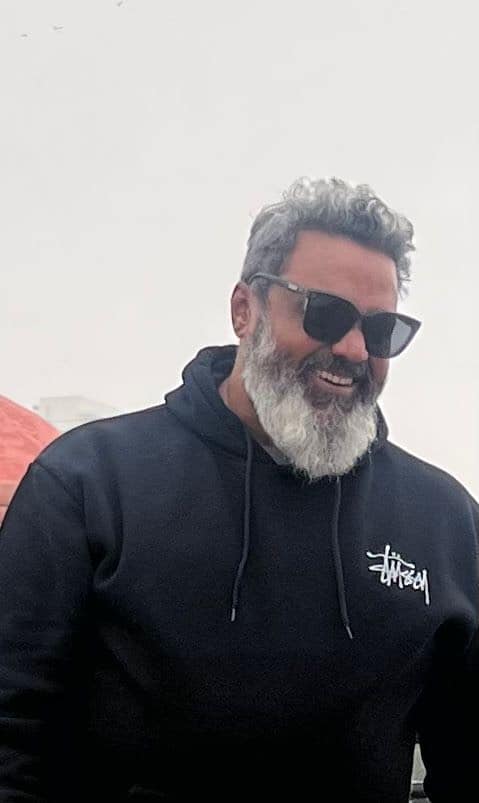 Ranjan Singh has co-produced Tiger's Pond.
Kashyap and Singh joined the film in its post-production stage after seeing a cut of the film. Singh was astounded, “The film (Vagachipani) has a fable kind of element in it, which, at one level, is so honest and simple, and yet it moves you emotionally by the end of it and that appealed to me the most,” he says.
Singh, who has a few films in the pipeline, of Kashyap, Prateek Vats and newcomers Shikha Makan and Vijayeta Kumar, plans to take Tiger’s Pond first to festivals across the globe and then hopes to find a platform in India to showcase it. They already have sales agent Loco Films spearheading this effort. Tiger’s Pond’s creative producer is the Singaporean Jeremy Chua, who’s “a fabulous co-producer to have on the film, and his experience does help in taking the film to the world,” says Singh.
Natesh Hegde, who lives between his Kotegalli village in Sirsi district and Bengaluru, talks about the making of Vagachipani, why he’s an outcast in the Kannada film industry & for whom he makes films. Excerpts:
What has been the learnings since Pedro as a filmmaker?
(Laughs) If I’d learn something, it would be subconsciously. Consciously, nothing.
The Tiger’s Pond story is set in your village?
We have shot in my village, which you can’t even locate on Google Maps. Vagachipani is a village next to mine. It’s a very small place. There’s a pond where tigers used to come to drink water. There are a few houses there.
You’ve adapted Vagachipani from a short story by writer Amaresh Nugadoni?
Yeah. The character of Pathi and the politician and his brother. His story is the root. But I changed a lot. The story I took from is called Dhare Uridhe. I’ve changed the setup and the whole gambling thing and the tiger god, everything came after that.
Why were you moved by Nugadoni’s story to make it into a film?
I was moved by the girl, the character of Pathi. When I was studying in college, I had seen that kind of a girl in my village, at the bus stop, a mentally challenged girl, who, as the weeks went by, her belly began to grow. Then when we returned after our holidays, she was not there any more. We don’t know what happened to her.
This character was on my mind. And then I read this story. You can take any place, whether in a village or city, you’ll see one such character.
You’ve not given a backstory to Pathi, the mute cowherdess.
If we see the whole procession thing, how the goddess is placed near the pond. It’s not a Vedic god. It’s a very tribal god created to ward off any tragedy that has befallen on a village, such as crops getting infected or anything else, they used to pray to this god and place the idol outside of their village so that all the bad omen goes away with this god. And the next village takes the god and they keep it in the outskirts of their village in the same way, it keeps moving and, like that, it gets discarded.
I wanted to create a parallel between these characters. So, I never tried to give a backstory to any of the characters. The point the film starts, that is their story, and their story ends with the film. The life beyond is there. But I don’t want to give an easy answer.
You’ve shown the women as working while men are just loafing around, plotting against each other, gambling on the streets.
Women are always working. They do house chores and all other work. They don’t go to cooperative society or small town to chill out in the evening. They are again making dinner for the family. So, they’re constantly working.
The world you create in your films is a man’s world.
It’s equally the woman’s world if you take the mother or Julie in Pedro or Pathi in this film, I never saw a stronger character than Pathi. She doesn’t talk but in the whole film, she is the only human figure. A very genuine human. How can we say that she’s not stronger? All the others are weaker characters. If you manipulate people [like the local politician], doesn’t mean you are powerful. You’re equally falling. It’s also a tragedy with you that you became this person. They are threatened by the whole environment, in how they are dealing with each other.
A palpable sense of fear and a menacing feeling stand grip your films. How would you define fear?
It’s difficult to articulate in words that’s why we are trying to create art, make films, to confront something.
How do you see power?
Just let me tell my story. Let me make my films. That’s the power I want.
And the breakdown of power in your cinema, what are you trying to say through that?
After watching my own films, what I observe is that there is no warmth between the characters and in the whole setup and in the telling of it. Maybe that’s my fear: that the warmth is not there.
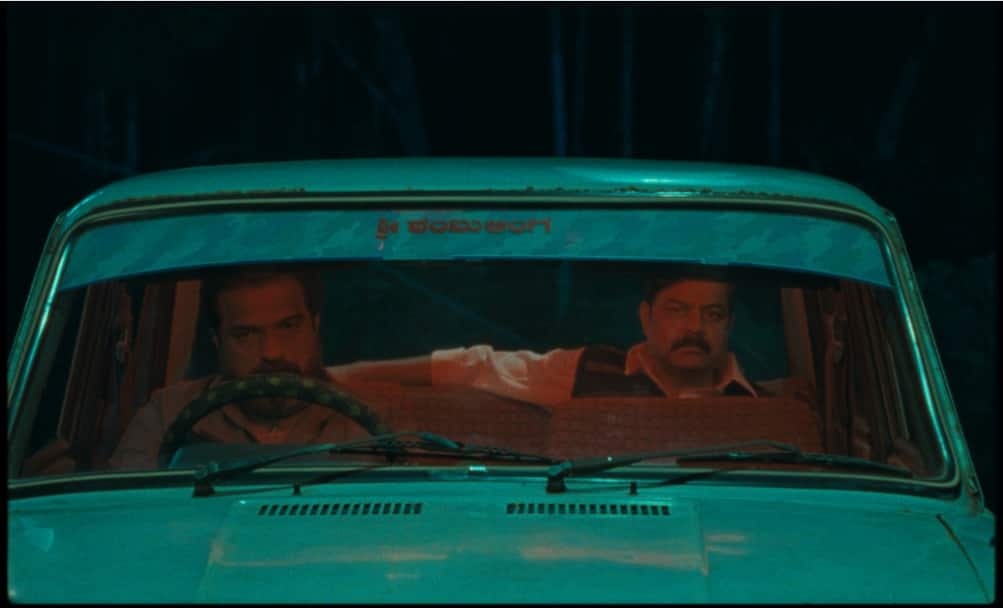 Malayalam actor Dileesh Pothan (left) and Kannada actor Achyuth Kumar in a still from Vagachipani.
The villain is hungry for political power, and easily sacrifices others as well as his own.
Yeah, it’s the greed. There is one line by [the late poet] P. Lankesh (father of slain journalist Gauri Lankesh). He says something which, in Kannada, means the possibility of betrayal from human beings is infinite.
This film feels slightly more accessible in a mainstream sense than Pedro?
If you feel so, I’ll be very happy.
Did you change the religion angle of Pedro with the caste angle in this one?
It’s not a conscious thing. The religion angle in Pedro was supposed to be that way. A Dalit Christian. If he were a Muslim or Hindu, the reaction would be very different. He’s in another place. That’s why he’s from that caste in this film, also. We don’t specify Pathi’s caste, but just by seeing her, we know what is the caste dynamics.
Basu mentions the atrocity act. And caste comes in demonstrably with Dileesh’s character.
If we observe our society, we know the caste is evident there. Because of that privilege, we are like operating this way.
 Gopal Hegde as Basu in a still from Kannada film Vagachipani.
You wanted your father Gopal Hegde to play Basu and not Dileesh’s character, the one who commits the crime.
Yeah, because there are some Pedro’s elements in Dileesh’s character. I didn’t want my father to repeat the similar role.
How did you think of Dileesh for that role?
Because of his gigantic size and vulnerable side. I wanted to create that character who looks very huge and is so vulnerable in that village because of that. I made him an immigrant from Kerala. He doesn’t know the language either.
Dileesh is a fantastic actor. This is the first time ever that he’s playing this kind of a role which is so inward. He always did comedies. This character had to be someone who can’t speak proper Kannada and the pronunciation and intonation had to be of a Malabari to show an immigrant talking. The clear divide is there.
And he has the constant pressure to fit in this village. He’s always putting effort to become one of them.
And it’s difficult. That’s happening everywhere. In the film industry also, we are struggling because we always want to prove that I’m a part of this industry.
What political statement are you making with this film?
Winning at the end and thousands of people clapping for him — that is the biggest danger.
 A still from the film.
Which one do you now like better: acting or directing?
Directing, of course.
You’ve acted in your short films, too. How was it being your own actor?
It was fun. I enjoy both. I used to act in the theatre before Pedro. Because of some circumstances, I had to act in Vagachipani. Actors dates were an issue. Plus, it was a very peculiar character. A traumatised child. So, you can’t overact. It needs a certain presence. We thought it’s better to play it than explain.
You made the film on 16mm. You’d wanted to make Pedro also in celluloid. But shooting on film is expensive.
It’s a practise of making film. It demands huge discipline. And also, you have to be very precise, very clear of what are you trying to make. Making films is itself gratifying and to making film in film stock is really something else.
How much of film stock did you require for this film?
We exposed some 70 cans.
You were not able to see the rushes while you were shooting, because of shooting on film. Was that restrictive?
I don’t see it that way. Because of the editing practise, I can see everything from a distance. I’m not too much into seeing who’s doing what superb acting. And I can’t criticise unnecessarily. It’s when you are on the editing table you are focusing on making, stitching it together. Because of that practice, once it’s done, I don’t have any relation with the material. I can clinically watch it and edit it.
Talk about the music, which is mostly ambient sound. There is the tiger’s roar. What was your brief for music?
Construction sounds.
Music has been done by Leo (Leonardo) Heiblum. He’s a Mexican musician. He did music for Birds of Passage (2018) and many films. My brief was like, I see music as a character, maybe resonating Pathi, the situation of Pathi. It’s difficult to put into words. When you see her, the image of her on screen, you feel something.
 Sumitra as Pathi in Vagachipani (Tiger's Pond); teh film's poster.
She’s striking. Is she an actress?
No, no. She’s from my village. She has not done any acting before. Sumitra is 19 or 20 year’s old and has a little difficulty in understanding things, she’s a little fragile child. You can’t explain and make her act, you just have to give instructions, and she’d follow.
I wanted to create a feeling like there is a coin in the pond which is lying there for years and fungus has gathered on the surface. You see a very different texture to it, like it’s lost. You just feel that it has been there since ages. So, that’s what I wanted to create, in the film: the look of it, the music, the characters.
You had Rishab Shetty backing Pedro but not this film. This time, how did Anurag Kashyap, his producer Ranjan Singh and Singaporean producer Jeremy Chua, a champion for Southeast Asian cinema, come on board?
Rishab supported me for my first film and even to start this film. But he became really busy with Kantara, so he couldn’t give time to nurturing this film. It was very difficult for him. It is very demanding also.
I am in love with Anurag [Kashyap]. I met him in many [film] festivals and we acted together (Aashiq Abu’s Malayalam film Rifle Club) and I acted in his film (starring Bobby Deol; tentatively titled Bandar). You don’t have to pretend with him, you can also scold him, he gives you that space.
From the beginning, Jeremy has been the support system. He’s a fantastic producer to work with. He and Deepti Dcunha programmed my film in Pingyao Film Festival, where I won the award. From there, we started developing this film. After finishing the shoot, Anurag came on board as producer in the post-production stage. These kinds of films need special care. It shouldn’t fall in the wrong hands.
This is the first Kannada film at the Berlin Film Festival?
Yes, reportedly. You feel good. Like it’s the first for a Kannada film, I don’t know how people are aware of it. People here are aware of how prestigious it is but I don’t know why it took so long for a Kannada film to go there.
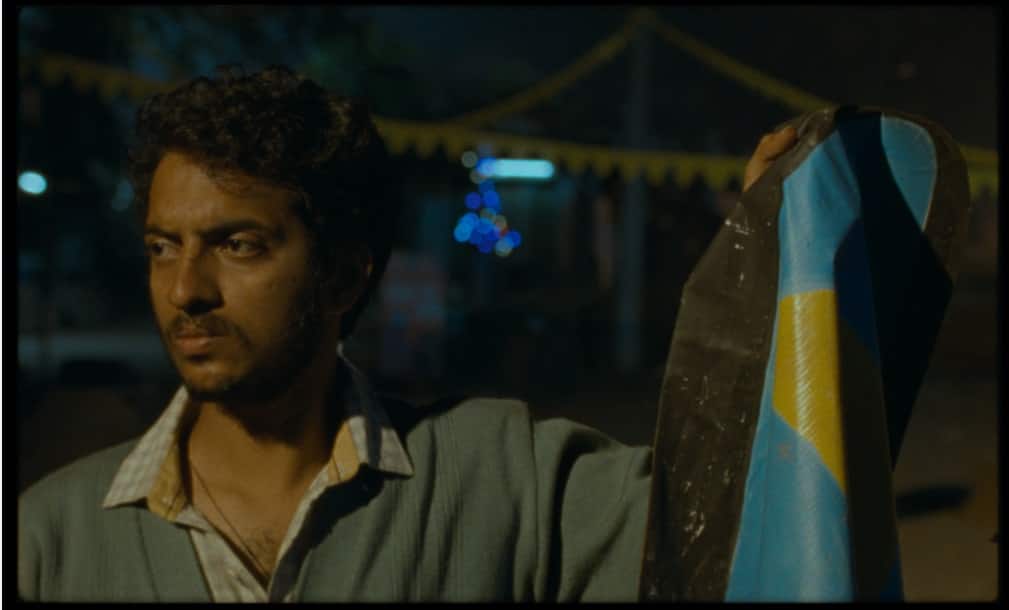 Natesh Hegde acting in his own film, Vagachipani (Tiger's Hill).
Why are you an outcast in the Kannada film industry? Bengaluru International Film Festival (BIFFes), Kannada cinema’s biggest platform, snubbed Pedro, like it has rejected Abhilash Shetty for a second time. Pedro didn’t get a theatrical nor OTT release. Have people in Karnataka seen it?
Some of them have seen it, at screenings here and there. But theatrical or digital distribution is yet to happen.
When you evoke that sense of time in your film that’s not there in the commercial space, it’s a different practise altogether, which they don’t understand. They only understand that you make a film and it releases in theatres on a Friday and the box office collection and then it’s on some OTT (streaming platform). They’re following a formula. I’m not saying they are not genuine with what they are doing. They’re very genuine. Without conviction, you can’t make commercial films even. They have tremendous conviction but they can’t understand this type of filmmaking, and question what is the purpose of this, why you want to make it.
At BIFFes, it’s not that there are some alien people doing that (selecting/rejetcing films). I knew some of them. They were friends. It was unnecessary. It happened because of some fool, who doesn’t understand what cinema is or the prestige of the film festival. We have a censor certificate. No one had any objection. I know I have that sensibility when I’m creating art. They said “religiously sensitive” and dropped mine but screened some film where there is an actual scene of butchering. So, then?
The OTTs have no space for indie cinema anymore. Theatres are not screening your films. Who are you making your films for if it doesn’t reach an audience?
Oh, that’s a very interesting question. What I believe is I’m not making films for this period only. And I’m not making films for a very tangible audience. I don’t know where my audience is, but I’m sure there are people who love this kind of films. And for me, I didn’t know who was Abbas Kiarostami, who was [Robert] Bresson, who was [Kenji] Mizuguchi. And they made me into a filmmaker. They are from Iran, France and Japan, respectively, and I never went to any film school. They were my film schools. [Andrei] Tarkovsky never got a Palme d’Or (at Cannes Film Festival). How famous was Abbas Kiorastami in Iran, and before these festivals started championing his films, he’d already made more than 20 films before. And Bresson was never a celebrated filmmaker. Even now, when I go to France, they don’t talk about Bresson in the same way they talk about [Francois] Truffaut or [Jean-luc] Godard.
So, I don’t know, if I get an audience in my lifetime and if I get money, I’ll be very happy. Otherwise, I have to somehow manage.
Why do you think that’s the case?
The form of my films is alienating to them. When you said this [Vagachipani] is more commercial, it’s not about the story. We think with the element of the story, it becomes commercial or arthouse or something. It’s not, it’s actually the form of it, the way we are telling the story.
You want to stick to doing this style of filmmaking?
I don’t know what my style is. When I will become aware of it, then I will start to handcraft my films. When you see recent films, not just from India, all over the world, it’s handcrafted. When films become too perfect, it loses its human nature, it doesn’t feel humane. It looks like a product.
Your films have a raw, edgy quality but it is also aesthetic to look at. So, there is a certain crafting that has gone into these.
I’m not saying non-aesthetic. Aesthetics is the sense, it differs from person to person. It’s not just about making films. It’s how you write something or how you wear a cloth or how you eat the food, for everything, you have a way of doing it.
By just looking at someone’s house, you say, he has some aesthetic sense, that is different. But consciously crafting your film to cater to something (an idea/notion, taste, trend, etc.) is a dangerous thing, whether for commercial purpose or for festivals or whatever.
 A film still from Tiger's Pond.
What comes to you first: the story, the characters or the image?
The space. This setting of it comes first or some very peculiar feeling of the way you feel when you see Pathi. The wind is blowing and you just see that statue. At that point you feel something, right? That kind of a peculiar feeling drives you to write a story. A peculiar film feeling, which are character-specific. The space is strangely interwoven with characters. Then comes the camera movement.
In this one, how differently did you play around with space as compared to Pedro?
We had more long shots in Pedro and Vagachipani has more close-ups. In Pedro, the space was gigantic and these characters were moving in it. While here, the characters are overwhelming.
Any recent Kannada films you liked?
Yeah, I like Raj’s film Garuda Gamana Vrishabha Vahana (2021). I really liked it. I don’t like his other films. [Sumanth Bhat’s] Mithya was good again (releasing in theatres on March 7).
Do you have Kannada language OTT platforms?
No, we don’t have yet.
What will your next film be on?
It’s a trilogy. The final in this series. But it will be a Hindi film.
Are you running away from Kannada films?
No, no. I’m here only. But this film, it’s difficult to make here.
Discover the latest Business News, Sensex, and Nifty updates. Obtain Personal Finance insights, tax queries, and expert opinions on Moneycontrol or download the Moneycontrol App to stay updated!
Find the best of Al News in one place, specially curated for you every weekend.
Stay on top of the latest tech trends and biggest startup news.