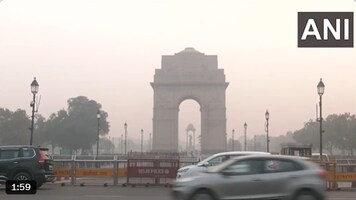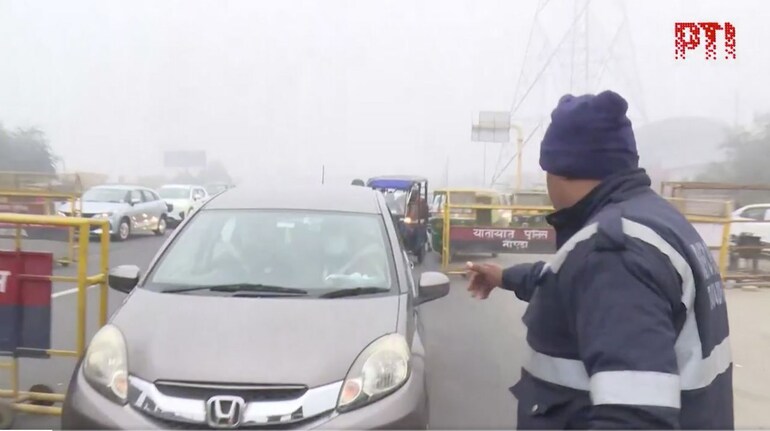
A stringent ban on thousands of vehicles came into force at Delhi’s borders on Thursday, as authorities scrambled to combat a thickening blanket of toxic smog that pushed air quality indices towards the catastrophic 500 mark.
The measures, part of the Supreme Court-mandated Stage IV of the Graded Response Action Plan (GRAP), saw transport and police teams conducting rigorous checks, turning away non-compliant vehicles and issuing hefty fines in a bid to curb one of winter’s largest pollution sources.
The visual reality at checkpoints like the DND Flyway, Kalindi Kunj and Ghazipur was one of severely reduced visibility and dense haze, with police barricades deliberately slowing traffic for inspection. The primary target: vehicles registered outside Delhi that do not meet the BS-VI emission standard, alongside those without valid Pollution Under Control Certificates (PUCC).
“We are strictly checking non-BS6 commercial and private vehicles registered outside Delhi. Violators face a Rs 20,000 challan or are forced to make a U-turn,” said a Delhi transport department officer overseeing operations at Shaheen Bagh, as reported by PTI. He emphasised the widespread nature of the crackdown, stating, “If owners try alternate routes, we have forces deployed across checkpoints... they can't escape.”
The enforcement is underpinned by portable machines that instantly verify a vehicle’s registration against BS norms and PUCC validity. An Uttar Pradesh Traffic Police officer at the border detailed the on-ground criteria: “We're stopping cars that seemingly look old and don't have blue stickers... We have also been directed to fine 10-year-old diesel and 15-year-old petrol vehicles of BS-III emission standards (or lower).”
The scale of the disruption is vast. According to official data, the overnight ban is likely to sideline a staggering number of vehicles from the National Capital Region (NCR): over 2 lakh in Gurgaon, 4 lakh in Noida and 5.5 lakh in Ghaziabad.
In Gurgaon alone, nearly 2 lakh private vehicles are below BS-VI, complemented by tens of thousands of commercial vehicles and buses, with 92,000 diesel vehicles already past the 10-year age limit.
The move has triggered acute anxiety among lakhs of daily commuters whose work and family lives hinge on crossing into Delhi. Meanwhile, the action has ignited a political firestorm.
Saurabh Bharadwaj, President of the Aam Aadmi Party’s Delhi unit, took to X (formerly Twitter) to accuse the central government of “headline management to fool people and the Supreme Court,” claiming that in reality, “there is no enforcement” at the borders.
The drastic step highlights the critical role of vehicular emissions in Delhi’s winter pollution crisis. Transport contributes 20-40% of PM2.5 levels during the season. Alarmingly, around 37% of the NCR’s 2.88 crore vehicles are BS-III or older, emitting up to 31 times more particulate matter and 16 times more nitrogen dioxide than modern standards allow.
While the border checks represent a severe immediate intervention, experts stress the need for systemic, long-term solutions. They point out that the current PUC system fails to measure particulate matter effectively and argue that vehicle scrappage policies and a massive bolstering of public transport must accompany such bans to create a lasting impact, especially against transboundary pollution.
For now, the capital remains under siege from its own air, with the success of this enforcement drive resting not just on police vigilance, but on a fraught equation of political will, public compliance and the urgent need for broader structural change.
Discover the latest Business News, Sensex, and Nifty updates. Obtain Personal Finance insights, tax queries, and expert opinions on Moneycontrol or download the Moneycontrol App to stay updated!
Find the best of Al News in one place, specially curated for you every weekend.
Stay on top of the latest tech trends and biggest startup news.