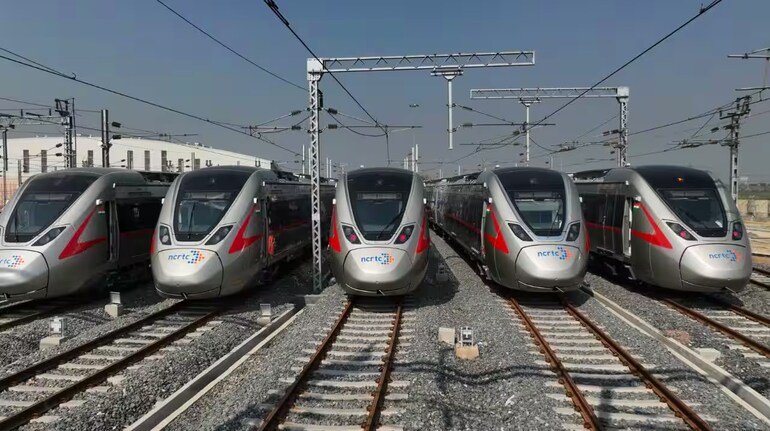

The Union Budget has signalled a strategic pivot for India’s pioneering regional rail network, reducing funding as its inaugural corridor enters its final stages. The National Capital Region Transport Corporation (NCRTC) has been allocated Rs 2,200 crore for the 2026-27 financial year, a drop of approximately 25% from the previous year’s Rs 2,918 crore.
This recalibration comes as work on the entire 82-kilometre Delhi-Ghaziabad-Meerut Namo Bharat Regional Rapid Transit System (RRTS) corridor is nearly complete. Officials confirmed the full corridor has undergone successful trial runs and is expected to become fully operational soon, with a 55-kilometre section from New Ashok Nagar to Meerut South already in service.
Finance Minister Nirmala Sitharaman’s budget earmarked Rs 1,324 crore under revenue expenditure and Rs 876 crore for capital expenditure for the project. According to budget documents, the investment continues to support efforts to decongest the Delhi-National Capital Region (NCR) and mitigate pollution through faster, cleaner public transport.
An NCRTC official indicated the revised allocation would provide the impetus for work to commence on new corridors once they receive formal sanction.
The agency is currently awaiting central government approval for the remaining two corridors of Phase I: the Delhi-Panipat-Karnal line and a section of the Delhi-Gurugram-SNB (Alwar) corridor, both reported to be at advanced stages of consideration.
These corridors, planned to converge at the Sarai Kale Khan Namo Bharat station in Delhi, are estimated to require five to six years for completion once cleared.
The reduced budgetary footprint also reflects the agency’s expenditure patterns. With just two months remaining in the 2025-26 fiscal year, the NCRTC had spent only Rs 2,000 crore of its Rs 2,918 crore allocation, with the majority of unspent funds lying under the capital expenditure head.
The project’s broader impact has been highlighted in official assessments. The 2025-26 Economic Survey of India lauded the RRTS for its contribution to pollution mitigation and labour market benefits. It noted that since partial operations began, an estimated 25 lakh vehicle trips have been avoided, offsetting around 69 lakh kg of CO2 emissions. The survey also outlined a roadmap for the network to source 60% of its energy from renewables.
On the economic front, the survey reported that construction alone generated roughly 166 lakh mandays of employment between 2019 and 2025, with operations expected to support around 12 lakh mandays annually. Early estimates suggest significant gains in accessibility, with nearly 6.9–7.6 lakh jobs in Meerut and about one lakh jobs at Sarai Kale Khan becoming reachable within one hour.
Looking beyond NCR, the Economic Survey identified a potential network of nearly 2,900 kilometres of Namo Bharat RRTS corridors across other regional clusters. These include Bengaluru–Mysuru–Tumakuru–Hosur, Chennai–Vellore–Villupuram–Chengalpattu and Hyderabad–Warangal, among others, positioning regional rapid rail as a potential engine of growth nationwide.
Discover the latest Business News, Sensex, and Nifty updates. Obtain Personal Finance insights, tax queries, and expert opinions on Moneycontrol or download the Moneycontrol App to stay updated!
Find the best of Al News in one place, specially curated for you every weekend.
Stay on top of the latest tech trends and biggest startup news.