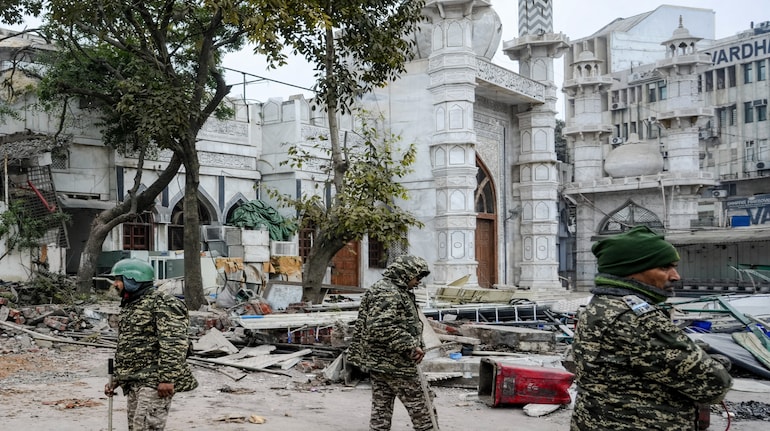

The narrow, teeming lanes around the 17th-century Turkman Gate in old Delhi echoed with conflict once again this week. A routine demolition drive by the Municipal Corporation of Delhi (MCD) escalated rapidly as residents, according to authorities, pelted stones, prompting police to respond with tear gas.
The immediate clash has, however, opened a far deeper wound, reviving visceral memories of a state-sponsored atrocity at the same site nearly half a century ago — a brutal flashpoint of Indira Gandhi’s Emergency.
Turkman Gate’s significance predates Mughal city
The squat, austere Mughal-era structure, built during Emperor Shah Jahan's founding of Shahjahanabad, stands as a palimpsest of Delhi’s layered history. As historian Swapna Liddle explained to The Indian Express, the gate’s significance predates the Mughal city itself. The road leading to it was an ancient thoroughfare, lined with older sites of veneration.
“It was beside this road that a Sufi saint called Shah Turkman Bayabani lived and was buried,” Liddle noted. His shrine remains and adjacent to it lies the grave traditionally believed to be that of Razia Sultan, the 13th-century ruler of the Delhi Sultanate.
When the Mughal city walls were built, this area was enclosed and the gate nearest the saint’s shrine inherited his name. The gate survived the 1857 rebellion and subsequent colonial alterations, a silent witness to the city’s evolution.
Sanjay Gandhi's 'beautification' drive
It was in the mid-1970s that Turkman Gate was violently thrust into the national consciousness. Sanjay Gandhi’s aggressive “beautification” drive, which targeted slums and unauthorised colonies, reached the densely populated, predominantly Muslim quarters of the walled city in April 1976.
Accounts from memoirs and later inquiries, such as those cited by economist Ashok Chakravarti, suggest Sanjay Gandhi had visited the area earlier and been met with hostility. A decision was swiftly taken to clear the settlements around the gate. The demolitions began on April 13, 1976. They soon became entangled with the regime’s coercive family-planning campaign, orchestrated locally by Sanjay Gandhi associate Rukhsana Sultana.
'Sterilisation target'
Residents faced an impossible choice. Anthropologist Emma Tarlo, in her work on the period, recorded that Sultana offered to halt the bulldozers only if the community supplied 300 sterilisation cases within a week. Simultaneously, panic and resistance grew. On April 19, as demolitions pressed deeper, protests erupted. A family-planning centre was attacked and police responded with lathis and tear gas.
A night of carnage: Stone pelting, police firing
The confrontation spiralled into a massacre. Chakravarti recalled a crowd of thousands, including women and children, gathering at Turkman Gate. Stone-pelting was met with police firing; eyewitnesses later reported hearing officers order their men to shoot.
What followed was chilling in its clinical brutality. That night, bulldozers returned to complete the clearance. Chakravarti’s account describes rubble — and bodies, including those of injured survivors still alive — being carted away to a refuse site, their screams drowned by machinery.
Journalists John Dayal and Ajoy Bose, in For Reasons of State: Delhi under Emergency (2018), wrote that the bulldozers worked “till they had obliterated all signs of life as well as death.” Independent estimates from survivor testimonies and researchers place the death toll around 400, with over a thousand injured.
This week’s clashes, though on a vastly different scale, have inevitably drawn a line back to 1976.
Discover the latest Business News, Sensex, and Nifty updates. Obtain Personal Finance insights, tax queries, and expert opinions on Moneycontrol or download the Moneycontrol App to stay updated!
Find the best of Al News in one place, specially curated for you every weekend.
Stay on top of the latest tech trends and biggest startup news.