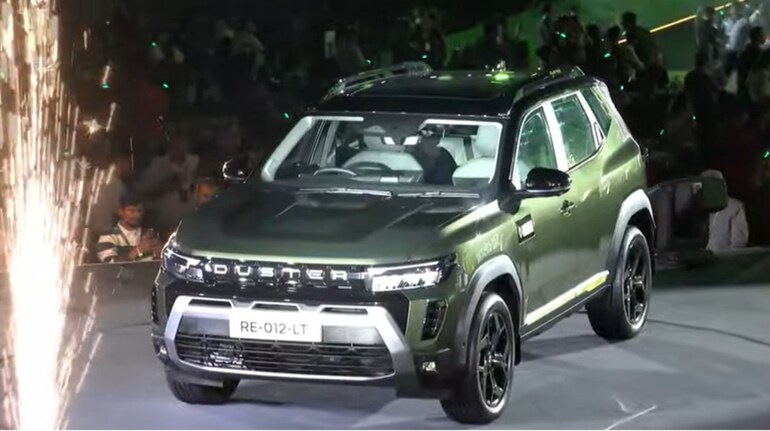

The India–European Union free trade agreement (FTA) will not only make it easier for premium and exotic cars to enter India at lower prices, but could also open the doors for Europe to import automobiles and automotive technologies developed in India, according to a senior Renault Group executive.
Speaking to Moneycontrol a day after the launch of the new-generation Duster mid-size sports utility vehicle (SUV), Fabrice Cambolive, Chief Growth Officer and CEO of the Renault brand at Renault Group, said the trade pact has the potential to reshape automotive flows between the two regions.
“We have been talking about getting India and Europe closer, and now we are seeing a real move in this direction,” Cambolive said.
He emphasised that the agreement should work both ways. “It should be a bi-directional agreement, which means it is not just important to be able to import into India, but also that the level of competitiveness and the level of products we have in India could be interesting for Europe,” he added.
Renault is in the middle of a renewed push in India, backed by fresh investments and a pipeline of new product launches. The strategy is aimed at ensuring that India, along with Brazil, contributes nearly half of Renault’s global growth in the coming years, even as the company stays away from the US and Chinese markets.
“India is a strategic market for us. It is where we see growth. It is a market where we can play not just domestically but on exports as well,” Cambolive said.
As part of its product offensive, Renault will become the third automaker—after Maruti Suzuki and Toyota—to introduce hybrid technology in the highly competitive mid-size SUV segment. The hybrid Duster, combining a petrol engine with battery support, will rival models such as the Maruti Suzuki Grand Vitara and Toyota Hyryder, and is expected to be launched around Diwali 2026.
Addressing questions on Renault’s electric vehicle (EV) plans in India, Cambolive clarified that the company has not ruled out EVs, but is prioritising its approach. “We are not reluctant to go into EVs; it is just a question of priority. The EV mix is 4–5 percent presently in India. Our main objective was to come with very efficient engines in the remaining 95 percent of the market. We don’t exclude launching an EV in the coming years,” he said.
Despite the broader growth in India’s passenger vehicle market—which expanded by around 6 percent between April and December—Renault’s volumes remained largely flat during the same period. The company sold 29,763 units in that timeframe, ranking ninth among India’s largest carmakers, according to data from the Society of Indian Automobile Manufacturers (SIAM).
The new Duster range will be powered by a Turbo TCe 160 engine producing 163 PS of power and 280 Nm of torque, while the Turbo TCe 100 engine will cater to the more accessible segment. The hybrid variant will feature a 1.8-litre petrol engine paired with a 1.4 kWh battery, underscoring Renault’s focus on efficiency and market-relevant technologies as it bets big on India’s role in its global strategy.

Discover the latest Business News, Sensex, and Nifty updates. Obtain Personal Finance insights, tax queries, and expert opinions on Moneycontrol or download the Moneycontrol App to stay updated!
Find the best of Al News in one place, specially curated for you every weekend.
Stay on top of the latest tech trends and biggest startup news.