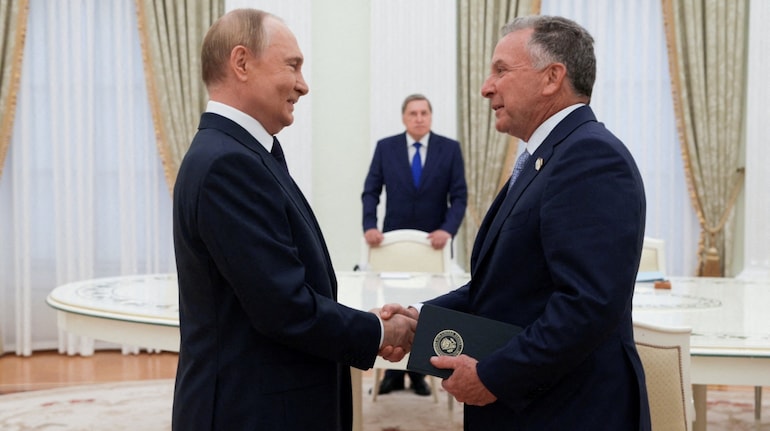
A leaked set of phone calls involving US presidential envoy Steve Witkoff and senior Russian officials has triggered political uproar in Washington and raised serious questions about the conduct of backchannel diplomacy with the Kremlin. The controversy, now popularly called “Witi-Leaks”, has also shifted attention to a larger mystery: who recorded and released these sensitive conversations.
The calls were first reported by Bloomberg, which said it had “reviewed and transcribed audio” recordings between Witkoff and Yuri Ushakov, a top aide to Russian President Vladimir Putin, as well as another call involving Ushakov and Putin’s economic adviser Kirill Dmitriev.
In the October 14 conversation, Witkoff appeared to guide Ushakov on how to present a peace proposal to President Donald Trump. According to the transcript, Witkoff said peace would likely require Ukraine giving up territory. “Now, me to you, I know what it’s going to take to get a peace deal done: Donetsk and maybe a land swap somewhere,” Witkoff said. “But I’m saying instead of talking like that, let’s talk more hopefully because I think we’re going to get to a deal here.”
Witkoff also suggested that Putin should congratulate Trump on the Israel-Hamas peace deal and encouraged arranging a direct Trump-Putin phone call before Ukrainian President Volodymyr Zelenskyy’s planned White House visit.
In the second call, Dmitriev discussed how to relay the peace framework. “I’ll informally pass it along, making it clear that it’s all informal. And let them do like their own,” he said. “I don’t think they’ll take exactly our version, but at least it’ll be as close to it as possible.”
Trump has defended his envoy despite growing calls for his dismissal. He described Witkoff as a “dealmaker”. The president told reporters, “He’s gotta sell this to Ukraine, he’s gotta sell Ukraine to Russia. That’s what a dealmaker does”. He added, “I haven’t heard it, but I heard it was standard negotiation. And I would imagine he’s saying the same thing to Ukraine, because each party has to give and take.”
White House communications director Steven Cheung also backed Witkoff, saying there was “nothing wrong” with what was said in the “supposed” transcript and that it showed “what a successful negotiator does in order to get a deal done.”
However, anger has spilled across both party lines. Republican Congressman Don Bacon said, “For those who oppose the Russian invasion and want to see Ukraine prevail as a sovereign & democratic country, it is clear that Witkoff fully favors the Russians.” He added, “He cannot be trusted to lead these negotiations. Would a Russian paid agent do less than he? He should be fired.”
Democrat Ted Lieu went further, calling Witkoff an “actual traitor” and saying, “Steve Witkoff is supposed to work for the United States, not Russia.”
Attention has also turned to the source of the leak. Ushakov acknowledged the authenticity of the calls but insisted parts were “fake” and called the leak “of course unacceptable”. He suggested the calls may have been made over WhatsApp, saying, “There are certain conversations on WhatsApp that, generally speaking, someone might somehow be able to listen to.”
Former intelligence officials told The Guardian that while interception is common, the source likely originated from the US. One said, “There are different ways of intercepting calls, including traditional signals intelligence methods, cyber-attacks, and having access to the devices, so anything is theoretically possible, but my strong suspicion is that this came from the US side, and if that’s the case, you have two entities who are capable of doing this, the CIA and the NSA.”
Others believe Russia or Ukraine could be responsible. The Guardian quoted Daniel Hoffman, a former CIA Moscow station chief, who said, “It’s really hard to speculate. It could be 100 million different things, including somebody on the Russian side trying to hurt Witkoff’s reputation.”
Ukraine is also viewed as having a motive. According to The Guardian, Kyiv may want to expose the “shocking extent of collaboration” between Witkoff and the Kremlin and undermine the peace plan that would require Ukraine to surrender territory.
Russia has denied any involvement. Ushakov said the leak may be an attempt to disrupt peace talks. “It is unlikely that this is done to improve relations,” he said, adding, “Someone is leaking, someone is listening, but not us.”
Despite the controversy, talks are set to continue. Ushakov confirmed that Witkoff will visit Moscow next week. “As for Witkoff, I can say that a preliminary agreement has been reached that he will come to Moscow next week,” he said.
Discover the latest Business News, Sensex, and Nifty updates. Obtain Personal Finance insights, tax queries, and expert opinions on Moneycontrol or download the Moneycontrol App to stay updated!
Find the best of Al News in one place, specially curated for you every weekend.
Stay on top of the latest tech trends and biggest startup news.