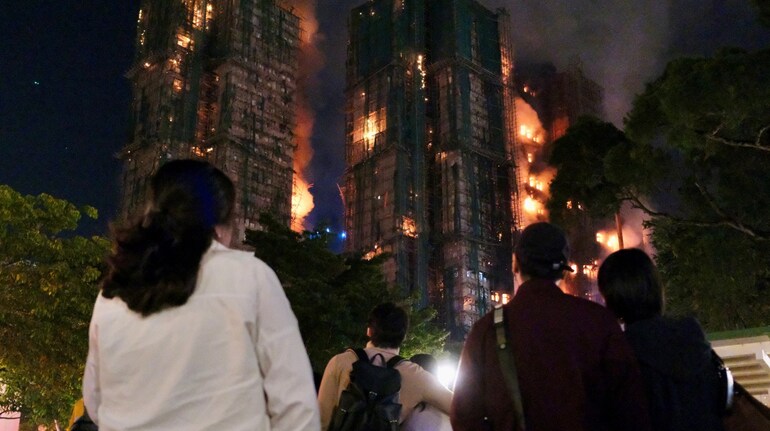
The death toll in the tragic Hong Kong residential fire has reached 65, while authorities continue to search for about 250 people still listed as missing. Flames kept emerging from upper windows even more than 24 hours after the blaze first erupted at the large housing estate. Thick smoke continues to fill the air at the complex.
The fire struck the eight-building Wang Fuk Court estate in Tai Po district, a northern suburb near the border with mainland China, home to roughly 4,800 residents across nearly 2,000 apartments. Many residents were elderly. Four of the buildings have been effectively extinguished. Three others remain under control, but the affected building formerly thought untouched drew renewed suspicion when investigators found construction materials that may have helped the fire spread.
Styrofoam insulation and dangerous building materials under scrutiny
Police investigating the blaze discovered sheets of Styrofoam -- a highly flammable material -- attached to the external walls around the elevator lobby of one tower. These foam panels appear to have been installed by the renovation contractor. Three men have since been taken into custody on suspicion of negligence, accused of leaving behind foam packaging and building materials that may have contributed to the rapid spread of the fire.
Styrofoam is a brand name of extruded polystyrene foam commonly used for insulation in walls and roofs. It is also used in packaging and disposable products. While it offers good insulation, Styrofoam can ignite at relatively low temperature and burns very quickly. When it catches fire, it releases dense and toxic fumes. Safety experts warn that Styrofoam should never be used near heat sources, open flames or in places where fire regulations require fire-resistant materials.
Authorities suspect that the combination of Styrofoam insulation, external bamboo scaffolding wrapped in plastic Chinese-style nets and renovation work may have created a dangerous chain reaction. The fire reportedly started on external scaffolding at a 32-storey tower under renovation. Flames climbed from the bamboo scaffolding and plastic netting into the building exterior, then spread to adjacent towers. Windy conditions on the night of the fire likely accelerated this spread.
Bamboo scaffolding and Chinese nets: a perilous renovation combo
Bamboo scaffolding, long used in Hong Kong and parts of Asia for construction, is lightweight and inexpensive. However, it is also highly flammable. When covered with plastic safety nets, often used to prevent debris, the netting can act like a sail in strong wind, allowing flames to travel rapidly. Once fire catches the scaffolding or netting, the risk of fire jumping to the building exterior or windows increases dramatically.
Since the housing estate was undergoing major renovation work at the time of the fire, investigators now believe negligence in safety compliance played a key role. It is suspected that proper fire safety protocols and fire-resistant materials were ignored in favor of cheaper alternatives. The discovery of Styrofoam panels around a lift lobby has strengthened this theory.
Scope of the tragedy and response
About 900 residents were evacuated overnight to temporary shelters. The authorities have also launched a sweeping inspection of other housing estates under renovation citywide. Hong Kong Chief Executive John Lee stated that all such buildings undergoing major works will be checked immediately to ensure compliance with fire safety rules. Police have also searched the offices of the renovation contractor, Prestige Construction & Engineering Company, which handled the upgrades at Wang Fuk Court.
The scale of the disaster has drawn strong responses from across the city and internationally. Chinese President Xi Jinping has expressed condolences to the victims. He also honoured the firefighter who died while trying to control the blaze.
What this disaster reveals about systemic failures
This tragedy has exposed deep failures in building regulation enforcement in Hong Kong. The use of flammable materials like Styrofoam for insulation and reliance on traditional bamboo scaffolding wrapped in plastic nets point to cost-cutting at the expense of safety. The fact that three different towers caught fire within hours of each other suggests widespread negligence rather than a single accident.
If the investigation confirms that Styrofoam and unsafe scaffolding caused or worsened the fire, it will raise serious questions about the contractors’ practices, building inspectors, and regulatory oversight. Families of victims will undoubtedly demand accountability, tighter safety rules and possibly criminal charges against those responsible.
Discover the latest Business News, Sensex, and Nifty updates. Obtain Personal Finance insights, tax queries, and expert opinions on Moneycontrol or download the Moneycontrol App to stay updated!
Find the best of Al News in one place, specially curated for you every weekend.
Stay on top of the latest tech trends and biggest startup news.