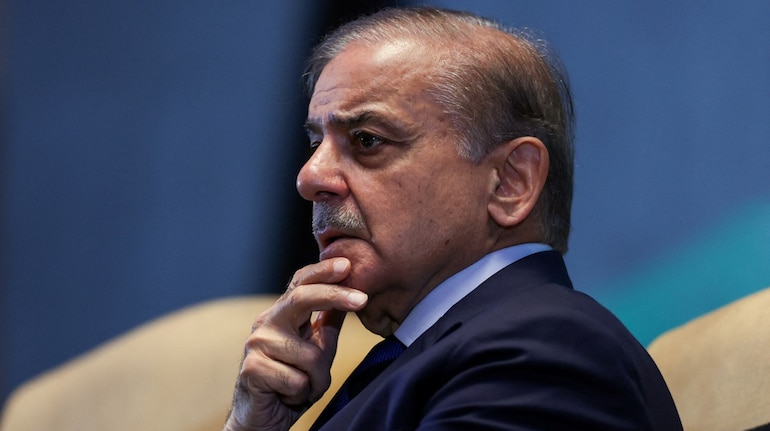

Pakistan Prime Minister Shehbaz Sharif recently expressed frustration over his country’s growing reliance on foreign loans, calling the practice a source of national embarrassment. Speaking to exporters and business leaders in Islamabad, Sharif said that both he and Army Chief Field Marshal Asim Munir feel “ashamed” when seeking financial assistance abroad.
“We feel ashamed when Field Marshal Asim Munir and I go around the world begging for money. Taking loans is a huge burden on our self-respect. Our heads bow down in shame. We cannot say no to many things they want us to do,” Sharif said, according to local broadcaster A1tv.
Sharif also openly admitted that the country’s survival is being driven by a “hybrid regime,” with the military playing a central role in governance.
Credit for stabilising the economy, Sharif further said, goes to Munir and the military. He lauded their “one-hundred-per-cent role” in tackling petrol smuggling and stabilising the sugar industry. He described the civilian-military relationship as a “partnership,” following Munir’s promotion last year to Field Marshal and Pakistan’s first Chief of Defence Forces, giving him control over all military branches and the nuclear command.
Notably, the Prime Minister’s comments once again bring into the spotlight Pakistan’s ongoing economic struggles, including a heavy debt burden, rising poverty, and high unemployment.
Recent estimates suggest that nearly 45% of the population now lives below the poverty line, up from 21.9% in 2018, with extreme poverty rising to 16.5%. Unemployment has reached around 7.1%, leaving more than eight million citizens jobless. Exports remain concentrated in textiles, while growth in sectors such as software, agriculture, and livestock is hindered by structural issues.
Sharif, however, praised Pakistan’s “all-weather” partners, including China, Saudi Arabia, the UAE, and Qatar, for providing critical financial support.
China, through the China-Pakistan Economic Corridor (CPEC), has rolled over billions in deposits, with $4 billion projected for 2024-25. Saudi Arabia extended a $3 billion deposit and deferred $1.2 billion in oil payments, while the UAE committed billions to energy, port, and wastewater projects. Qatar signed protocols for $3 billion in investments in aviation, agriculture, and hospitality.
Pakistan’s reliance on foreign loans has become structural, with the country now on its 23rd IMF program. Critics argue that without significant reforms, such as improving taxation on the landed elite and formal retail sectors, loans merely cover interest payments on previous debt, leaving the economy in a persistent cycle of dependence.
Sharif also lamented the lack of development in research, innovation, and domestic industries, calling for alternative strategies to reduce Pakistan’s reliance on international aid. The Prime Minister’s public admission of “begging” for loans reflects both the severity of the debt crisis and the limits of traditional strategies that framed foreign aid as strategic or geopolitical support.
Meanwhile, Pakistan continues to rely on its military’s credibility with creditors, involving the Army Chief in negotiations, while the civilian government faces rising pressure to implement structural economic reforms.
(With inputs from agencies)Discover the latest Business News, Sensex, and Nifty updates. Obtain Personal Finance insights, tax queries, and expert opinions on Moneycontrol or download the Moneycontrol App to stay updated!
Find the best of Al News in one place, specially curated for you every weekend.
Stay on top of the latest tech trends and biggest startup news.