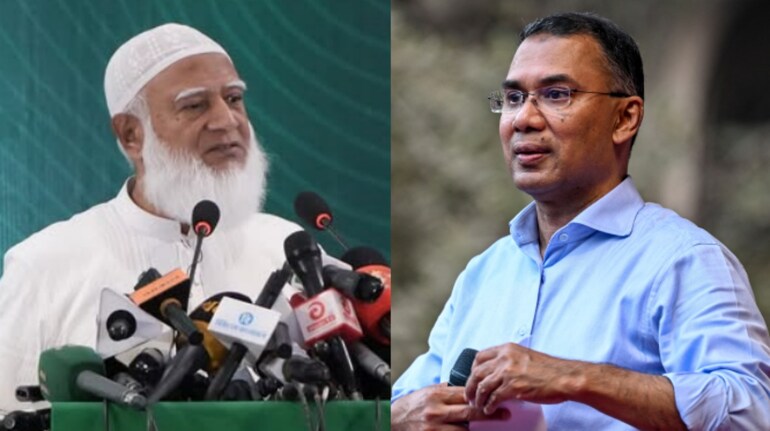

Bangladesh will vote on February 12 in its first national election since the dramatic ouster of former prime minister Sheikh Hasina in 2024, an upheaval that ended 15 years of Awami League rule and ushered in an interim administration led by Muhammad Yunus.
The election is unprecedented. For the first time in decades, the Awami League is barred from political activity, removing the country’s most dominant party from the ballot. The vacuum has allowed two very different forces to compete for power. The Bangladesh Nationalist Party led by Tarique Rahman, and Jamaat-e-Islami led by Shafiqur Rahman.
Both parties are campaigning amid economic strain, political churn, and growing anxiety over attacks on minorities. Their manifestoes outline sharply different visions for governance, the economy, foreign policy, and defence, offering voters two distinct futures for Bangladesh.
Jamaat-e-Islami’s vision: Ambition, ideology and contradictions
Jamaat-e-Islami has released a 41-point “People’s Manifesto” under the slogan “A Safe and Humane Bangladesh.” Shafiqur Rahman unveiled the document in Dhaka before diplomats, business leaders, and civil society representatives.
Women at the centre, but absent on the ballot
Jamaat claims women’s empowerment as a core priority, even as it fields no female candidates.
The manifesto promises to include a “significant number of women in the cabinet” and says, “The cabinet will reflect the diversity of the nation by ensuring representation of religious and ethnic communities and other historically under-represented sections of society.”
It also proposes reduced maternity working hours and a safe workplace for women. Jamaat has said it will enact a Muslim Personal Law aligned with Shari‘ah and ensure women receive their lawful inheritance.
A $2 trillion dream economy
Jamaat lays out sweeping economic targets. It promises to raise Bangladesh’s global economic ranking from 35th to 20th, attract $15 billion in foreign investment, and cut import dependence by 30 per cent.
Its long-term goal is to transform Bangladesh into a $2 trillion economy by 2040 and raise per capita income to $10,000.
This ambition contrasts with present realities. Bangladesh’s economy currently stands at around $475 billion in nominal terms, with PPP estimates at about $1.78 trillion.
Foreign policy: India named, Pakistan missing
Jamaat’s foreign policy section is revealing. It explicitly lists India, Bhutan, Nepal, Myanmar, Sri Lanka, Maldives, and Thailand as neighbours with whom it seeks peaceful relations based on “mutual respect and fairness.”
Pakistan is notably absent.
Instead, Jamaat emphasises ties with Muslim-majority nations and deeper engagement with the US, UK, EU, Japan, and Canada. It also speaks of expanding diplomacy in Africa, Eastern Europe, and South America, and maintaining active roles in the UN, SAARC, and ASEAN.
The omission of Pakistan reflects its shrinking relevance even for Islamist parties, while India continues to be acknowledged as an unavoidable regional anchor.
Defence and security proposals
Jamaat promises a new national defence policy, a military research institution, and modernisation of the armed forces. It also proposes voluntary military training for young men and women aged 18 to 22.
BNP’s pitch: Unity, reform and economic recovery
The Bangladesh Nationalist Party has framed its manifesto around political reform, economic revival, and religious harmony. After boycotting the 2014 and 2024 elections, the BNP is contesting this poll as a major force.
Its manifesto outlines five priorities, including state reform, economic rebuilding, and national unity.
Minority attacks shape BNP’s messaging
The BNP places strong emphasis on religious freedom following recent attacks on minorities, particularly Hindus.
The party declares, “We are all Bangladeshis,” and affirms that “religion is individual, the state is for all.”
This stance comes after lynchings and arson attacks on Hindu households during the interim government period.
‘Friend yes, master no’
The BNP does not name India directly but lays out a foreign policy doctrine titled “Bangladesh Before All: Friend Yes, Master No.”
“Bangladesh will not interfere in other states’ internal matters and will not allow interference in its own matters,” the manifesto says.
It also promises to secure Bangladesh’s water rights on the Teesta and Padma, stop border killings, and curb smuggling. It commits to zero tolerance for terrorism and extremism.
The BNP proposes stronger engagement with the Muslim world, revival of SAARC, and ASEAN membership, while outlining a ‘Made in Bangladesh’ defence initiative to build self-reliance.
$1 trillion economy by 2034
BNP leader Tarique Rahman has promised to make Bangladesh a $1 trillion economy by 2034.
He said growth would “not be based” on privileges but on the “productive power” of citizens, vowing to “break the oligarchic structure” and revive a middle class that has been “literally wiped out.”
The party promises tariff stability, investment incentives, job creation, and a stable foreign exchange regime, projecting Bangladesh as “a safe, prosperous, investment destination.”
Institutional overhaul and justice agenda
The BNP promises a people-oriented government, reinstatement of the caretaker system, a new Upper House in Parliament, a Vice-President post, and a 10-year cap on any prime minister’s tenure.
It also vows accountability for crimes committed during what it calls the “fascist era” under Hasina.
On defence, the BNP says it will adopt a modern policy based on the “People’s Warfare Doctrine” of Ziaur Rahman, with emphasis on air power and maritime security.
An election without Pakistan in the picture
Across both manifestoes, one reality stands out. India features as a necessary regional partner, directly or indirectly. Pakistan, once central to Bangladeshi political rhetoric, barely figures at all.
As Bangladesh votes in a transformed political landscape, the manifestoes suggest a country looking outward for growth and stability, while quietly moving past old alignments that no longer serve its future.
Discover the latest Business News, Sensex, and Nifty updates. Obtain Personal Finance insights, tax queries, and expert opinions on Moneycontrol or download the Moneycontrol App to stay updated!
Find the best of Al News in one place, specially curated for you every weekend.
Stay on top of the latest tech trends and biggest startup news.