






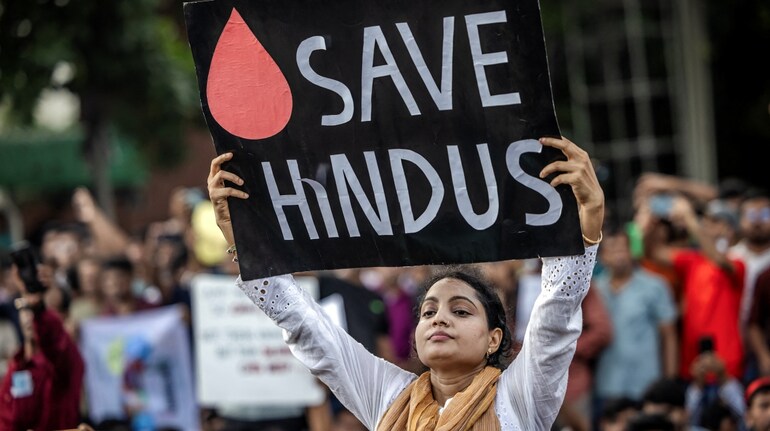

More than two months after Moni Chakraborty was brutally murdered inside his shop at Charsindhur Bazar in Narsingdi district, justice remains elusive. The killer is still at large. For Moni’s family, time has frozen in grief and fear. The silence of the legal system has been as devastating as the crime itself.
Inside their modest home, Moni’s mother clutches his photograph, her hands shaking. Hope has drained from the household. His widow, now the sole breadwinner, conducts private tuitions to keep their young son in school. Survival has replaced mourning. Fear has replaced faith.
“I am scared,” his mother says quietly. “We are told to lock ourselves in. In Narsingdi, where we live, there have been three murders in the last month alone. Tomorrow, it could be us.”
Red alerts across minority neighbourhoods
What is unfolding in Narsingdi reflects a much larger pattern. Intelligence inputs indicate that at least ten areas in Dhaka, many of them minority dominated, are under heightened security watch ahead of the February 12 elections.
The sense of dread is most visible in Shakharibazar, a centuries-old Hindu enclave known for shops selling puja items and shakha pola, the traditional bangles worn by married Hindu women. News18 visited the area and found a street that felt unnaturally quiet. As cameras appeared, residents slipped into narrow alleys. Those who stayed spoke in hushed voices.
“We are scared,” Jyoti Das told News18. “Jamaat threatens us, but we cannot vote for them. At most, we will go to the booth and cast NOTA. We are stuck between a rock and a hard place.”
Jamaat’s intimidation and credibility crisis
Warnings from Jamaat-e-Islami cadres telling minorities to “vote right or face action” have created a climate of fear that the party is now struggling to contain. Facing growing scrutiny, Jamaat leaders have gone into denial mode.
Former Diplomatic Affairs Minister Barrister Fakrul Aslam dismissed the allegations when speaking to News18. “It is wrong to say we are threatening Hindus. We do not practice the politics of majority versus minority,” he said.
On the ground, however, that assurance rings hollow. Residents describe intimidation as subtle but persistent. In some constituencies, Jamaat has fielded Hindu candidates to project inclusivity. Locals dismiss this as tokenism that does little to counter daily fear.
Yunus government accused of paralysis
Much of the anger is directed at the interim administration led by Muhammad Yunus. The government has been widely criticised for failing to prevent attacks on minorities or bring perpetrators to justice.
In what many see as a symbolic and insufficient gesture, the Yunus administration recently announced the gift of a mud house to the family of Dipu Chandra Das, another victim of recent violence. The move has drawn criticism for prioritising optics over accountability.
For Bangladesh’s roughly 8 percent Hindu population, a mud house offers little comfort. What they seek is safety, arrests, and assurance that the state will protect them. Those assurances have not come.
A test Yunus is failing
As Bangladesh prepares to vote, the plight of its minorities has become a stark indictment of the interim government’s failure to maintain law and order. While Yunus presents himself internationally as a stabilising figure, the ground reality tells a harsher story of fear, silence, and unchecked radicalism.
In Shakharibazar, the shakha pola hanging in shop windows have taken on new meaning. They are no longer just symbols of tradition. They represent a community holding its breath, waiting to see whether the state will stand by its citizens or abandon them to the mob.
Discover the latest Business News, Sensex, and Nifty updates. Obtain Personal Finance insights, tax queries, and expert opinions on Moneycontrol or download the Moneycontrol App to stay updated!
Find the best of Al News in one place, specially curated for you every weekend.
Stay on top of the latest tech trends and biggest startup news.





