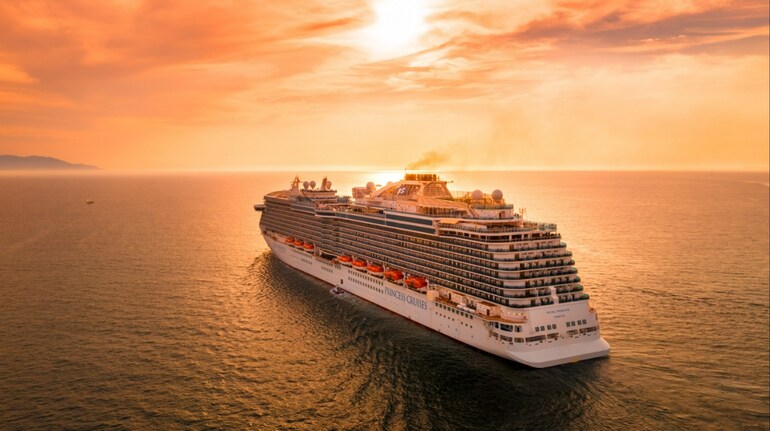
The escalating US–Israel–Iran conflict is not only grounding flights but also disrupting travel at sea, forcing cruise lines to cancel sailings and prompting Indian travellers to delay their summer cruise holidays.
As tensions spread across the Middle East and key maritime corridors, several cruise ships remain stranded in regional ports while travellers grow cautious about booking voyages that pass through sensitive routes, such as the Red Sea and the Strait of Hormuz.
“The ongoing Iran–Israel conflict has created uncertainty across parts of the Middle East, directly affecting sailings in the region and the Red Sea,” said Akansha Agarwal, co-founder and Chief Marketing Officer (CMO) of Int2cruises, Asia’s cruise-first online travel aggregator.
Cruise operators are prioritising passenger safety, she said, with some sailings cancelled and others delayed. For Indian travellers, the immediate impact has been a temporary pause in booking decisions, particularly for cruise routes connected to the Middle East.
“We are seeing caution around these routes,” Agarwal told Moneycontrol. “Some travellers who were planning Europe or Singapore cruises in the near term are postponing their decision by a couple of months.”
The conflict is affecting not just ships but also the air corridors that cruise passengers rely on, as many sailings begin in Gulf hubs such as Dubai or Doha. With airlines suspending services and airspace closures across parts of the region, connectivity for cruise travellers has become uncertain.
Indian travellers take a wait-and-watch approach
The timing of the crisis is particularly sensitive for Indian cruise travel.
March is typically a critical booking window for summer departures, when families plan vacations around school holidays. Travellers usually book cruises 60–90 days before departure, making March and April peak decision months.
“The current situation has made travellers more cautious,” Agarwal said. “Some are delaying bookings by a month or two to see how the situation develops.”
The slowdown appears to be driven more by sentiment than a collapse in demand.
“Many families are still planning their summer holidays,” she said. “But confirmations are happening at a slower pace because people want more clarity before committing.”
Summer remains the busiest cruise season globally, particularly for destinations such as Europe and Alaska, where sailings typically run from April to early October. For Indian travellers, May and June see the highest cruise demand as families travel during school breaks.
Cruise ships stranded, sailings cancelled
Globally, at least six cruise ships remain stuck in the Middle East, according to international reports, following the escalation of hostilities between Iran and Israel.
Ships operated by cruise lines, including TUI Cruises, MSC Cruises, Celestyal Cruises and Aroya Cruises, are currently docked in ports such as Dubai, Abu Dhabi and Doha.
These vessels are unable to move to safer waters without passing through the Strait of Hormuz, a strategic maritime chokepoint near Iran that has been effectively closed to shipping amid the conflict.
Some operators have already cancelled voyages. Celestyal Cruises, for instance, confirmed that its 1,260-passenger ship Celestyal Journey will remain in Doha, while two sailings scheduled from Dubai on March 2 were cancelled.
MSC Cruises has also cancelled its remaining three cruises for the winter season and is working with airline partners such as Emirates and Etihad Airways to secure return flights for stranded passengers.
However, limited flight availability has made evacuation difficult, adding to the disruption for travellers attempting to return home.
India’s cruise tourism ambitions
The disruption comes at a time when India has been actively trying to grow its cruise tourism sector.
According to the Ministry of Ports, Shipping and Waterways, the number of cruise passengers in India reached 4.71 lakh in FY24, reflecting steady growth in the segment.
The government’s Cruise Bharat Mission, launched in September 2024, aims to significantly expand cruise tourism by developing more than 5,000 km of operational waterways and attracting over 1.5 million river cruise passengers in the coming years.
Officials believe the Indian cruise market has the potential to grow eightfold over the next decade, supported by rising disposable incomes and increasing interest in experiential travel.
River cruise tourism is also emerging as a fast-growing segment. Government data shows inland cruise trips increasing from 96 in 2018–19 to 371 in 2023–24, while passenger numbers rose from 2,284 to over 11,400 during the same period.
For now, however, the escalating tensions in the Middle East are casting a shadow over cruise travel.
While demand remains intact, travellers are choosing caution over commitment, waiting for geopolitical waters to calm before setting sail.
Discover the latest Business News, Sensex, and Nifty updates. Obtain Personal Finance insights, tax queries, and expert opinions on Moneycontrol or download the Moneycontrol App to stay updated!
Find the best of Al News in one place, specially curated for you every weekend.
Stay on top of the latest tech trends and biggest startup news.