- My Alerts
- Go Ad-Free
-
My Account













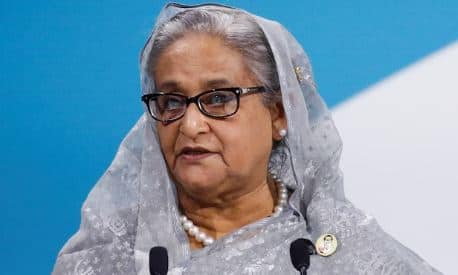
Sheikh Hasina
Sheikh Hasina (born September 28, 1947) is a seasoned Bangladeshi politician and the daughter of Bangladesh’s founding father, Sheikh Mujibur Rahman. She served as Prime Minister from 1996–2001 and
...Read more- Bangladesh’s dangerous turn: Why India cannot ignore a Pakistan-friendly BNP in Dhaka
The BNP’s growing influence has been cemented by Rahman’s dramatic return from 17 years in exile and the recent death of his mother Khaleda Zia, which removes the most visible restraint on the party’s hard-line factions.
- Bangladesh: Hindu candidate contests Sheikh Hasina’s seat amid rising attacks on minorities
Hindu leader Gobinda Chandra Pramanik will contest Sheikh Hasina’s former seat in Gopalganj amid rising minority violence in Bangladesh. Interim PM Muhammad Yunus’s government faces criticism for failing to protect minorities.
- Bangladesh: Sheikh Hasina alleges ‘unspeakable torture’ of minorities in Christmas address, hits out at Yunus regime
Ousted Prime Minister Sheikh Hasina accused Bangladesh’s current rulers of illegally seizing power and persecuting minorities, as fresh lynchings of Hindu men heightened tensions during the Christmas period.
- ‘Dark Prince’ back home: Tarique Rahman’s comeback piles pressure on Yunus. Why India is watching closely | Explained
Tarique's Dhaka rally was a direct challenge to the authority of the Yunus administration, which has increasingly appeared paralysed as unrest spreads across Dhaka and other cities.
- Yunus reassures US on timely, free and fair polls as Bangladesh reels from political killings
Bangladesh has seen a fresh spike in violence since Hadi was shot dead at close range on December 12. The unrest was compounded days later by the lynching of Dipu Chandra Das, a Hindu youth, over alleged blasphemy.
- Khaleda Zia’s son to return to Bangladesh after 17 years in exile: Why BNP sees Tarique Rahman’s comeback as a turning point
Tarique Rahman's presence on the ground is expected to energise the opposition’s campaign at a time when Bangladesh’s political environment remains tense, with recurring violence and growing space for radical groups.
- Another Bangladeshi leader shot dead: What we know about the ‘mystery woman’ angle in latest political shooting
The incident occurred in broad daylight near a medical college, underscoring how lawlessness has spread far beyond Dhaka into other urban centres.
- Was Sheikh Hasina a ‘villain’ or a ‘shock absorber’? How Bangladesh’s turmoil is changing the way her rule is judged
As Bangladesh inches toward elections, the question dominating public discourse is no longer how Sheikh Hasina fell, but whether her removal has accelerated the very forces she once kept contained.
- ‘Everyone will have axes in their hands’: Why India sees danger for its diplomats in Bangladesh
India had Wednesday summoned Bangladesh’s High Commissioner Riaz Hamidullah to lodge a strong protest over what it described as a rapidly deteriorating security environment in the neighbouring country.
- Hasina invokes 1971 as she questions Yunus’s Pakistan push: 'Disturbing echoes'
It comes as no surprise that Yunus is rushing to embrace Pakistan, a regional player he doesn’t understand, begging for any form of international validation, says Hasina.
- Bangladesh to vote on Feb 12: What India must prepare for after a year of strained ties under Yunus | Explained
Relations between India and Bangladesh have deteriorated sharply under Muhammad Yunus. His administration has leaned closer to China and Pakistan while distancing itself from New Delhi.
- Bangladesh to hold national elections on Feb 12 next year, first since Hasina’s exit and months of turmoil
This will be the country’s first national vote since last year’s student-led uprising that forced former Prime Minister Sheikh Hasina to flee to India.
- Bangladesh court convicts ex-PM Sheikh Hasina and UK lawmaker niece Tulip Siddiq in land scam case
A Dhaka court sentenced prime minister Sheikh Hasina to five years and her UK MP niece Tulip Siddiq to two for corruption linked to the Purbachal New Town land project.
- Bangladesh turmoil: Awami League announces resistance marches over Sheikh Hasina’s death sentence
The Awami League described the tribunal’s judgment as “farcical,” claiming it had been “rejected with contempt” by the people and denounced the proceedings as a “mockery of a trial.”
- 'Yunus cannot touch my mother': Sheikh Hasina's son Sajeeb on her death sentence
Wazed accused Yunus of damaging the country, alleging that he is turning Bangladesh into a failed state and an Islamist terrorist state.
- Flawed trial, political pressure, no defence: Why Sheikh Hasina’s death sentence stands on shaky legal ground
Legal experts now argue that the court had no authority to try Hasina for crimes allegedly committed in 2024. Its jurisdiction, they say, does not extend beyond the 1971 war.
- 'Never received threat but US attitude has changed': Ex-Bangladesh PM Sheikh Hasina's son on Western pressure
Speaking about the new US government under President Donald Trump, Sheikh Hasina's son said with this, the situation is completely different and that there is a distinct change in outlook of Washington towards Dhaka.
- Sheikh Hasina’s death sentence raises the big question: What’s ‘international’ about Bangladesh’s ICT?
Behind the facade of the word “international” lies a court that is deeply domestic, politically controlled, and structurally isolated from the global justice system it seeks to imitate.
- The conspiracy that claimed Sheikh Hasina’s family: Why her parents and siblings were killed on August 15, 1975?
The August 1975 coup plunged the young nation into years of political turmoil and set off a cycle of military interventions that lasted for decades.
- Why India may reject Sheikh Hasina’s extradition: Analyst points to political exemption clause in treaty
Bangladesh’s interim government, led by Chief Adviser Muhammad Yunus, has formally asked India to hand over Hasina, calling it a “legal obligation under the extradition treaty.”



