






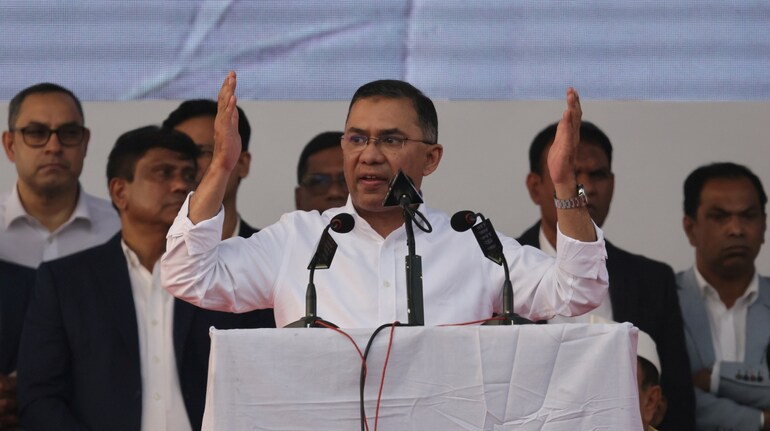

After nearly 17 years in exile, Bangladesh Nationalist Party acting chairman Tarique Rahman returned to Dhaka on Wednesday and addressed a massive rally, instantly altering the country’s political mood. His comeback comes at a time when Bangladesh is struggling with growing violence, minority attacks, and visible administrative drift under the interim government led by Muhammad Yunus.
Standing before a sea of supporters, Rahman invoked American civil rights leader Martin Luther King Jr and declared, “I have a plan,” projecting himself as a decisive alternative to an interim setup that has failed to control the streets. Opening his speech with “Beloved Bangladesh,” Rahman thanked party workers who stood by the BNP during his absence and claimed the country was once again at a historic turning point.
His rally was not just a homecoming event. It was a direct challenge to the authority of the Yunus administration, which has increasingly appeared paralysed as unrest spreads across Dhaka and other cities.
Yunus government under pressure as violence escalates
Rahman’s return has coincided with a sharp rise in street violence, arson, and protests, exposing the interim government’s inability to maintain law and order. In recent days, attacks on Hindu minorities, vandalism of homes and shops, and mob violence have intensified fears among vulnerable communities.
One of the most shocking incidents involved Dipu Chandra Das, a Hindu man who was lynched and set on fire while unconscious following allegations of blasphemy. Such incidents have drawn criticism from India and international observers, yet the Yunus-led administration has struggled to respond with firmness or clarity.
Against this backdrop, Rahman framed his return as a response to what he called a complete collapse of governance. “The people want to regain their democratic rights and their right to speak freely,” he said, appealing to citizens across social and religious lines.
A familiar figure with a controversial past
While Rahman now seeks to project himself as a unifying leader, his past continues to define public debate. During the BNP’s earlier rule, Rahman was widely known as the “dark prince,” accused by critics of running the government from Dhaka’s Hawa Bhaban, which was seen as an informal power centre.
He was later convicted in multiple cases, including corruption charges and involvement in the 2004 grenade attack on an Awami League rally. These cases were pursued during the tenure of former prime minister Sheikh Hasina, forcing Rahman to leave the country in 2008 as legal pressure mounted.
Despite these convictions, Rahman has retained firm control over the BNP from abroad and remains the party’s undisputed leader. His supporters portray him as a victim of political vendetta, while critics argue his return marks the revival of an era associated with instability and confrontational politics.
BNP’s anti-India line returns to centre stage
A central feature of Rahman’s political identity remains his party’s longstanding hostility toward India. Over the years, the BNP has accused New Delhi of interfering in Bangladesh’s domestic politics and backing rival governments.
That narrative resurfaced strongly after the killing of anti-India activist Osman Hadi. BNP supporters alleged Indian involvement in the killing, triggering violent protests across Dhaka. Rahman paid tribute to Hadi during his rally, saying he dreamed of a democratic Bangladesh and economic justice for the people.
This rhetoric has added strain to already tense India-Bangladesh relations, particularly as India has raised concerns over attacks on Hindu minorities. New Delhi has repeatedly urged Bangladeshi authorities to protect minorities and uphold the rule of law, concerns that have gone largely unanswered by the interim government.
Meeting Yunus but no sign of stability
After the rally, Rahman met Muhammad Yunus to discuss the political situation. However, the meeting failed to inspire confidence that the interim administration can manage the deepening crisis.
For many observers, Rahman’s ability to mobilise large crowds so quickly has exposed the weakness of the interim setup. The Yunus government, meant to act as a stabilising force ahead of elections, now appears increasingly sidelined by street politics and rival power centres.
Rahman used his speech to call for peace, discipline, and unity, but the violent behaviour of his supporters in recent days has raised doubts about whether his return will calm tensions or intensify them.
What a Rahman comeback could mean for India-Bangladesh ties
With elections scheduled for February 2026, Rahman is positioning himself as the man who can “turn the tables.” If he succeeds, India-Bangladesh relations could enter a more turbulent phase.
A Rahman-led government is likely to revive nationalist rhetoric, question existing cooperation with India, and harden Bangladesh’s stance on regional issues. Given the BNP’s past positions, New Delhi could face a leadership in Dhaka that is openly skeptical of India’s role in South Asia.
For India, Rahman’s rise presents a strategic challenge, particularly at a time when minority safety and regional stability are already under strain.
A country at a crossroads
Tarique Rahman’s return has redrawn Bangladesh’s political landscape. It has highlighted the interim government’s failures, reopened old wounds about governance and violence, and revived deep mistrust in India-Bangladesh relations.
Whether Rahman can convert crowd energy into electoral victory remains uncertain. What is clear is that Bangladesh is heading toward a volatile election season, with a leader returning from exile, an interim government losing control, and a country once again caught between competing visions of power.
Discover the latest Business News, Sensex, and Nifty updates. Obtain Personal Finance insights, tax queries, and expert opinions on Moneycontrol or download the Moneycontrol App to stay updated!
Find the best of Al News in one place, specially curated for you every weekend.
Stay on top of the latest tech trends and biggest startup news.





