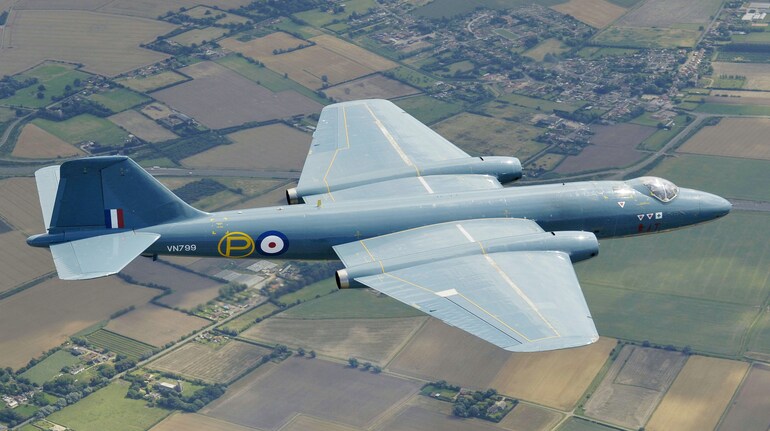

The English Electric Canberra became one of the Indian Air Force's most vital offensive weapons when the India-Pakistan war started in September 1965. The 1965 combat marked the first time Indian Canberras were utilised extensively against a capable foe with modern fighter aircraft and radar defences. The aircraft was designed as a high-altitude jet bomber and had already demonstrated its worth in previous operations. During those weeks, they conducted some of the IAF's most audacious and deepest strikes during the conflict.
A bomber suited for deep strikes
After joining Indian service in the late 1950s, the Canberra swiftly rose to prominence as the nation's main long-range bomber. It could travel great distances without refuelling, fly at high altitudes, and carry a big bomb load. These characteristics made it appropriate for deep penetration attacks on supply depots, radar stations, and airfields within Pakistan.
The Indian government approved the full use of the IAF after the conflict intensified with Pakistan's commencement of Operation Gibraltar and fighting moved to the western front. In order to undermine Pakistan's air strength and supplies, Canberra squadrons were assigned to strategic bombing and surveillance operations.
At the time, a number of Canberra units were in action, such as No. 5 Squadron and No. 35 Squadron. In order to evade Pakistani radar and fighter interception, their crews frequently flew at night or at high altitudes.
Early raids on Pakistani air bases
The disruption of Pakistan Air Force bases was one of the main goals of the Canberra campaign. Chaklala in Rawalpindi, Mauripur near Karachi, Multan, Peshawar, and the crucial fighter base at Sargodha were among the vital installations that Indian bombers targeted. For Pakistani air operations against Indian towns and ground forces, these bases were crucial.
The raids were frequently conducted at night. Crews from Canberra would fly over the border, descend into their objectives, drop bombs in a single pass, and then quickly rise away. The aircraft frequently had to travel hundreds of kilometres across hazardous country.
The burden on Indian ground forces fighting in Punjab and Kashmir was lessened as a result of Pakistan having to reroute fighters and anti-aircraft resources to defend its air facilities.
The Peshawar raid
The mid-September 1965 raid on the Peshawar air base is one of the most well-known Canberra operations. Squadron Leader Charanjit Singh and Flight Lieutenant Mangat Singh of No. 5 Squadron spearheaded a deep raid into northwest Pakistan on the evening of September 13-14.
The Canberras launched a highly accurate attack on the Peshawar airstrip and installations while flying over an extensive area of hostile territory. Because the aircraft had to pass near many Pakistani radar zones, the mission needed cautious navigation. The operation was considered one of the most audacious bomber flights of the war, according to the Indian Air Force's own historical accounts.
Several gallantry awards were given for the valour shown throughout these actions. Several Maha Vir Chakras, with the unique distinction of a Bar to the medal, were given to Canberra crews from the Central Air Command.
Canberra missions over the battlefield
Strategic bombing missions weren't the only actions in Canberra. Along the Punjab front, some aircraft were utilized to help ground combat. In the Khem Karan region, for example, Canberra bombers hit Pakistani troop concentrations and supplies sites while fighter aircraft supplied escort.
On September 14, Pakistani F-86 Sabre fighters made an effort to intercept the bombers during one such trip. They engaged in a duel with Indian fighter escorts, shielding the slower Canberra formation and enabling it to finish the bombing mission.
The coordinated deployment of bombers and fighters, which became a defining feature of air operations during the conflict, was proven by these flights.
Reconnaissance and intelligence gathering
Canberra aircraft performed reconnaissance flights in addition to bombing missions. These aircraft, which were outfitted with cameras rather than bombs, took pictures of Pakistani infrastructure, troop concentrations, and airfields.
Indian planners were able to watch Pakistani military movements and pinpoint targets thanks to the information obtained from these sorties. Because Pakistani interceptors regularly tried to shoot down the intruding aircraft, high-altitude reconnaissance flights were especially dangerous.
Nevertheless, the Canberras were able to operate above the reach of numerous interceptors thanks to their altitude performance, which frequently provided them with a margin of safety.
Losses and challenges
The Canberra missions were difficult despite their strengths. Threats from Pakistani radar networks and interceptor planes were ongoing. Both sides lost aircraft to anti-aircraft fire and fighter encounters during the air war.
Indian bombers returning from missions were occasionally intercepted by Pakistani fighters like the F-104 Starfighter, resulting in aerial battles and casualties. Indian air bases were also attacked (Wikipedia). The air battle was fought by both sides, as evidenced by a significant Pakistani strike on Pathankot airbase early in the war that damaged multiple aircraft on the ground.
Nevertheless, throughout the war, the Canberra squadrons kept up their flying duties.
Impact of the Canberra campaign
The Canberra had become one of India's most dependable aircraft by the time the ceasefire went into force on September 23, 1965. Throughout the conflict, the bombers carried out surveillance and tactical support flights in addition to striking numerous airfields and infrastructure targets within Pakistan.
The Canberra missions showed India's capacity to carry out deep bombing raids and maintain an air campaign in adverse environments, even though the overall air war concluded without a clear winner.
The aircraft served the Indian Air Force for decades afterward, taking part in surveillance missions during the Kargil conflict and the 1971 war before retiring in 2007 after about 50 years of service.
A bomber that defined an era
India used jet aircraft on a big scale for the first time in a modern war during the Canberra missions in 1965. Their crews hit targets deep within Pakistan while flying great distances at night, frequently without advanced navigational aids, and collected vital intelligence for the war effort.
These missions tested the Indian Air Force's ability to organize, navigate, and fly in combat. Because of its success during those weeks, the Canberra was guaranteed to be a key component of India's air power for many years to come.
Discover the latest Business News, Sensex, and Nifty updates. Obtain Personal Finance insights, tax queries, and expert opinions on Moneycontrol or download the Moneycontrol App to stay updated!





Find the best of Al News in one place, specially curated for you every weekend.
Stay on top of the latest tech trends and biggest startup news.