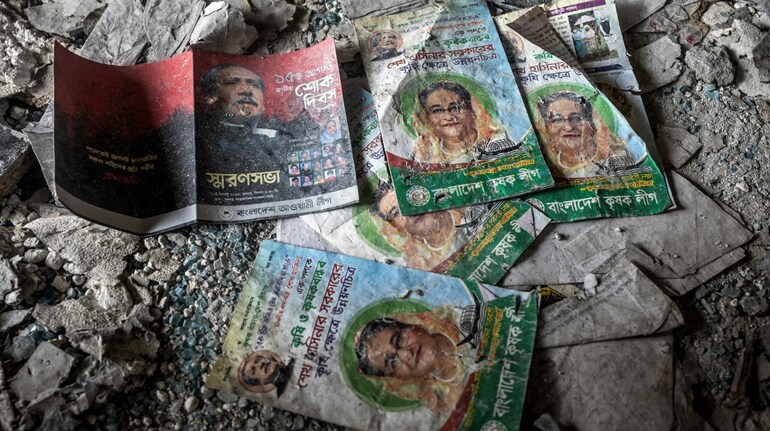
As Bangladesh slides deeper into political disorder, a quiet but significant reassessment is taking place about what the country has lost since Sheikh Hasina’s removal from power. What was once framed as a moral correction is now being questioned as a strategic miscalculation, with the interim government struggling to assert authority amid escalating street violence, arson, and institutional paralysis.
For years, Sheikh Hasina was criticised at home and abroad for concentrating power and narrowing democratic space. Those critiques dominated the global narrative until August 2024, when her ouster was welcomed by many as the opening of a new democratic chapter. Less than a year later, the optimism has evaporated. In its place is a vacuum that the Yunus-led interim administration appears unable or unwilling to fill.
A state without an anchor
The most striking feature of post-Hasina Bangladesh is not newfound freedom but the absence of control. Protest movements no longer resemble expressions of civic dissent. They look like tests of street supremacy. Mobs decide which buildings burn, which voices are silenced, and which communities are targeted. The interim government’s responses have been hesitant and inconsistent, reinforcing the perception that the state has lost its monopoly over order.
This erosion of authority has reignited a broader debate about whether Hasina’s rule, for all its flaws, functioned as a stabilising anchor in a deeply fragile society.
Context ignored, consequences amplified
A recurring theme in online discourse is the charge that Western observers misread Bangladesh entirely. Critics argue that the country was assessed as if it were a consolidated European democracy rather than a densely populated state with unresolved ideological fault lines and a long history of political violence.
Under Hasina, extremist outfits were contained, not eliminated but kept from dictating the political agenda. Civil-military relations were tightly managed. Institutional continuity, while imperfect, existed. Removing that framework without a credible replacement has exposed how shallow the opposition ecosystem actually was.
The interim government inherited none of Hasina’s control mechanisms, nor has it developed new ones. Instead, it has presided over a rapid loss of coherence, allowing radical groups to test boundaries that once held firm.
The myth of a ready democratic alternative
One of the most damaging assumptions behind the transition was the belief that liberal forces were waiting to step in once Hasina exited. That assumption now looks dangerously naive. The political vacuum has not been filled by reformists or technocrats but by the loudest and most organised actors on the street.
Social media debates increasingly describe the current arrangement as a hybrid regime in which unelected radicals exert disproportionate influence while formal authority remains weak and reactive. The Yunus administration’s reluctance to confront these groups has only deepened the impression that power lies elsewhere.
Stability reconsidered, not romanticised
The reassessment of Hasina’s legacy is not an exercise in nostalgia. Few argue that her rule was democratic in the textbook sense. What is being questioned is whether the pursuit of democratic optics without regard for ground realities has left Bangladesh worse off.
Minorities who once relied on state protection now face intimidation. Journalists operate under threat. Courts appear hesitant. Each incident chips away at the idea that the transition has strengthened democratic norms.
In this context, Hasina’s tenure is being reframed not as an ideal but as a lesser risk. Predictability, it turns out, had value.
An interim government running out of time
The Yunus-led administration was expected to guide Bangladesh through a delicate transition. Instead, it is being judged by its inability to prevent disorder or articulate a clear path forward. Its silence in the face of escalating radicalism has become as consequential as any policy decision.
As Bangladesh inches toward elections, the question dominating public discourse is no longer how Sheikh Hasina fell, but whether her removal has accelerated the very forces she once kept contained. The irony is stark. In trying to correct perceived authoritarianism, the interim government may have ushered in a far more dangerous phase of instability, one in which authority dissolves, institutions hollow out, and the promise of democracy recedes rather than advances.
Discover the latest Business News, Sensex, and Nifty updates. Obtain Personal Finance insights, tax queries, and expert opinions on Moneycontrol or download the Moneycontrol App to stay updated!
Find the best of Al News in one place, specially curated for you every weekend.
Stay on top of the latest tech trends and biggest startup news.