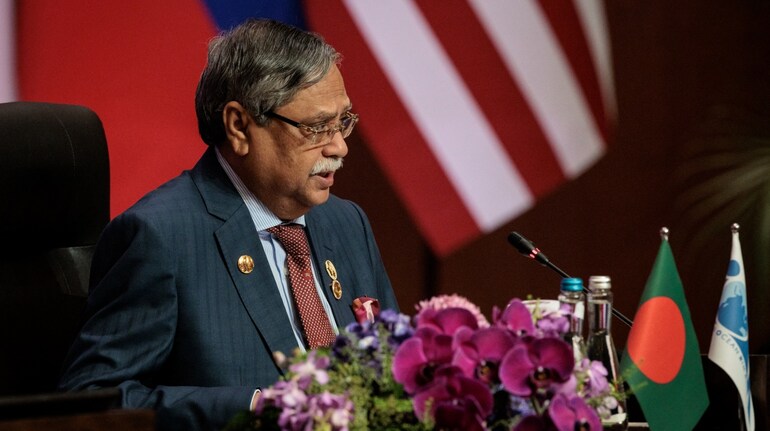

Bangladesh President Mohammed Shahabuddin has accused former chief adviser Muhammad Yunus of deliberately sidelining the presidency, violating constitutional norms and attempting to weaken the authority of the head of state during the tenure of the interim government.
In an interview with Bengali daily Kaler Kantho, Shahabuddin alleged that Yunus repeatedly ignored constitutional requirements, failed to maintain institutional coordination and kept the President completely uninformed about key state decisions.
‘No coordination, no information’
According to Shahabuddin, Yunus did not brief him on foreign visits, agreements or major policy actions, despite constitutional provisions mandating regular consultation with the President.
“The constitution says that whenever he goes on a foreign visit, he must meet the President after returning and inform me in writing about the discussions and outcomes. He travelled abroad 14 to 15 times but did not inform me even once," Shahabuddin said.
The President claimed that even significant international agreements were concluded without his knowledge.
“I knew nothing about it. Such a state agreement must be communicated to the President. That is a constitutional obligation. But he neither informed me verbally nor in writing," he told the newspaper.
Allegations of deliberate marginalisation
Shahabuddin accused Yunus of intentionally isolating him politically and administratively, despite the President playing a key role in the formation of the interim administration.
“I was the source of the process through which he became chief adviser, yet he never coordinated with me. He did not come to see me even once and tried to keep me completely in the dark," he said.
The President also alleged that Yunus blocked his foreign engagements without consultation. Referring to invitations from Kosovo and Qatar, Shahabuddin said officials drafted letters declining the visits in his name without seeking his consent.
“A letter was prepared saying I was extremely busy with state work and therefore could not attend. No discussion was held with me before preparing it," he said, adding sarcastically, “Does a President remain that busy under our constitution?"
Claims of erasing the presidency
Shahabuddin further alleged that the interim government actively sought to erase his public presence both domestically and internationally.
“They did not want my name to appear anywhere. They tried to keep me in darkness so that people would not know or recognise me," he said.
He claimed that he was prevented from attending university convocations and national events traditionally presided over by the President.
In one instance, Shahabuddin alleged that his official photographs were removed overnight from Bangladeshi diplomatic missions abroad after an adviser raised objections during a foreign visit.
“Across the world, embassies and high commissions display the President’s photograph because the President represents the state. That long-standing tradition was ended overnight," he said, adding that he saw it as “perhaps the first step toward removing me."
Press office dismantled, staff removed
The President also accused the interim government of dismantling Bangabhaban’s press operations after a routine courtesy meeting with newly elected members of the Dhaka Reporters Unity was reported in the media.
“They forcefully removed three officials, the press secretary, deputy press secretary and assistant press secretary. Even photographers who had worked here for 30 years were withdrawn," Shahabuddin said.
“We cannot even issue a press release now," he added.
Pressure to remove the President
Shahabuddin claimed that sustained political and institutional pressure was applied to remove him from office, including attempts to replace him through unconstitutional means.
“At one stage there was even a plan to replace me by installing a former chief justice. An adviser approached that judge, but he refused, saying constitutionally the president stands above and he could not take the position unlawfully," he said.
He also described a serious security situation during an October 22, 2024, siege of Bangabhaban, when mobs attempted to storm the premises.
“My blood may be shed at Bangabhaban, but I will preserve constitutional continuity," he said, adding that the army provided three layers of security and eventually brought the situation under control.
Army and opposition support
Shahabuddin credited leaders of the opposition BNP and the armed forces with standing by the presidency during what he described as a volatile political period.
“They assured me they were not in favour of removing the president through unconstitutional means," he said, adding that military leaders told him, “Your defeat would mean the defeat of the armed forces."
Despite the pressure, Shahabuddin said he chose to remain in office to uphold constitutional order.
“I endured everything with firmness only to maintain constitutional continuity," he told Kaler Kantho, alleging that repeated efforts were made to weaken the presidency under Yunus but ultimately failed.
Discover the latest Business News, Sensex, and Nifty updates. Obtain Personal Finance insights, tax queries, and expert opinions on Moneycontrol or download the Moneycontrol App to stay updated!
Find the best of Al News in one place, specially curated for you every weekend.
Stay on top of the latest tech trends and biggest startup news.