






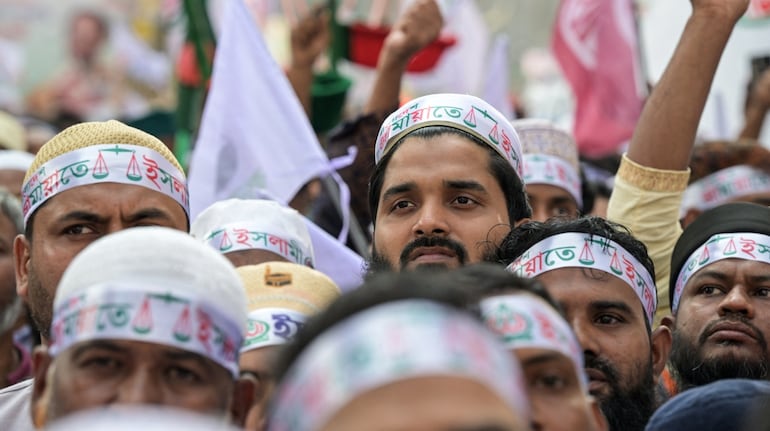
Bangladesh will vote on February 12, 2026, in its first national election since the 2024 uprising that forced Sheikh Hasina out of office and compelled her to flee to India. The announcement by the Election Commission marks a turning point for the country and sets the stage for a high stakes political contest. For India, the significance is far deeper. This election will determine the shape of its eastern strategic environment for years to come and will influence issues ranging from counterterrorism to regional power balance.
Relations between India and Bangladesh have deteriorated sharply under the interim government led by Nobel laureate Muhammad Yunus. His administration has leaned closer to China and Pakistan while distancing itself from New Delhi. At the same time, attacks on minority Hindus have increased, extremist networks appear to be reactivating, and foreign intelligence activity has grown. All of this places India in a precarious position ahead of the polls.
How relations between India and Bangladesh deteriorated under Yunus
Under Sheikh Hasina, India and Bangladesh developed one of the closest partnerships in the region. Dhaka cooperated with Indian security agencies, cracked down on insurgent groups, expanded transit links and offered reliable political alignment. This strategic comfort ended abruptly after the 2024 uprising. Since taking charge, Muhammad Yunus has pursued a foreign policy that keeps India at arm’s length. He has slowed progress on long standing connectivity projects, avoided substantive engagement with New Delhi and cultivated a narrative that Bangladesh must assert greater distance from India. This shift is not accidental but reflects a deliberate political recalibration that benefits countries like China and Pakistan.
Yunus has also strengthened diplomatic and commercial ties with Beijing. Chinese officials have increased their presence in Dhaka and have pushed for deeper involvement in infrastructure and energy sectors. At the same time, Yunus has adopted a softer posture toward Pakistan, something that was unthinkable during Hasina’s tenure. This has created space for Islamabad to reenter Bangladesh’s political and social networks. Indian analysts believe this marks a dangerous drift that erodes the gains of the past decade.
ISI’s growing footprint in Bangladesh and its implications for India
One of the most alarming developments under the interim administration is the resurgence of Pakistan’s Inter Services Intelligence inside Bangladesh. Moneycontrol earlier reported that ISI networks have expanded their operations in recent months, taking advantage of the political instability that followed Hasina’s fall. Covert operatives have reestablished contacts in Dhaka and Chattogram and have sought to activate dormant cells that once targeted India’s northeast.
These networks are attempting to rebuild the funding pipelines and logistical routes that were dismantled by Hasina’s government. Analysts quoted in Moneycontrol warn that Bangladesh is becoming a new base for the ISI and that India’s eastern flank is at greater risk today than at any point in the last fifteen years. The interim government has done little to counter this trend, and its permissive environment has emboldened actors that remain hostile to India.
Rising violence against minority Hindus under the interim government
Reports from local communities and Indian media highlight a rise in attacks on Hindu families, temples and businesses since the Yunus government took control. These incidents have occurred in both urban and rural regions and often involve targeted harassment by extremist groups. Many victims say local authorities are either indifferent or too weak to intervene. Analysts argue that the interim government has not shown the political will to contain radical organisations that were kept in check during the Hasina years.
This pattern has reinforced India’s concern that the domestic climate in Bangladesh is becoming more volatile and more hostile to minorities. The treatment of Hindus has always been an indicator of political stability in Bangladesh. The current increase in violence signals deeper social fractures that could spill across borders and create humanitarian pressures on India.
Why the 2026 Bangladesh election matters for India’s national security
The outcome of the election will determine whether India regains a cooperative partner in Dhaka or must manage a neighbour drifting toward China and Pakistan. India’s security agencies worry that a government hostile or indifferent to Indian interests could destabilise the northeast, hamper intelligence sharing and embolden extremist organisations. Bangladesh’s growing closeness to China could also reshape the balance of power in the Bay of Bengal, which is critical for India’s maritime security. A deeper Chinese presence in Bangladesh would complete a strategic arc around India, linking influence in Myanmar to military cooperation in Pakistan.
There is also the risk that political instability could trigger refugee inflows into Indian states bordering Bangladesh. Economic distress, minority persecution, and local unrest often lead to spikes in cross-border movement. India faces the added challenge of uncertainty surrounding bilateral trade, connectivity and energy projects, many of which slowed under the interim government. These disruptions threaten long-term regional integration plans that India has invested heavily in.
Can the election restore India-Bangladesh ties
Much depends on the shape of the next government. With the Awami League banned from participating unless the interim administration reverses its decision, the political contest is expected to involve the BNP, Jamaat-e-Islami, and the National Citizens Party. None of these political forces have a track record of stable engagement with India. Analysts fear that a government composed of these groups may not prioritise India’s interests or regional security.
For New Delhi, the Bangladesh election in February 2026 is not a routine political event. It is a decisive moment that will influence strategic stability, counterterror cooperation, and the safety of India’s eastern border for years to come. India hopes that the polls will mark the beginning of a more stable and cooperative chapter, but the signals from the interim government under Yunus suggest that serious challenges lie ahead.
Discover the latest Business News, Sensex, and Nifty updates. Obtain Personal Finance insights, tax queries, and expert opinions on Moneycontrol or download the Moneycontrol App to stay updated!
Find the best of Al News in one place, specially curated for you every weekend.
Stay on top of the latest tech trends and biggest startup news.




