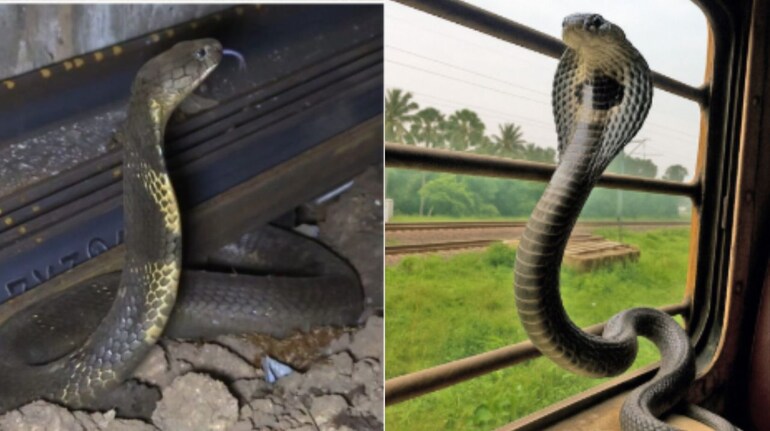

A new scientific study has highlighted an unusual wildlife concern in India, where king cobras are increasingly being found aboard trains, raising questions about animal movement, conservation risks, and public safety. The research, published in the journal Biotropica, examines how railway networks in Goa may be unintentionally transporting a vulnerable snake species into environments where survival becomes more difficult.
There’s a snake on the train
King cobras are the world’s longest venomous snakes, and the Western Ghats king cobra is a vulnerable species found in forested regions of India. To understand its distribution, researchers analysed 22 years of verified rescue records and local reports collected between 2002 and 2024. The study identified 47 confirmed locations across Goa, including 18 in North Goa and 29 in South Goa.
Five of these records were located close to busy railway corridors, suggesting trains may play a role in unexpected snake movement. Local residents frequently reported sightings in villages and forested zones, while no encounters were reported from agricultural fields or paddy areas. One notable case occurred in 2017 when a king cobra was found onboard a train during a rescue operation involving study author Dikansh Parmar. Similar incidents were recorded in 2019 and 2023, with images circulating widely online.
Getting off at the wrong stop
The study suggests that trains may be moving snakes into habitats unsuitable for their survival. Researchers used species distribution modelling that combined climate conditions, vegetation patterns, and human footprint data to predict suitable habitats within Goa. These predictions were then compared with actual rescue locations, particularly those near railway lines.
The analysis showed that the Western Ghats king cobra is most suited to interior forest regions near rivers and streams, away from coastal zones. However, railway sites where snakes were found were statistically less suitable, typically drier and offering limited prey and vegetation cover. The researchers believe snakes may enter goods trains seeking shelter or prey and later disembark far from their natural environments.
Threat reduction for both humans and snakes
The accidental relocation of king cobras poses risks for both the species and people. The Western Ghats king cobra already faces conservation pressure, and relocation to unsuitable habitats may reduce survival chances. At the same time, encounters onboard trains can be dangerous for passengers, as king cobra bites can cause fatalities within minutes.
The researchers note that fear often leads to snakes being killed unnecessarily. While the train transport theory is based on correlational evidence rather than direct observation, the study stresses the importance of rescue organisations, public education, and citizen science networks. The authors argue that better awareness and coordinated reporting can reduce conflict and help protect both humans and this iconic snake species as environmental pressures continue to grow.
Discover the latest Business News, Sensex, and Nifty updates. Obtain Personal Finance insights, tax queries, and expert opinions on Moneycontrol or download the Moneycontrol App to stay updated!
Find the best of Al News in one place, specially curated for you every weekend.
Stay on top of the latest tech trends and biggest startup news.