For over 25 years, scientists have aimed to explore Europa, Jupiter’s icy moon. Finally, their ambition is becoming reality. NASA's Europa Clipper mission is set to launch on 10 October, aboard a SpaceX rocket from Kennedy Space Center. This spacecraft will take a five-and-a-half-year journey to Europa, carrying hopes of unlocking its mysteries through nearly 50 flybys.
The primary goal is to understand if Europa could support life. Europa, about the size of our moon, has a vast hidden ocean beneath its icy crust. This ocean is thought to contain twice as much water as all Earth's oceans combined. For astrobiologists, Europa holds potential to reveal whether life could exist beyond Earth.
The Europa Clipper will spend three years orbiting Jupiter and conducting detailed investigations of the moon's surface and ice shell. It aims to uncover the dynamics of the ice and explore whether plumes of water erupt from the surface, as seen on Saturn’s moon, Enceladus. These observations will provide vital clues about the workings of icy ocean worlds, thought to be common across the universe.
Read Also: Mount Everest is still rising: The world's tallest mountain is growing faster; find out how“We’ve never sent a mission dedicated to studying such worlds,” said Curt Niebur, NASA’s program scientist. “There are many discoveries waiting to be made, and it's going to be thrilling.”
Italian astronomer Galileo Galilei discovered Europa in 1610. Our first close-up view came in 1979, thanks to NASA’s Voyager probes, which showed Europa’s surface had many cracks but few craters. This suggested Europa’s surface was young and possibly active.
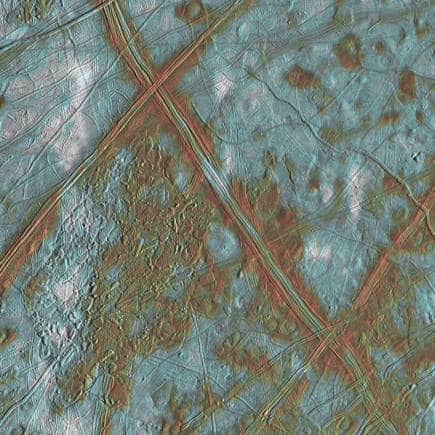 The Galileo probe revealed a captivating view of Europa’s surface, featuring domes, ridges, and red patches containing organic or carbon-based molecules. (Image: NASA)
In 1996, NASA’s Galileo mission detected Europa’s magnetic field, hinting at a subsurface ocean. Space physicist Margaret Kivelson led the team that first theorised Europa’s salty ocean beneath its icy shell, a discovery that changed how we view such moons. Since then, other bodies, like Saturn’s Enceladus and Neptune’s Triton, have joined the category of “icy ocean worlds.”
Read Also: Once thought to be extinct, this bald bird, makes a comeback in Europe after 300 yearsThe Europa Clipper spacecraft is the largest planetary explorer NASA has ever built. It carries nine cutting-edge instruments to study Europa during its flybys, getting as close as 25 kilometres from the surface. The mission will create a detailed map of Europa and determine whether there are passageways connecting the surface to its ocean.
Clipper’s instruments will probe the ice shell using radar to detect hidden pockets of water. These pockets could hold life-supporting conditions, similar to Lake Vostok beneath Antarctica. “Life thrives where materials can mix,” said astrobiologist Kate Craft. “If we find these spots in Europa’s ice, they would be prime locations for future missions.”
Europa’s surface contains reddish-orange organic material that Clipper will analyse using a spectrometer. The material may come from the ocean or be debris from nearby moons. The spacecraft will also search for geysers, which might offer a chance to sample material from beneath the ice.
NASA’s mission will work alongside the European Space Agency’s JUICE mission, set to explore Jupiter’s other moons, Ganymede and Callisto. Together, the two missions aim to unravel the mysteries of Jupiter’s icy moons.
Though Clipper won't drill into Europa’s surface, it will gather crucial data to inform future missions. While some researchers doubt the possibility of hydrothermal activity in Europa’s ocean, others believe that life could still exist in less active environments. Clipper will help settle these debates by measuring the moon’s magnetic and gravity fields, providing insight into its interior.
Though not a life-detection mission, Europa Clipper will be the first to assess whether icy ocean worlds like Europa can sustain life. “If Europa Clipper shows that icy ocean worlds are habitable,” said Niebur, “it could mean that life-sustaining environments are common in the universe.”
with exciting discoveries on the horizon.
Discover the latest Business News, Sensex, and Nifty updates. Obtain Personal Finance insights, tax queries, and expert opinions on Moneycontrol or download the Moneycontrol App to stay updated!
Find the best of Al News in one place, specially curated for you every weekend.
Stay on top of the latest tech trends and biggest startup news.