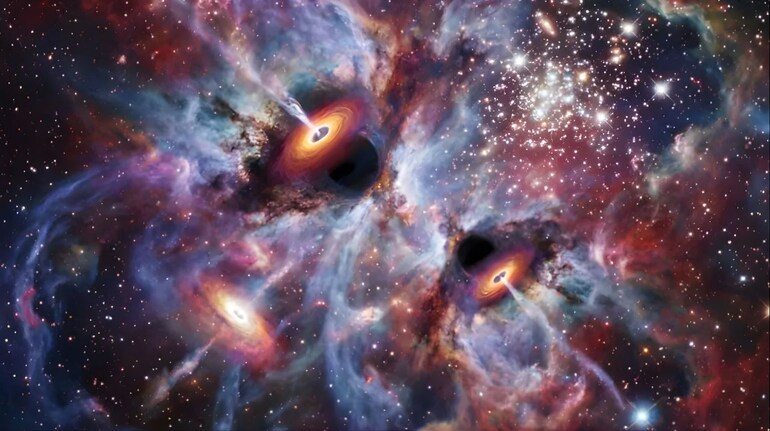

James Webb Space Telescope spotted something deeply puzzling. Giant black holes appeared surprisingly early in cosmic history. They existed when the universe was still very young. Much younger than scientists ever expected. Their massive size defied traditional growth theories. Astronomers were left searching for answers.
What Did Black Holes Help Scientists Understand?
James Webb detected massive black holes very early. They formed soon after the Big Bang. Much earlier than scientists predicted. Old theories could not explain their size. Slow growth should have kept them small. But they were already cosmic giants.
New research revealed the reason. Early black holes went on feeding frenzies. They consumed huge amounts of gas rapidly. They crossed normal growth limits. This process is called super-Eddington accretion. It enabled extremely fast expansion.
Who Found This Study?
The research team analysed James Webb data. The findings were published in a peer-reviewed journal. Experts reviewed and verified the results. The study gained global scientific attention. They compared it with theoretical models. Scientists tested different black hole growth scenarios. They observed which matched reality best. Rapid feeding matched Webb’s discoveries.
When Baby Black Holes Became Giants
Most black holes begin from dying massive stars. These “seed” black holes start relatively small. Slow growth was once considered the only path. Feeding on surrounding gas takes millions of years. But Webb’s discoveries challenged this slow process. Some black holes grew far too quickly.
The Black Hole Feeding Frenzy Explained
New computer simulations revealed a shocking possibility. Early black holes experienced violent growth periods. They swallowed huge amounts of gas rapidly. Scientists call this “super-Eddington accretion.” It means feeding beyond theoretical safety limits. Like cosmic monsters binge-eating in space.
What This Discovery Tells Us About Cosmos?
Supermassive black holes formed faster than believed. Early galaxies were more extreme than imagined. The universe evolved rapidly after birth. Structure appeared sooner than expected. Black holes shaped galaxy formation early. They influenced cosmic history from the beginning.
What Comes Next for Astronomers?
Future telescopes will test this idea further. Gravitational wave detectors may help. Merging black holes reveal growth histories. NASA and ESA missions will contribute. Scientists will keep watching cosmic monsters.
Discover the latest Business News, Sensex, and Nifty updates. Obtain Personal Finance insights, tax queries, and expert opinions on Moneycontrol or download the Moneycontrol App to stay updated!
Find the best of Al News in one place, specially curated for you every weekend.
Stay on top of the latest tech trends and biggest startup news.